Log in
Sign up for FREE
arrow_back
Library

Algebra Lesson 3-3 Quiz v7

star
star
star
star
star
Last updated about 2 years ago
7 questions
1
1.5
1
1
1
1
0
Question 1
1.

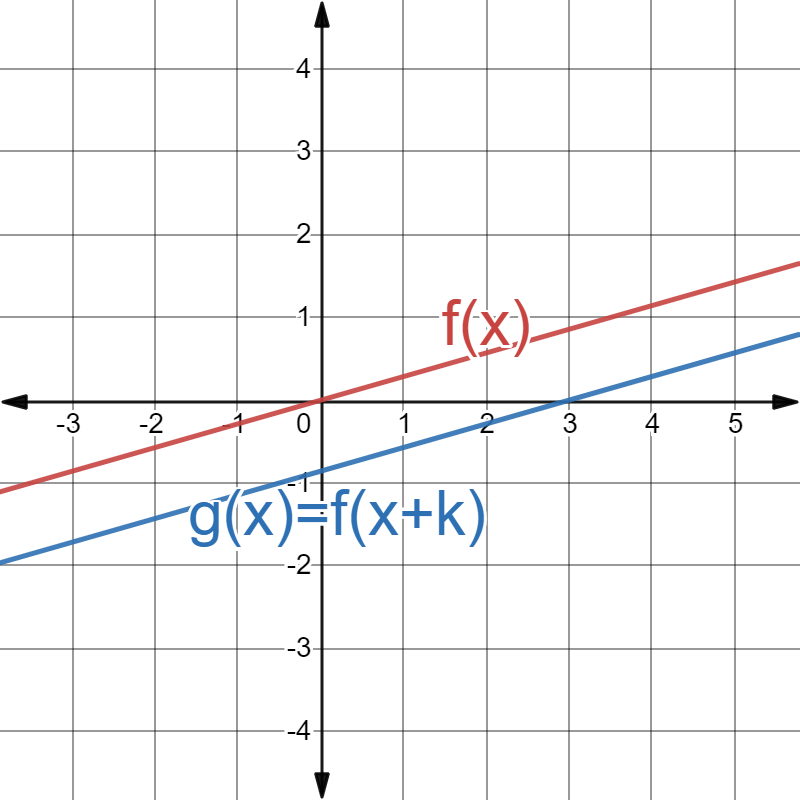
Inspect the graph below. What is the value of k?

Question 2
2.

Let f(x)=-6x+2 and h(x)=f(\frac{1}{3}x)+4.

A. What is the slope-intercept equation for h(x), (something like h(x)=mx+b)?
B. What is the slope of h(x)?
C. What is the y-intercept of h(x)?

Question 3
3.

Continuing with the transformation above, we have f(x)=-6x+2 and h(x)=f(\frac{1}{3}x)+4.

Changing the function f into the transformed function h requires both a horizontal stretch by a factor of 3 and vertical translation by 4 units.

Which of these two transformations affects the y-intercept, and how so? Explain your answer and add any equations or graphs necessary to make your explanation clear.

Question 4
4.

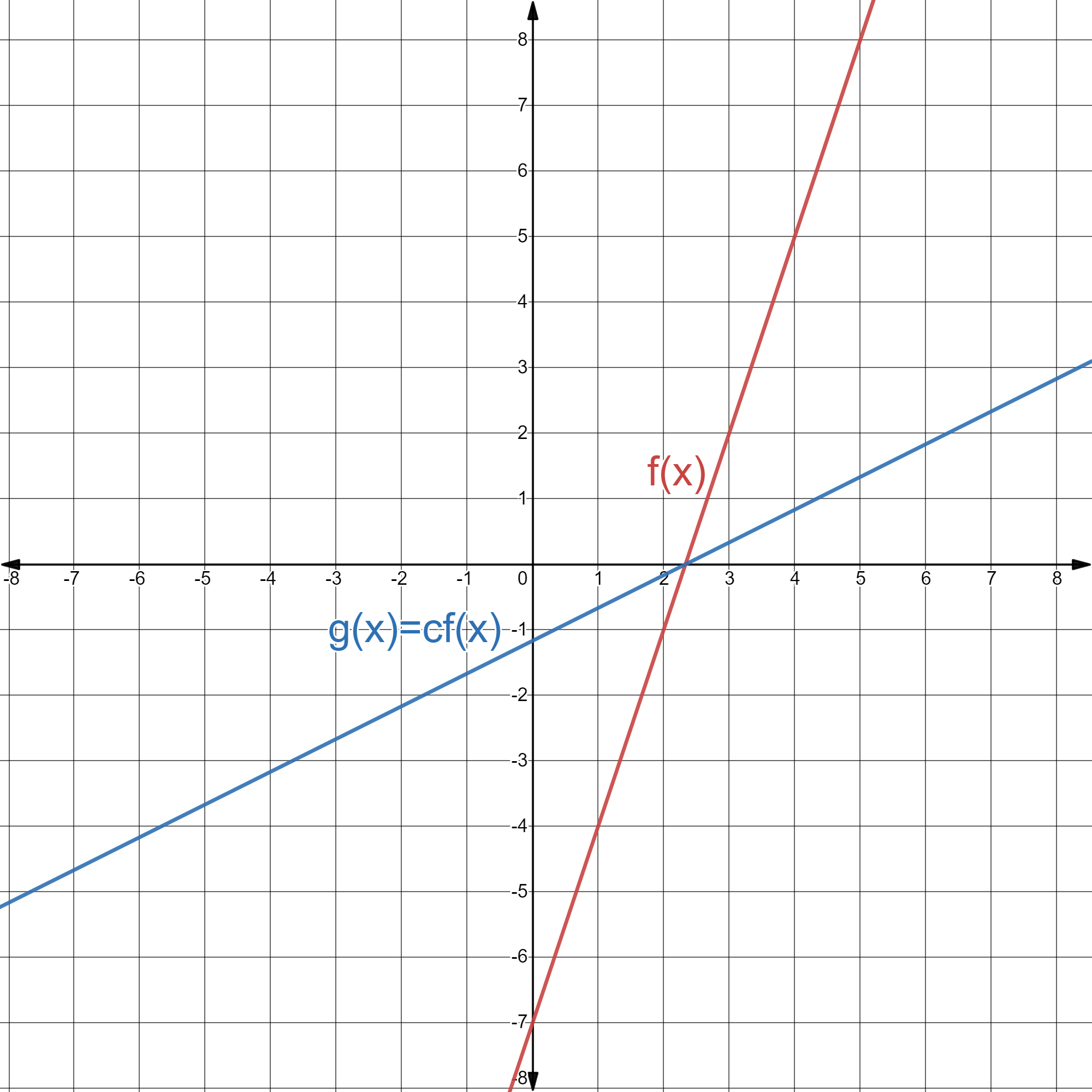
Select the equations that accurately match the graph.

Question 5
5.

If f(x)=34x+25 and g(x)=f(x-3)+15, which equation defines g(x)?

Question 6
6.

A spider produces silk for its web at a regular pace, so that the total linear length of silk in centimeters, f(x), is a function of how many hours the spider has been working, x.

When the spider is working normally, the function f is modeled by the equation f(x)= 75x.
When the spider is forced to consume caffine, the quality of the web it weaves deteriorates. But the rate of silk production does increase, from 75 \frac{\textrm{cm}}{\textrm{hr}} to 100 \frac{\textrm{cm}}{\textrm{hr}}.

What type of transformation describes the change from normal silk production to accelarated silk production?

Question 7
7.

BONUS: Maximum 2 percentage points

Describe the domain and range of the function f(x) from the scenario above.