The karyotype diagram shows a full set of human chromosomes.
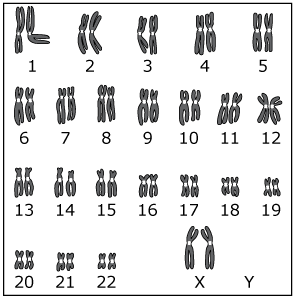
The karyotype diagram shows the number of chromosomes that would be found in of a human female.
Mmuae Afoforo a Wobɛpaw:
body cells
haploid
gametes
diploid
In North America, the populations of six species of bats have decreased by up to 99% since 2006. These decreases in population sizes are largely due to white-nose syndrome (WNS). WNS is caused by a fungus that infects the skin on bats’ wings, ears, and noses. The infected skin, which often appears white, loses more water than healthy, normal skin.
One species of bat affected by WNS is the little brown bat. This bat has a very small mass (about 14 g) and hunts for flying insects at night. Females typically give birth to one offspring per year.
In preparation for winter, little brown bats eat more insects to build up fat reserves in their bodies. In winter, they hibernate, which decreases body temperature, breathing rate, and metabolic rate. The bats do not eat while they are hibernating.
Little brown bats typically wake up only for brief periods of time during hibernation. When a bat does wake up, its body temperature increases as it flies around.
WNS affects the number of times that a bat wakes up during hibernation. Healthy bats wake up once every 20 days, and about 80% survive hibernation. Bats infected with WNS wake up once every 9 days, and only about 4% survive hibernation.
WNS causes damage to tissue on the wings, ears, and noses of bats. Which of the following processes most directly helps repair this damaged tissue?
The karyotype diagram shows a full set of human chromosomes.
The karyotype diagram shows the number of chromosomes that would be found in of a human female.
Corn is one of the most important crops grown in the United States. Corn, which is mostly starch, is used as a food source for humans and other animals.
Humans first developed corn as a food crop over 8000 years ago. These early farmers produced corn by selectively breeding a wild grass called teosinte. The kernels of teosinte have a hard coating that makes them difficult for humans to eat. A key step in developing corn as a food crop was selecting individual plants that produced kernels without this coating so that they could more easily be used as a food source. The illustrations show the kernels on an ear of corn and the kernels on an ear of teosinte.
Corn and teosinte share the scientific name Zea mays. A single gene with two alleles codes for kernel coating (H) or no kernel coating (h) in Zea mays. To determine the inheritance pattern of this gene, scientists crossed teosinte that is true-breeding (homozygous) for kernel coating and domestic corn that is true-breeding for no kernel coating to produce offspring with partially formed kernel coatings.
Select two types of cells that combine to produce offspring when a corn plant is crossed with a teosinte plant.
Referring to the same info found in question 3:
Corn kernels are fertilized seeds that develop into corn plants after they are planted. How does the number of chromosomes in a corn kernel cell compare to the number of chromosomes in the body cell of a corn plant?
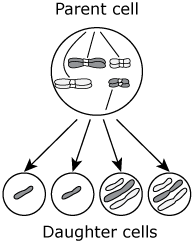
A scientist is studying the stages of meiosis in a cell that has two pairs of chromosomes. The diagram shows a parent cell and four daughter cells formed after meiosis.
Which of the following best explains what occurred in this parent cell?
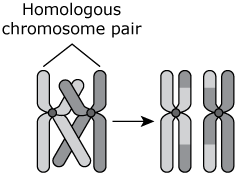
The diagram represents the process of crossing over.
The diagram supports the claim that crossing over genetic variability (differences in organisms) because the homologous chromosomes during crossing over.
A scientist is trying to develop a wheat plant that tolerates cold temperatures and is resistant to insect pests. The scientist has identified two types of wheat to cross-pollinate. One type has traits that make it tolerant of cold weather. The other type has traits that make it resistant to many insects.
Which of the following explains why the process of meiosis is important to the scientist’s work?
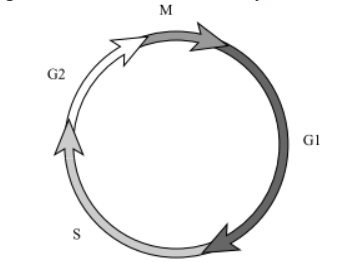
The diagram below shows the cell cycle.
Which of the following activities occurs in the G1 phase?
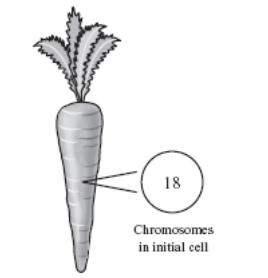
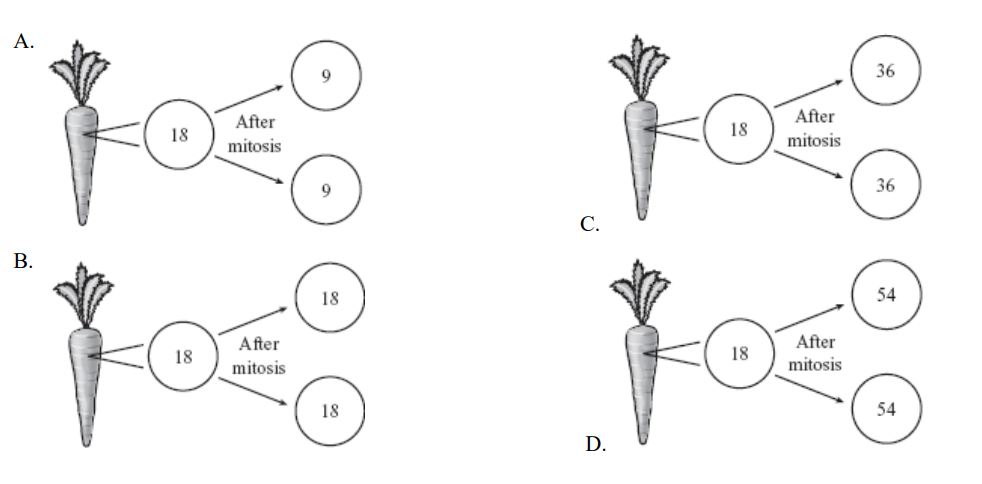
The diagram below provides information about a carrot cell.
A carrot cell contains 18 chromosomes. Which of the following diagrams illustrates the correct number of chromosomes in new cells produced by mitosis?
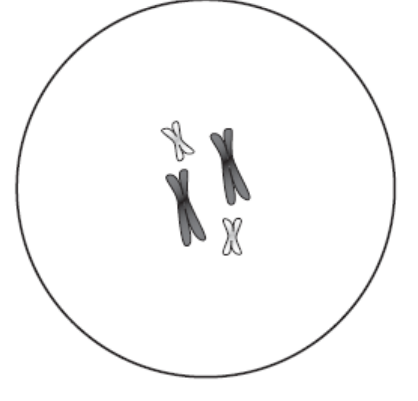
The illustration below represents a cell that is entering mitosis.
A. Identify one function of mitosis
The cell shown in the illustration in #10 has recently completed the synthesis phase (S phase) of the cell cycle and is in prophase of mitosis. What happened in this cell during the S phase in preparation for division? Describe the evidence that supports your answer.
Draw the end products that will be formed when the cell from #10 completes mitosis. (Use the circle tool to help!!)