Log in
Sign up for FREE
arrow_back
Library

Scientific Inquiry #05 (Rock Pocket Mice)

star
star
star
star
star
Last updated about 2 hours ago
7 questions
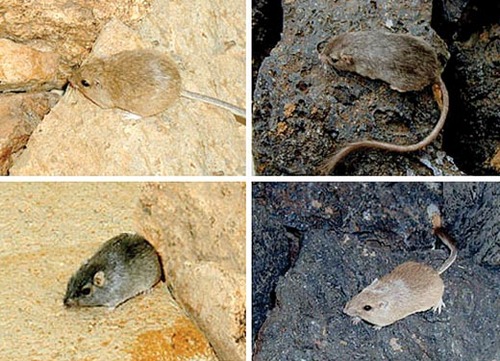
A typical rock pocket mouse is about 170 millimeters long from its nose to the end of its tail, shorter than an average pencil. And at just 15 grams, this tiny mouse weighs about as much as a handful of paper clips. You can find populations of rock pocket mice all over the Sonoran Desert in the southwestern United States.

There are two common varieties—a light-colored variety and a dark-colored variety. There are also two major colors of substrate, or surface materials that make up the desert floor. Most of the landscape consists of light-colored sand and rock, but patches of dark volcanic rocks that formed from cooling lava flows are found, separated by several kilometers of light-colored substrate.
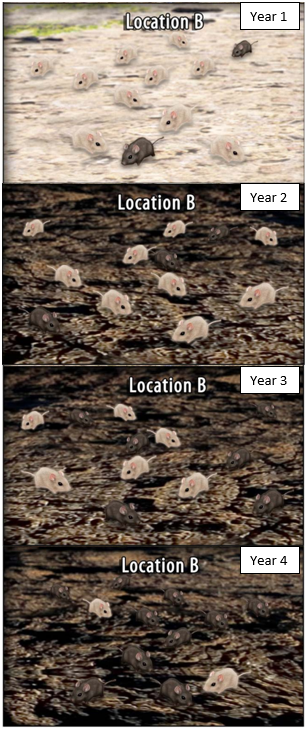
Consider a population of Rock Pocket mice at Location B over 4 years:


Required
1
Question 1
1.

What do the images above make you wonder? What questions do you have? What do you notice?

You may answer all or just 1 question.

Required
1
Question 2
2.

Look at the embeded simulation below or go to Rock Pocket Mouse Simulation.

How could you use this simulation to explore the phenomenon of rock pocket mice?

Required
1
Question 3
3.

What conclusions can you form from your investigation with the Rock Pocket Mouse simulations?

What explanations do you have for the change in the Rock Pocket Mouse population?

Required
0.5
HS-LS4-4
Required
0.5
HS-LS4-4
Required
0.5
HS-LS4-4
Required
0.5
HS-LS4-4
Scientists believe that change in a population (evolution) requires 4 parts:
  • Variation: Individuals in a population differ in some traits
  • Inheritance: Traits are passed from parents to offspring
  • Differential Survival & Reproduction: More offspring are born than can survive. Some individuals with a trait are more likely to survive and reproduce than those without the trait. However, traits that are beneficial in one environment may not be beneficial in another.
  • Adaptation: The frequency of the trait that helps individuals survive or leave more offspring will increase in the population over time. This process can take many generations and extend over long periods of time.
How does the Rock Pocket Mouse fulfill these 4 parts?
Question 4
4.
Variation: __________
Question 5
5.
Inheritance: __________
Question 6
6.
Differential survival & reproduction: __________
Question 7
7.
Adaptation: __________