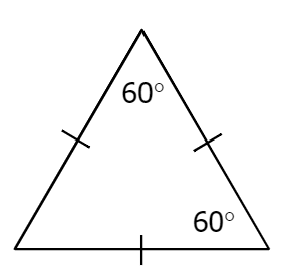
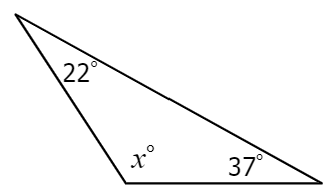
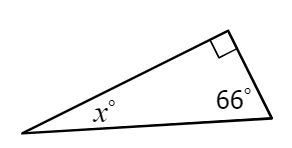
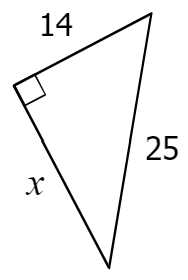
Classify the following triangle by angles and sides.
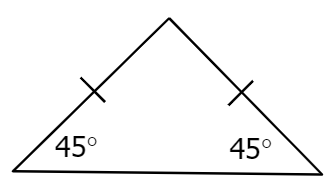
Classify the following triangle by angles and sides.
Match the term with the correct answer. (level 2)
| Draggable item | arrow_right_alt | Corresponding Item |
|---|---|---|
scalene triangle | arrow_right_alt | all three angles are less than 90 degrees |
acute triangle | arrow_right_alt | one angle is greater than 90 degrees |
isosceles triangle | arrow_right_alt | one angle is 90 degrees |
right triangle | arrow_right_alt | no sides are the same |
equilateral triangle | arrow_right_alt | two sides are congruent |
obtuse triangle | arrow_right_alt | all three sides are congruent |
Classify the following triangle by angles and sides.
Classify the following triangle by angles and sides.
The sides of the triangle are called
What is the pythagorean theorem? Give the formula.
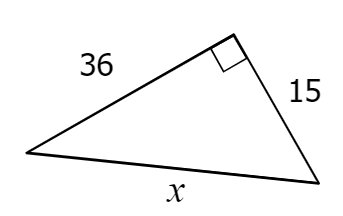
Find the missing side length (use the Pythagorean Theorem).
Round to the nearest tenth if needed.
Find the missing side length (use the Pythagorean Theorem).
Round to the nearest tenth if needed.
Is it possible for a triangle to have sides of length 5, 12, and 14? Why or why not?
*Hint* Draw the triangle, label the sides, and use the Pythagorean theorem.
(Level 4)