Log in
Sign up for FREE
arrow_back
Library
Week 10
By Anil Nayak
star
star
star
star
star
Share
share
Last updated 4 months ago
10 questions
Add this activity
Required
1
Required
1
Required
1
Required
1
Required
1
Required
1
Required
1
Required
1
Required
1
Required
1
Question 1
1.
Question 2
2.
Question 3
3.
Question 4
4.
Question 5
5.
Question 6
6.
The solution to the equation cot~x=2.4, \pi \leq x \leq 2\pi, correct to the nearest tenth, is ____
Question 7
7.
Question 8
8.
Question 9
9.
Question 10
10.
The nearest positive solution of 7sin~x+3=0, to the nearest degree, is
If csc(\frac{4\pi}{3})+k=cot(\frac{8\pi}{3}), then the
exact
value of
k
is
-\sqrt{3}
-\frac{1}{\sqrt{3}}
\frac{1}{\sqrt{3}}
\sqrt{3}
Use the following information to answer the question.
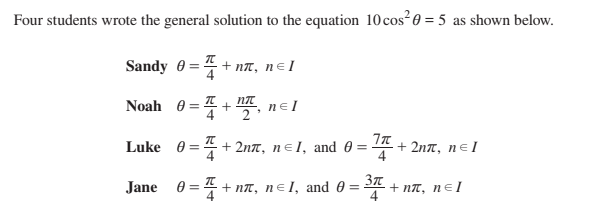
The two students who have stated a correct general solution are
Sandy and Luke
Sandy and Jane
Noah and Luke
Noah and Jane
Use the following information to answer the question.
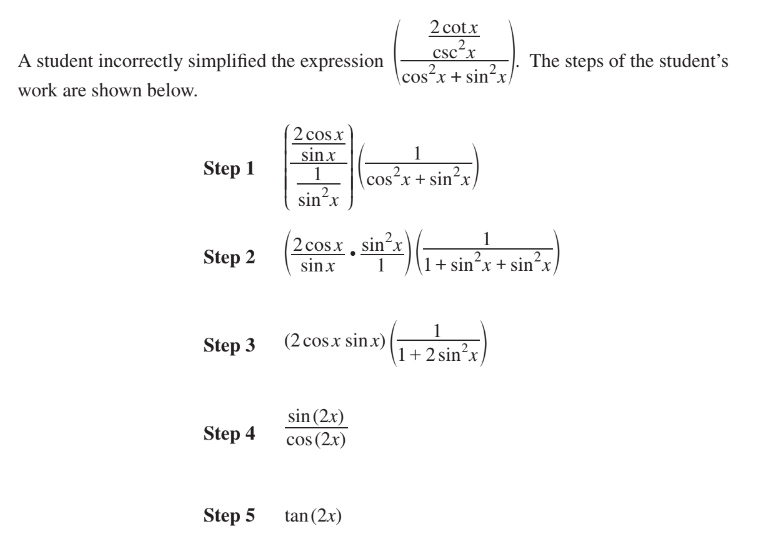
The student’s first error was recorded in Step
1
2
3
4
The graph of the function P(x)=a(x-r)(x-1)^{2}(x-4) passes through the point (0,6).
The value of
a
in terms of
r
is
a=\frac{3}{2r}
a=-\frac{3}{2r}
a=\frac{2}{3r}
a=-\frac{2}{3r}
The infinitely many angles coterminal with -\frac{5\pi}{4} are described by
\frac{3\pi}{4}+2\pi n, n\epsilon I
\frac{5\pi}{4}+2\pi n, n\epsilon I
\frac{3\pi}{4}+\pi n, n\epsilon I
\frac{5\pi}{4}+\pi n, n\epsilon I
Use the following to answer the next question.
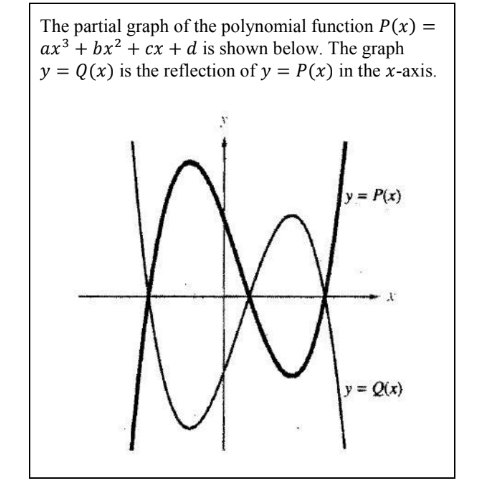
According to this information, the equation of the
polynomial function Q is
Q(x)=ax^{3}+bx^{2}+cx-d
Q(x)=-ax^{3}+bx^{2}+cx+d
Q(x)=-ax^{3}+bx^{2}+cx-d
Q(x)=-ax^{3}-bx^{2}-cx-d
The mapping (x,y) \rightarrow (x+6, \frac{1}{3}y+2) was applied to the function y=\frac{1}{x}. The equation of the resulting function is
y=\frac{3}{x+6}+2
y=\frac{3}{x-6}+2
y=\frac{1}{3(x+6)}+2
y=\frac{1}{3(x-6)}+2
The restriction for the expression \frac{sec\theta}{1-cot\theta} is
\theta \neq \frac{n\pi}{2}, n\in I
\theta \neq n\pi, n\in I
\theta \neq \frac{\pi}{4}+n\pi, \frac{n\pi}{2}, n\in I