Brings clouds close to the base of the ground (low ceilings)
Approach with very little warning
Poor visibility and rain
Changes the weather completely in a few hours
Occurs more slowly
Weather clears rapidly after the front passes
Provides a warning of the coming front
The weather that does occur is more intense
Are generally less intense
Warm front
Cold front
4 points
4
Question 2
2.
Cold fronts at the __________ force warmer air upward. Cold fronts are __________ and generally move at 20 to 30 miles per hour (but some cases report 60 miles per hour speeds). This quick movement of warmer air upwards is causing the creation of clouds. Depending on the stability of the warmer air mass, cloud types are going to change. Typically these clouds are going to be either towering, cumulous, or cirrus types clouds. However, we may see some cumulonimbus clouds as well. Depending on the intensity of the cold front, cumulonimbus clouds can result in __________.
After the frontal passage, towering cumulonimbus clouds will begin to dissipate and the precipitation will also decreases. In some cases, where a fast moving cold front is present, a squall lime will form. Squall lines are __________ that form ahead of the cold fronts. They are very intense and can move very quickly.
4 points
4
Question 3
3.
Warm front symbol
__________
Cold front symbol
__________
Stationary front
__________
Occluded front
__________
13 points
13
Question 4
4.
A large body of air that has relatively uniform temperature and humidity __________
What is an air mass?
__________
An air mass has similar __________
The boundary between cold and warm air masses is called a __________.
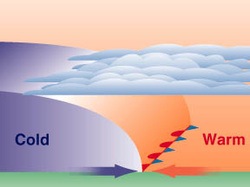
What type of front is represented in this picture below? __________
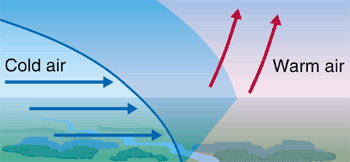
What type of front is represented in this image? __________
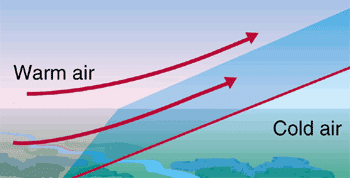
Which front is likely to produce thunderstorms? __________
Violent storms generally form along __________?
Light rain and humid temperatures?__________
Which front is there little movement? __________
Stationary fronts can bring a lot of precipitation because __________
The warm front is moving North in the image. I can tell because: __________
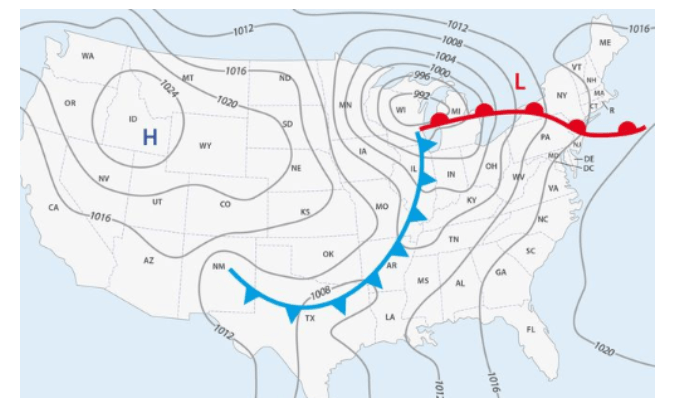
Which type of front is displayed? __________
3 points
3
Question 5
5.
Mrs. Misty went to bed last night and it was cold but not really cold. When she woke up this morning it is much colder and it had snowed over 5 inches over night. What kind of Front do you think caused the weather last night? __________
It has been raining on and off today, gently. The rain has finally stopped and Mr. Guesno takes his dog Indigo for a walk but it is very warm outside so they don't walk long. What kind of Front do you think caused today's weather? __________
It has been thundering and lightning today and Ms. Maddy's dog has been so scared. When it finally calms down she takes her dog Shiloh out to use the bathroom. Burr she should have put a jacket on it is very cool outside but at least it is not raining anymore. What kind of Front do you think caused the weather today? __________
PART 2: Types of Air Masses
4 points
4
Question 6
6.
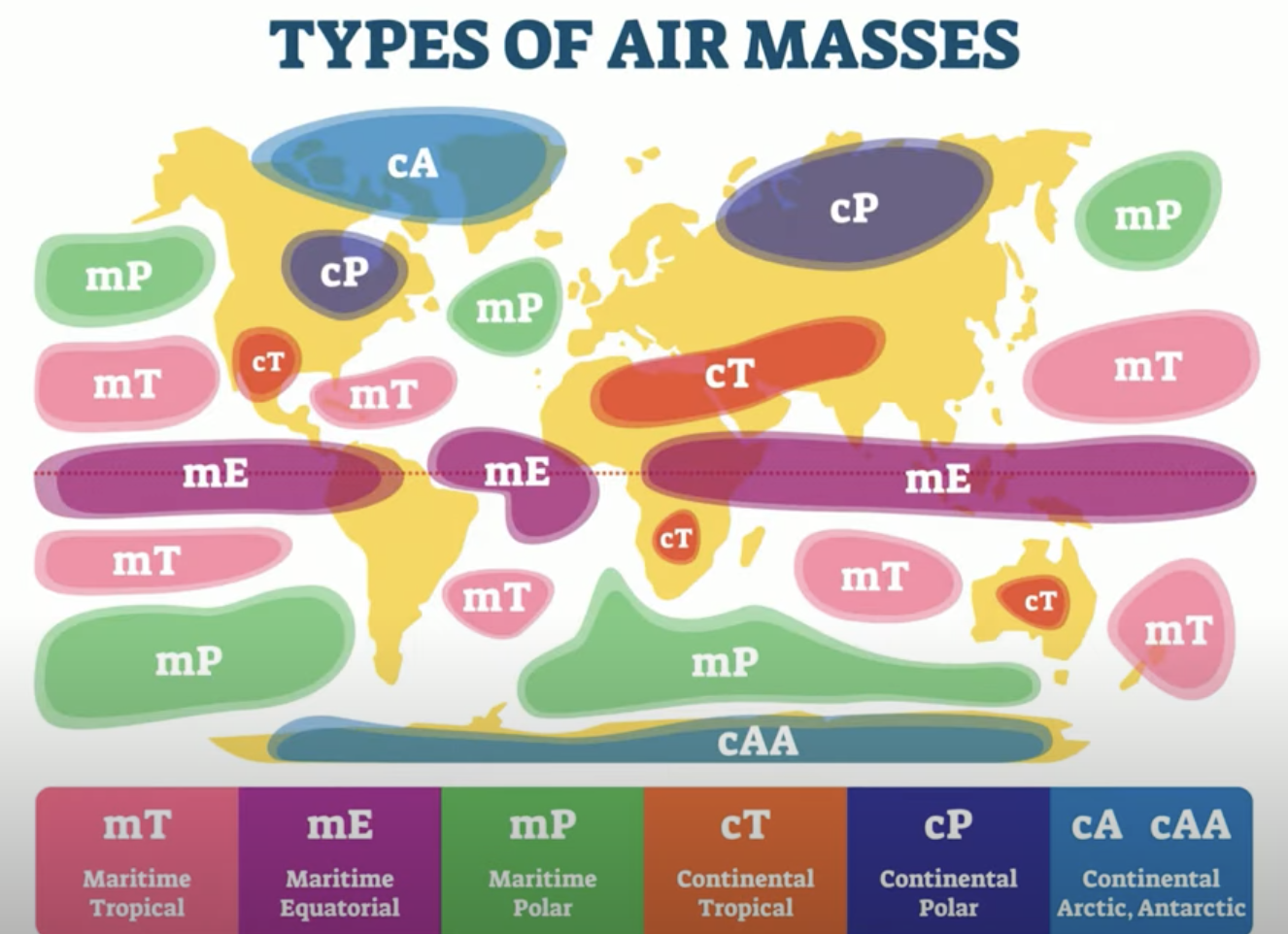
________________is when air mass forms over land.
_____________ is when air mass forms over the ocean.
_____________is when air mass forms near the equator.
__________is when air mass forms near the poles.
Other Answer Choices:
Continental
Tropical
Maritime
Polar
4 points
4
Question 7
7.
Warm and dry weather __________.
WARM and WET weather __________.
COLD and WET weather __________.
COLD and DRY weather __________.
4 points
4
Question 8
8.
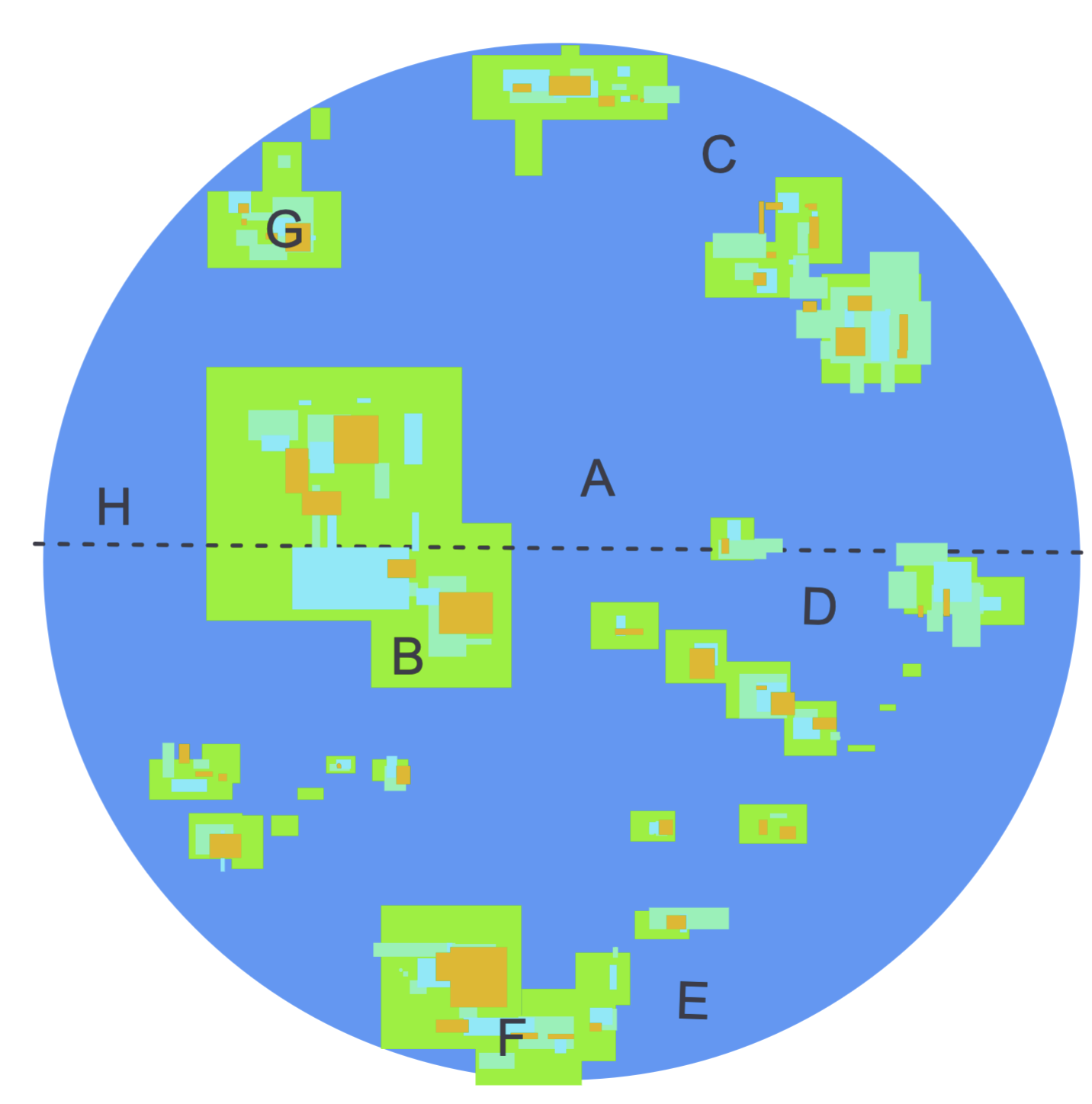
This is planet "Goosey". Each letter represents an air mass developing. Categorize the air masses into their respective categories.
G
B
H
E
D
A
C
F
mT (maritime Tropical)
mP (maritime Polar)
cT (continental Tropical)
cP (continental Polar)
5 points
5
Question 9
9.
A) Air masses most likely form in __________
B) An air mass is a portion of the atmosphere that has similar...__________
C) The temperature and humidity of a location depend partially on __________
D) __________ explains dry or moist (wet) conditions, while __________ describes how hot or cold something is.
E) How are air masses moved? __________
F) The INTERACTION between air masses can impact, __________
6 points
6
Question 10
10.
A) Which air mass would be classified as Maritime Polar (mP)?__________
B) Which air mass would be classified as Maritime Tropical (mT)? __________
C) Which air mass would be classified as Continental Tropical (cT)? __________
D) Which air mass would be classified as Continental polar (cP)? __________
Which air mass would bring warm and wet weather? __________
Which air mass is higher in humidity (amount of water vapor)? __________
2 points
2
Question 11
11.
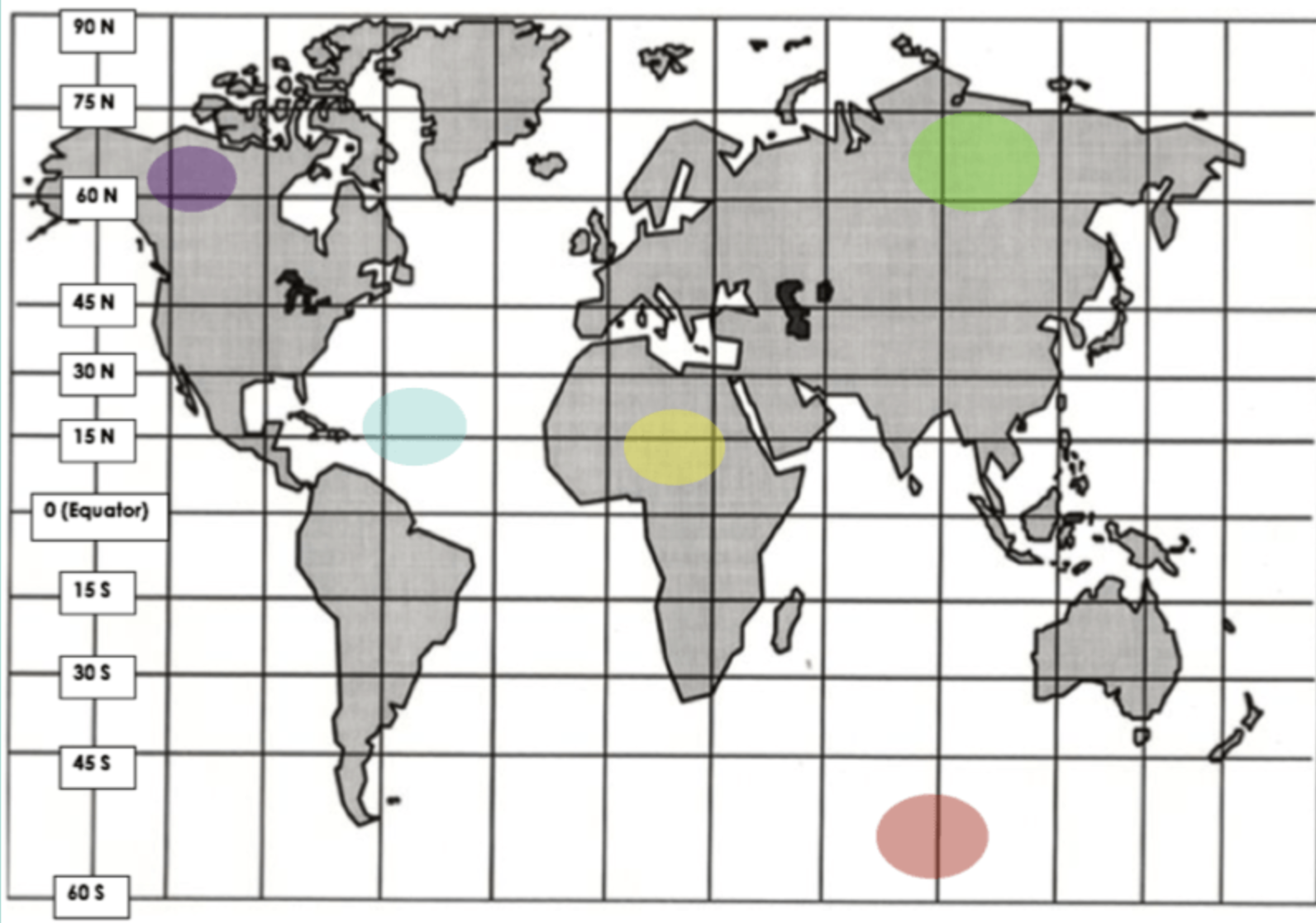
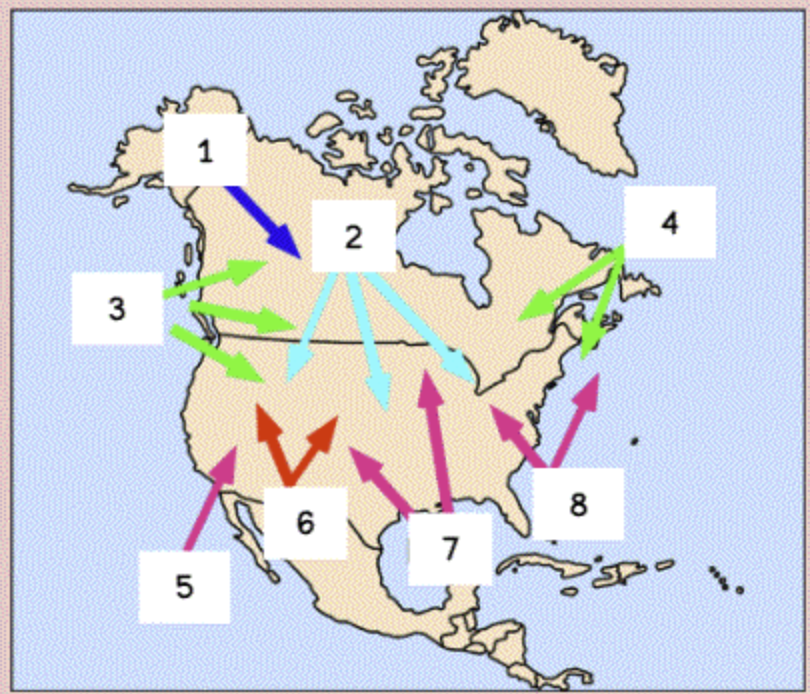
Which type of air mass would form at Point 8 on the MAP? __________
Which type of air mass would form at Point 2 on the MAP? __________
1 point
1
Question 12
12.
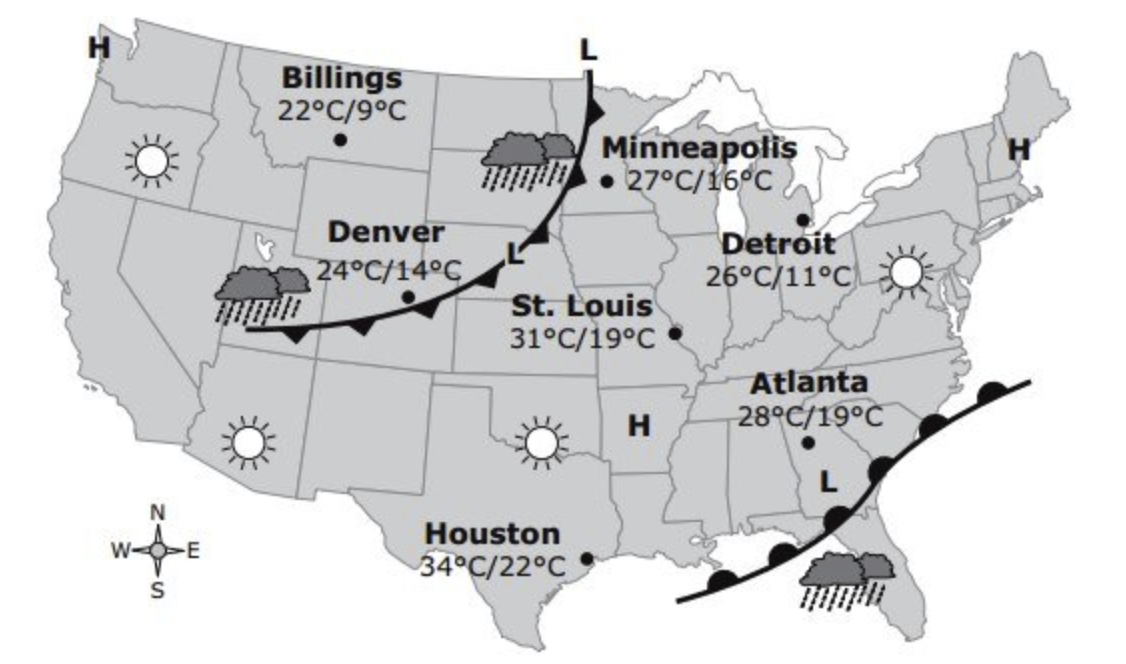
Based on the weather map, which city will most likely experience increasing temperatures during the next 24 hours?
4 points
4
Question 13
13.
Create your own planet!!! Give your planet a name. Draw the equator for your planet. Add ocean and land masses.
Label air mass parts of your planet:
A) maritime polar mP
B) maritime tropical mT
C) continental polar cP
D) continental tropical CT
PART 3: Weather Vs. Climate
1 point
1
Question 14
14.
Disperse the following into climate and weather categories
Amount of precipitation today
Can change in a few hours
Hurricane season
Air pressure
Wind speed
Analyzes years of patterns
Short-term
Long-term
Years worth of data
Cloud cover
Relative humidity for the next
two hours
Weather
Climate
2 points
2
Question 15
15.
What is the difference between weather and climate change?
Weather refers to short term atmospheric conditions while climate is the weather of a specific region averaged over a long period of time. Climate change refers to long-term changes.
Please match the description to either explaining Weather OR Climate
We quickly got out of the water because we heard thunder and lightning.
The Sahara desert is one of the dries and hottest regions on the planet with an average summer temperature of 104 degrees
Tomorrow, Florida is about to be hit by a huge hurricane
The average temperature in Aruba is 90 degrees almost all year long
There was a light snow fall over night that causes my flowers to die
Climate (long-term weather patterns)
Weather (short-term)
7 points
7
Question 16
16.
People like to talk about conditions that affect their lives. Climate and weather are two of those conditions. For the following items, say whether each is about weather or climate!
A) "What should I wear today Rosalie?" __________
B) " Hey Ezra, what equipment do I need for the camping trip next summer?"__________
C) "Deangelo did you know that it has rained on my birthday for the past three years." __________
D) "Hey Jasper, we just got three feet of snow in March! That means there's no global warming!" __________
E) "Mabel, I wonder when I should plant the tomato seeds in my garden?" __________
F) "It's me Aumarie! Our state has experienced the worst drought since records began more than 120 years ago."__________
G) "News flash Kaleah! The drought in California has ended with the first significant storm this year dumping more than 10 inches of rain in many locations and filling most of the reservoirs to pre-drought conditions. I am only telling you this since I am your friend Caius" __________