Elegy on the Death of Cesar Chavez

Last updated over 2 years ago
20 questions
In this poem, Rudolfo Anaya eulogizes Cesar Chavez, who fought for the rights of migrant farm workers in America. The poem celebrates Chavez’s life and mourns his death, even as his causes survive. As you read the poem, respond to the questions.
Required
1
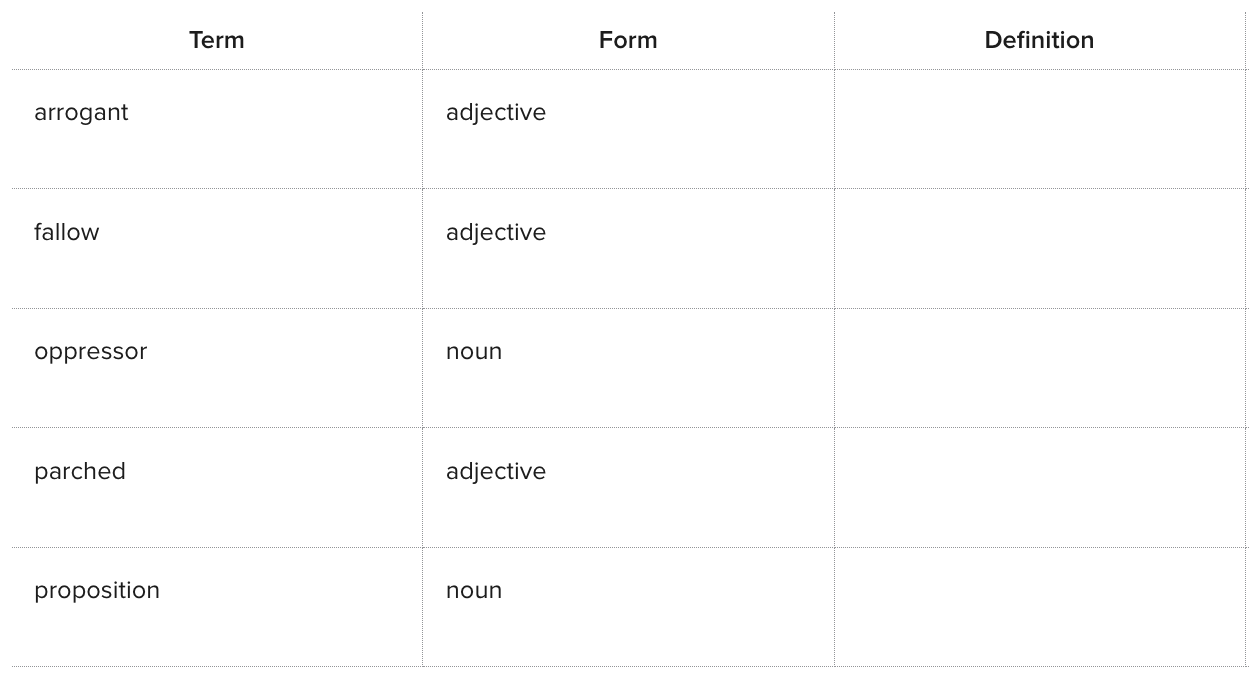
Match the definitions to the words.
Other Answer Choices:
plowed by left unplanted
very dry
having an exaggerated sense of one's own importance and a lack of respect for other people
potential laws submitted to voters for final approval
a person or group who uses cruel or unjust power or authority over others
Required
1

Finish this sentence: His arrogance was so off-putting that...

Required
1

Finish this sentence using the word FALLOW and some description: The fields were... and...

Required
1

Finish this sentence: Their oppressor...

Required
1

Write a sentence with the word PARCHED that is set in the summertime.

Required
1

Finish this sentence by incorporating the word PROPOSITION: The protesters marched against the...

Required
1

Let's summarize: How can you tell an elegy from other kinds of poems?

Required
1

Why do you think Cesar Chavez loved California?

Required
1

Select all the words that match the tone of this elegy.

César is dead,
And we have wept for him until our eyes are dry.
Dry as the fields of California that
He loved so well and now lie fallow.
Dry as the orchards of Yakima, where dark buds
Hang on trees and do not blossom.
Dry as el Valle de Tejas where people cross
Their Foreheads and pray for rain.

This earth he loved so well is dry and mourning
For César has fallen, our morning star has fallen.

The messenger came with the sad news of his death—
O, kill the messenger and steal back the life
Of this man who was a guide across fields of toil.
Kill the day and stop all time, stop la muerte
Who has robbed us of our morning star, that
Luminous light that greeted workers as they
Gathered around the dawn campfires
Let the morning light of Quetzacótal and Christian saint
Shine again. Let the wings of the Holy Ghost unfold
And give back the spirit it took from us in sleep.

Across the land we heard las campanas doblando:
Ha muerto César, Ha muerto César.

How can the morning star die? We ask. How can
This man who moved like the light of justice die?
Hijo de la Virgen de Guadalupe, hombre de la gente,
You starved your body so we might know your spirit.

The days do carry hope, and the days do carry treason.

O, fateful day, April 23, 1993, when our morning
Star did not rise and we knew that in his sleep
César had awakened to a greater dream.

And we, left lost on this dark, dry Earth,
Cursed the day la muerte came to claim
The light within his noble body.

He was a wind of change that swept over our land.
From the San Joaquin Valley north to Sacramento
From northwest Yakima to el Valle de Tejas
From el Valle de San Luis to Midwest fields of corn
He loved the land, he loved la gente.

His name was a soft breeze to cool the campesino’s sweat
A scourge on the oppressors of the poor.

Now he lies dead, and storms still rage around us.
The dispossessed walk hopeless streets,
Campesinos gather by roadside ditches to sleep,
Shrouded by pesticides, unsure of tomorrow,
Hounded by propositions that keep their children
Uneducated in a land grown fat with greed.

Yes, the arrogant hounds of hate
Are loose upon this land again, and César
Weeps in the embrace of La Virgen de Guadalupe,
Still praying for his people.

“Rise, mi gente, rise,” he prays.

His words echo across the land, like the righteous
Thunder of summer storms, like the call of a
Warrior preparing for the struggle. I hear his
Voice in the fields and orchards, in community halls,
In schools, churches, campesino homes and
Presidential palaces. “Rise, mi gente, rise.”
That was his common chant. Rise and organize,

Build the House of Workers.
Build the House of Justice now!

Do not despair in violence and abuse.
Rise together and build a new society.
Build a new democracy, build equality,
And build a dream for all to share.

His voice stirs me now, and I rise from my grief.
I hear the words of the poet cry:
“Peace, peace! He is not dead, he doth not sleep—
He hath awakened from the dream of life.”

I hear César calling for us to gather.

I hear the call to a new Huelga,
I hear the sound of marching feet
The guitarra strums of the New Movimiento
The old and young, rich and poor, all move
To build the House of Justice of César’s dream!

The trumpet of righteousness calls us to battle!
And the future opens itself like the blossom
That is his soul, the fruit of his labor.
He calls for us to share in the fruit.

“He lives, he wakes—‘tis Death is dead, not he;
Mourn not for Adonais.”

Do not weep for César, for he is not dead.
He lives in the hearts of those who loved him,
Worked and marched and ate with him, and those
Who believed in him.

His disciples know he is not dead.
For in the dawn we see the morning star!
El lucero de Dios!
Light comes to illuminate the struggle,
And bless the work yet to be done.

Throughout Aztlán we call the young to gather;
Rise and put aside violence and temptations.
Rise and be swept up by the truth of his deeds,
Rise not against each other, but for each other,
Rise against the oppressors who take your seat
And labor and sell it cheap.

“Rise, mi gente, rise!”

Our César has not died!
He is the light of the new day.
He is the rain that renews parched fields.
He is the hope that builds the House of Justice.
He is with us! Here! Today!
Listen to his voice in the wind.
He is the spirit of Hope,
A movement building to sweep away oppression!
His spirit guides us in the struggle.
Let us join his spirit to ours!
Sing with me. Sing all over this land!

“Rise, mi gente, rise!

Rise, mi gente, rise!”
Required
1

What is most likely the reason the author chose to commemorate Cesar Chavez?

Required
1
The poem is written from a __________ point of view and in the __________ tense.
Required
1

What can the reader infer from the bolded red passage?

Required
1

What is the central idea of the passage that is bold and purple?

Required
1

Which line from the poem best supports the correct answer to the last question?

Required
1

Which of these inferences is best supported by the passage that is bold and green?

Required
1

Which line from the poem best supports the correct answer to the last question?

Required
1

Match the Spanish Phrase with it's English meaning

Draggable itemCorresponding Item
El hijo de la Virgen de Guadalupe\
death
Ha muerto César
the ringing bells
hombre de la gente
Cesar is dead
las companas doblando
Son of the Virgin of Guadalupe
mi gente
man of the people
El lucero de Dios
strike
la muerte
my people
huelga
the light of God
Required
2

What is the effect of the author's use of Spanish words and phrases throughout the elegy?

César is dead,
And we have wept for him until our eyes are dry.
Dry as the fields of California that
He loved so well and now lie fallow.
Dry as the orchards of Yakima, where dark buds
Hang on trees and do not blossom.
Dry as el Valle de Tejas where people cross
Their Foreheads and pray for rain.

This earth he loved so well is dry and mourning
For César has fallen, our morning star has fallen.

The messenger came with the sad news of his death—
O, kill the messenger and steal back the life
Of this man who was a guide across fields of toil.
Kill the day and stop all time, stop la muerte
Who has robbed us of our morning star, that
Luminous light that greeted workers as they
Gathered around the dawn campfires
Let the morning light of Quetzacótal and Christian saint
Shine again. Let the wings of the Holy Ghost unfold
And give back the spirit it took from us in sleep.

Across the land we heard las campanas doblando:
Ha muerto César, Ha muerto César.

How can the morning star die? We ask. How can
This man who moved like the light of justice die?
Hijo de la Virgen de Guadalupe, hombre de la gente,
You starved your body so we might know your spirit.

The days do carry hope, and the days do carry treason.

O, fateful day, April 23, 1993, when our morning
Star did not rise and we knew that in his sleep
César had awakened to a greater dream.

And we, left lost on this dark, dry Earth,
Cursed the day la muerte came to claim
The light within his noble body.

He was a wind of change that swept over our land.
From the San Joaquin Valley north to Sacramento
From northwest Yakima to el Valle de Tejas
From el Valle de San Luis to Midwest fields of corn
He loved the land, he loved la gente.

His name was a soft breeze to cool the campesino’s sweat
A scourge on the oppressors of the poor.

Now he lies dead, and storms still rage around us.
The dispossessed walk hopeless streets,
Campesinos gather by roadside ditches to sleep,
Shrouded by pesticides, unsure of tomorrow,
Hounded by propositions that keep their children
Uneducated in a land grown fat with greed.

Yes, the arrogant hounds of hate
Are loose upon this land again, and César
Weeps in the embrace of La Virgen de Guadalupe,
Still praying for his people.

“Rise, mi gente, rise,” he prays.

His words echo across the land, like the righteous
Thunder of summer storms, like the call of a
Warrior preparing for the struggle. I hear his
Voice in the fields and orchards, in community halls,
In schools, churches, campesino homes and
Presidential palaces. “Rise, mi gente, rise.”
That was his common chant. Rise and organize,

Build the House of Workers.
Build the House of Justice now!

Do not despair in violence and abuse.
Rise together and build a new society.
Build a new democracy, build equality,
And build a dream for all to share.

His voice stirs me now, and I rise from my grief.
I hear the words of the poet cry:
“Peace, peace! He is not dead, he doth not sleep—
He hath awakened from the dream of life.”

I hear César calling for us to gather.

I hear the call to a new Huelga,
I hear the sound of marching feet
The guitarra strums of the New Movimiento
The old and young, rich and poor, all move
To build the House of Justice of César’s dream!

The trumpet of righteousness calls us to battle!
And the future opens itself like the blossom
That is his soul, the fruit of his labor.
He calls for us to share in the fruit.

“He lives, he wakes—‘tis Death is dead, not he;
Mourn not for Adonais.”

Do not weep for César, for he is not dead.
He lives in the hearts of those who loved him,
Worked and marched and ate with him, and those
Who believed in him.

His disciples know he is not dead.
For in the dawn we see the morning star!
El lucero de Dios!
Light comes to illuminate the struggle,
And bless the work yet to be done.

Throughout Aztlán we call the young to gather;
Rise and put aside violence and temptations.
Rise and be swept up by the truth of his deeds,
Rise not against each other, but for each other,
Rise against the oppressors who take your seat
And labor and sell it cheap.

“Rise, mi gente, rise!”

Our César has not died!
He is the light of the new day.
He is the rain that renews parched fields.
He is the hope that builds the House of Justice.
He is with us! Here! Today!
Listen to his voice in the wind.
He is the spirit of Hope,
A movement building to sweep away oppression!
His spirit guides us in the struggle.
Let us join his spirit to ours!
Sing with me. Sing all over this land!

“Rise, mi gente, rise!

Rise, mi gente, rise!”
Required
3
  • César had awakened to a greater dream.
  • in the fields and orchards, in community halls,
    In schools, churches, campesino homes and
    Presidential palaces
  • The idea of light and the morning star
  • Dry as the fields of California
  • The word "dry" in the first 2 stanzas
  • He is the light of the new day.
    He is the rain that renews parched fields.
    He is the hope that builds the House of Justice.
    He is with us!
  • From the San Joaquin Valley north to Sacramento
    From northwest Yakima to el Valle de Tejas
    From el Valle de San Luis to Midwest fields of corn
  • where dark buds
    Hang on trees and do not blossom
  • How can
    This man who moved like the light of justice die?
  • Build the House of Workers.
    Build the House of Justice now!
  • Dry as the orchards of Yakima
  • “Rise, mi gente, rise.” across several stanzas
  • our morning star, that
    Luminous light that greeted workers as they
    Gathered around the dawn campfires
  • The trumpet of righteousness calls us to battle!
    And the future opens itself like the blossom
  • He was a wind of change that swept over our land.
  • Rise and put aside violence and temptations.
    Rise and be swept up by the truth of his deeds,
    Rise not against each other, but for each other,
    Rise against the oppressors who take your seat
    And labor and sell it cheap.
  • storms still rage around us
  • Imagery
  • Repetition
  • Metaphor/simile
Required
5

Poetry is an emotional art. It is also very personal. Which metaphor, image, or piece of repetition stands out to as particularly moving (emotionally, intellectually, culturally). Make sure you include a quote with your choice and explain what it is about this figurative language that is poignant to you.