Which of the following will be reduced in this reaction?

Which of the following will be reduced in this reaction?
energy is often referred to as energy of motion. , or stored energy, is based on position. measures the kinetic energy of atoms and molecules in matter.energy is the used to bond ions and atoms together.
Which of the following are included in the laws of thermodynamics?
An reaction is a chemical reaction that is not spontaneous and requires the input of energy. An reaction is a chemical reaction that is spontaneous and releases energy.
Which of the following will be reduced in this reaction?
Requires carbon dioxide as a reactant
Requires oxygen as a reactant
Requires carbohydrates as a reactant
Produces carbohydrates as an end product
Produces carbon dioxide as an end product
Uses energy
Releases energy
Produces oxygen as an end product
Photosynthesis
Cellular Respiration
In the first stage of photosynthesis, _______________ molecules accumulate to form a gradient in the thylakoid.
Plants and other photosynthesizing organisms contain
Cellular respiration has three main stages: place the following into the correct order.
glycolysis
Krebs Cycle
electron transport chain
During the electron transport chain (cellular respiration), what form of energy is produced in the largest quantity?
2 molecules of pyruvate are produced in which stage of cellular respiration?
Which of the following processes does not contribute to carbon cycling?
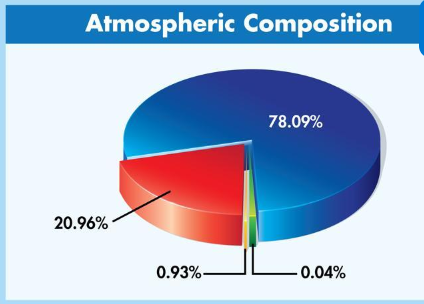
The pie chart shows the gases that make up Earth's atmosphere. Which gas is represented by the section labeled 78.09%?
Which of the following is true of the phosphorus cycle but NOT the water cycle?
The water cycle includes three major processes. is the process of water falling from the atmosphere toward Earth's surface i.e. rain. is the process of water transforming from a liquid to a gas called water vapor. is the process of water cooling and changing into a liquid.
Phosphorous is an important component in which of the following?
Nitrogen is a primary elemental component of which of the following?
Which is an example of chemical weathering?
Mechanical weathering is
What is weathering?
What is deposition?
What is erosion?
Which answer choice correctly lists sediment by increasing grain size?