Homework - Rain Shadow

Last updated 9 months ago
10 questions
Note from the author:
  • Landforms - Landforms studied in topography can include anything that physically impacts the area. Examples include mountains, hills, valleys, lakes, oceans, rivers, cities, dams, and roads.
  • Elevation - The elevation, or height, of mountains and other objects is recorded as part of topography. It is usually recorded in reference to sea level (the surface of the ocean).
  • Latitude - Latitude gives the north/south position of a location in reference from the equator. The equator is a horizontal line drawn around the middle of the Earth that is the same distance from the North Pole and the South Pole. The equator has a latitude of 0 degrees.
  • Longitude - Longitude gives the east/west position of a location. Longitude is generally measured in degrees from the Prime Meridian.
  • Landforms - Landforms studied in topography can include anything that physically impacts the area. Examples include mountains, hills, valleys, lakes, oceans, rivers, cities, dams, and roads.
  • Elevation - The elevation, or height, of mountains and other objects is recorded as part of topography. It is usually recorded in reference to sea level (the surface of the ocean).
  • Latitude - Latitude gives the north/south position of a location in reference from the equator. The equator is a horizontal line drawn around the middle of the Earth that is the same distance from the North Pole and the South Pole. The equator has a latitude of 0 degrees.
  • Longitude - Longitude gives the east/west position of a location. Longitude is generally measured in degrees from the Prime Meridian.

Air Pressure

We experience pressure from the air all around us. Air is made up of many molecules, mainly nitrogen and oxygen. These molecules are constantly bumping into us from all different directions. The force from these molecules bumping against us is what creates air pressure.

We don’t tend to notice air pressure because it remains relatively constant when we stay at the same elevation. However, air pressure decreases as we move from sea level to the top of a mountain. There are fewer air molecules bumping against you the higher up you go, so the air pressure is lower. You may have felt the effects of this pressure change when flying in an airplane or driving to the top of a mountain. The pressure change causes your ears to “pop.”

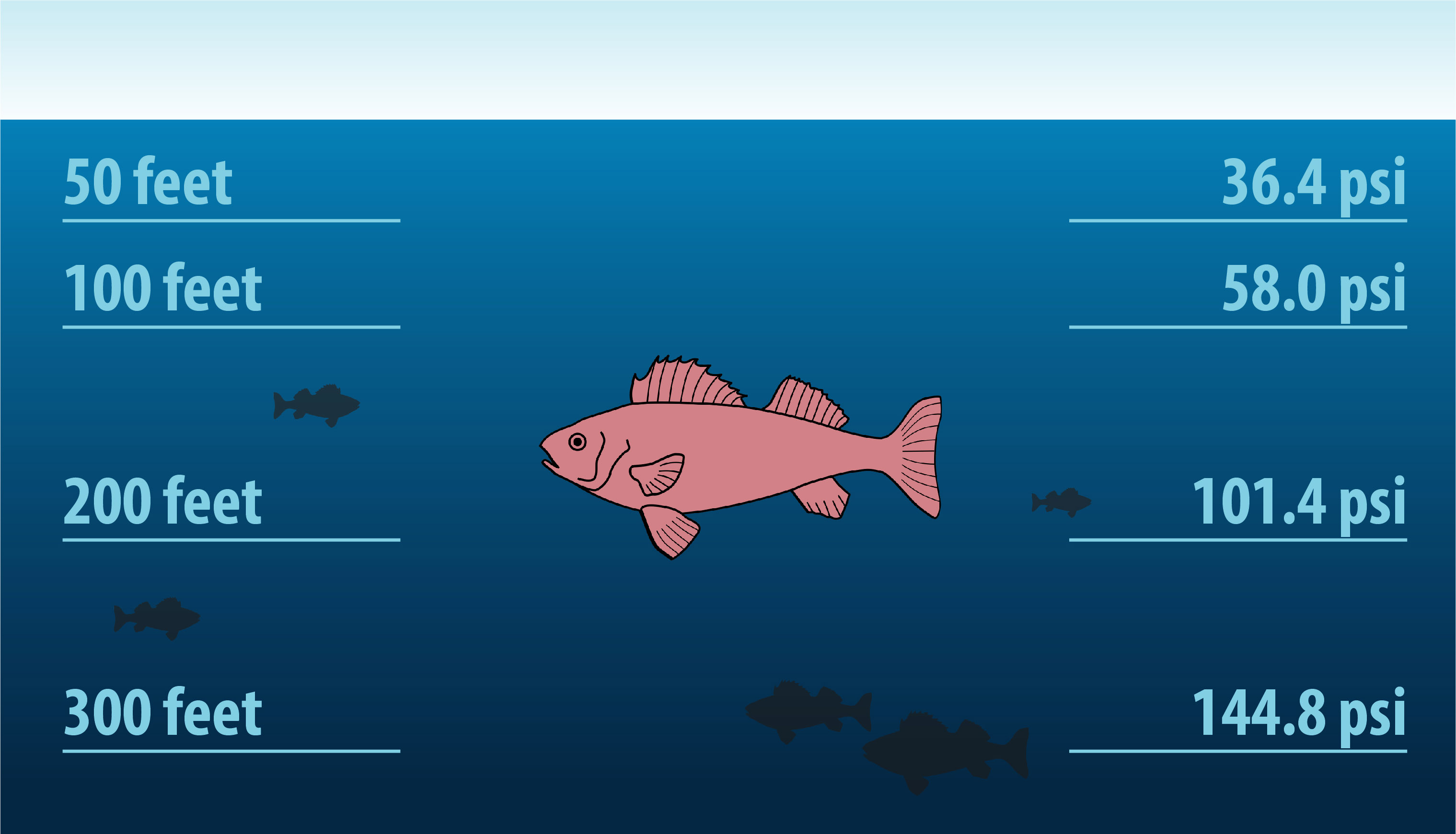
When you’re submerged in the ocean, you experience pressure from the force of the water molecules that surround you. At the surface, the pressure from the water is the same as the pressure from the air.  Pressure increases the deeper you go in the ocean because there is more water above you. This water has weight, and weight is force. This force pushes against you, so you experience greater pressure all around.

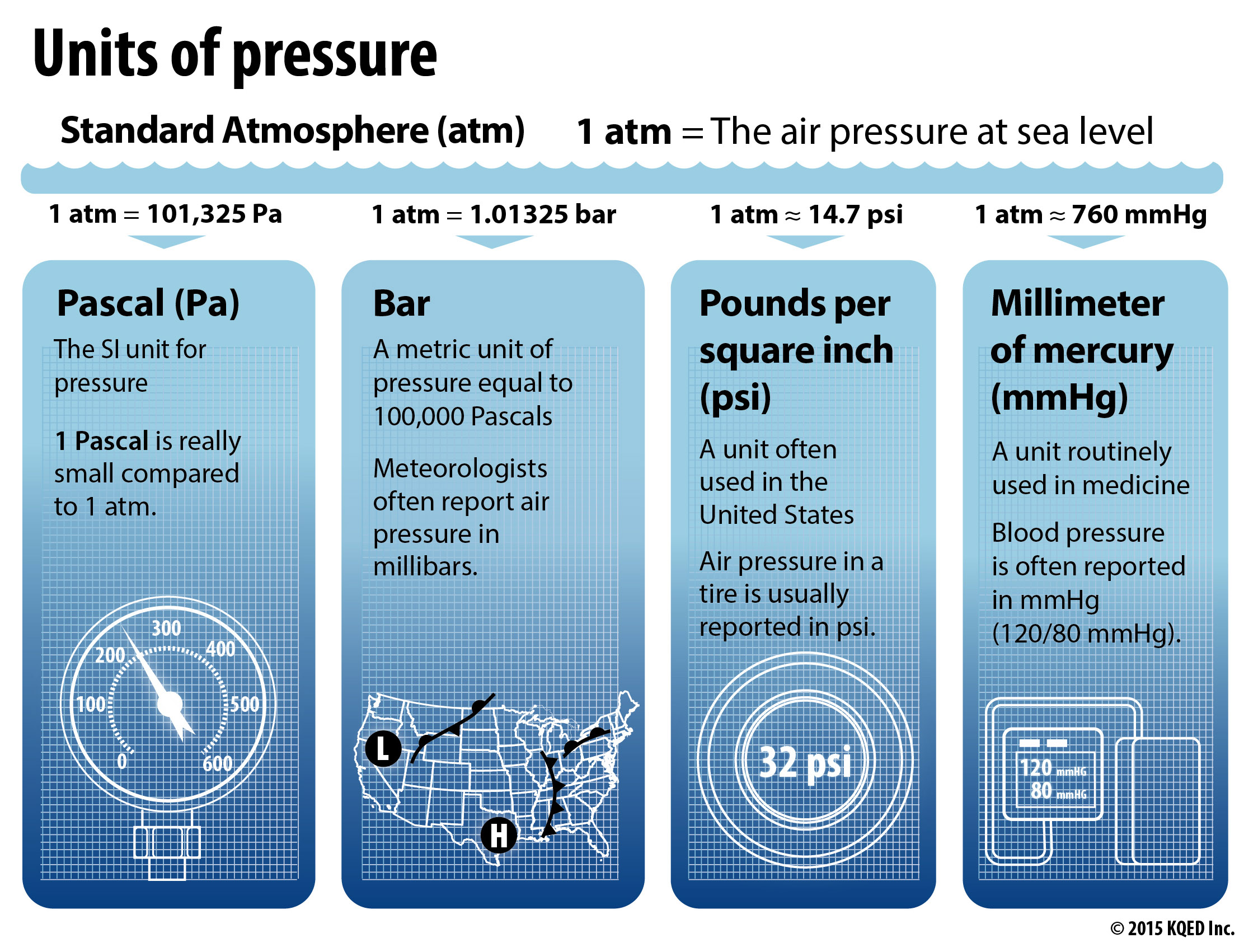
Pressure is measured in many different units. Air pressure at Earth’s surface is equal to one atmosphere (atm).
1


Why does this pressure matter for fish?

Many, but not all, fish have a gas-filled organ called a swim bladder. The swim bladder helps fish stay buoyant in the water. Without the swim bladder the density of their bodies would cause the fish to sink. The fish would have to keep swimming just to stay afloat. In fact, sharks don’t have swim bladders to keep them buoyant, so if they don’t swim continually they sink to the bottom.

When a fish is quickly brought to the surface, the lower pressures allow the gas molecules inside the swim bladder to have more space to move. This causes the swim bladder to expand like a balloon. When the swim bladder expands, it presses on other organs. It can even force some organs out of the fish’s body. This often results in the death of the fish.

The relationship between volume and pressure is explained by Boyle’s law: As pressure increases, the volume of a gas decreases. As pressure decreases, the volume of a gas increases.

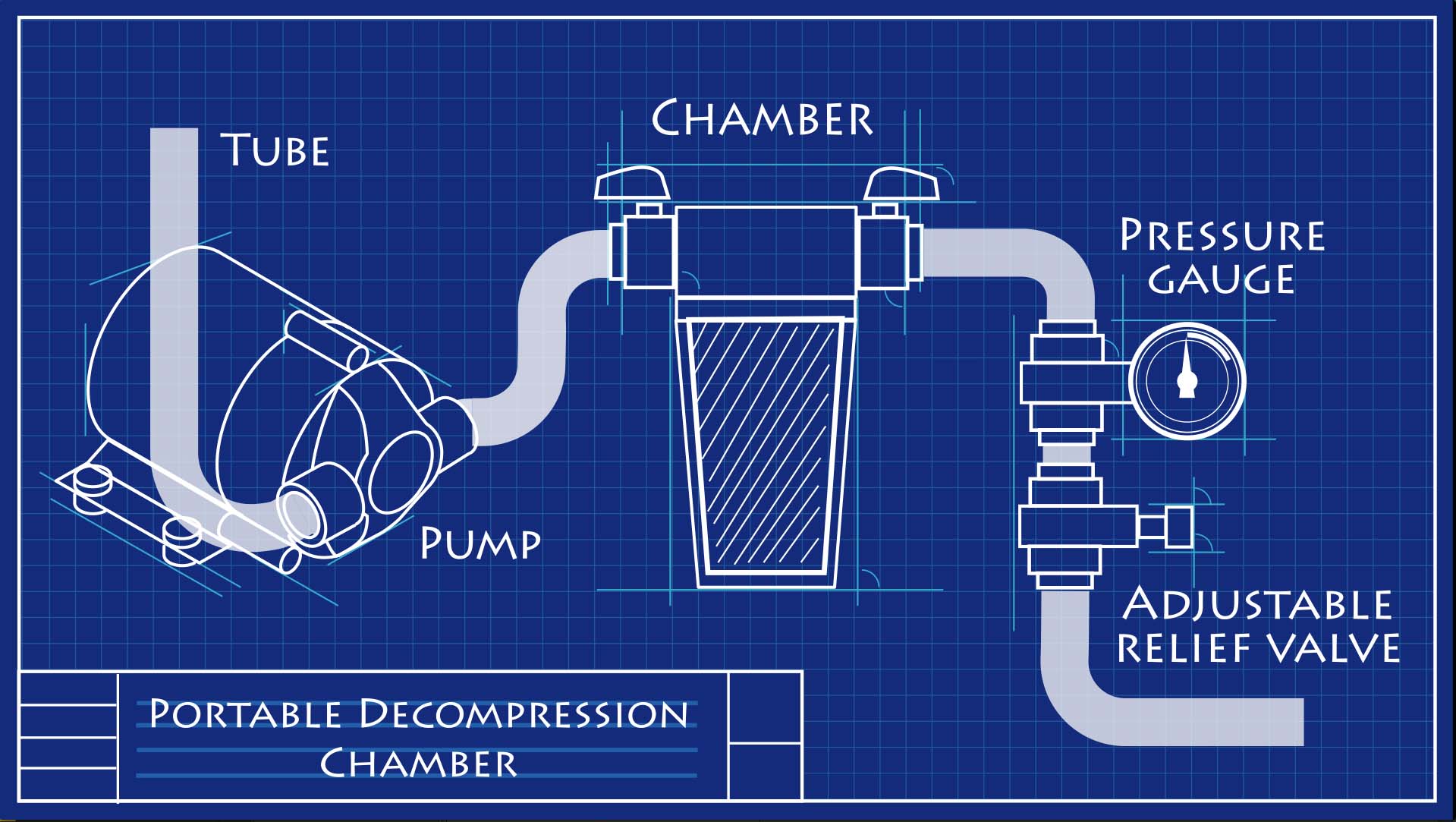
Scientists at the Academy engineered a portable decompression chamber that maintains high pressures while fish are brought to the surface. At the surface, the chamber is connected to a pump and valves that slowly decrease the pressure. Given enough time, many fish can regulate the gas in their swim bladders and adjust to slow changes in pressure. This is what the portable decompression chamber allows the fish to do.
1
8

There are areas on the Earth near large mountains that are very dry or desert-like. These dry areas are called _______ areas.

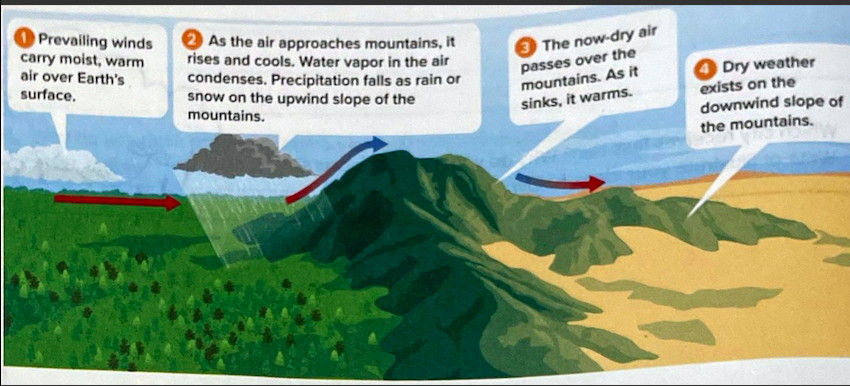
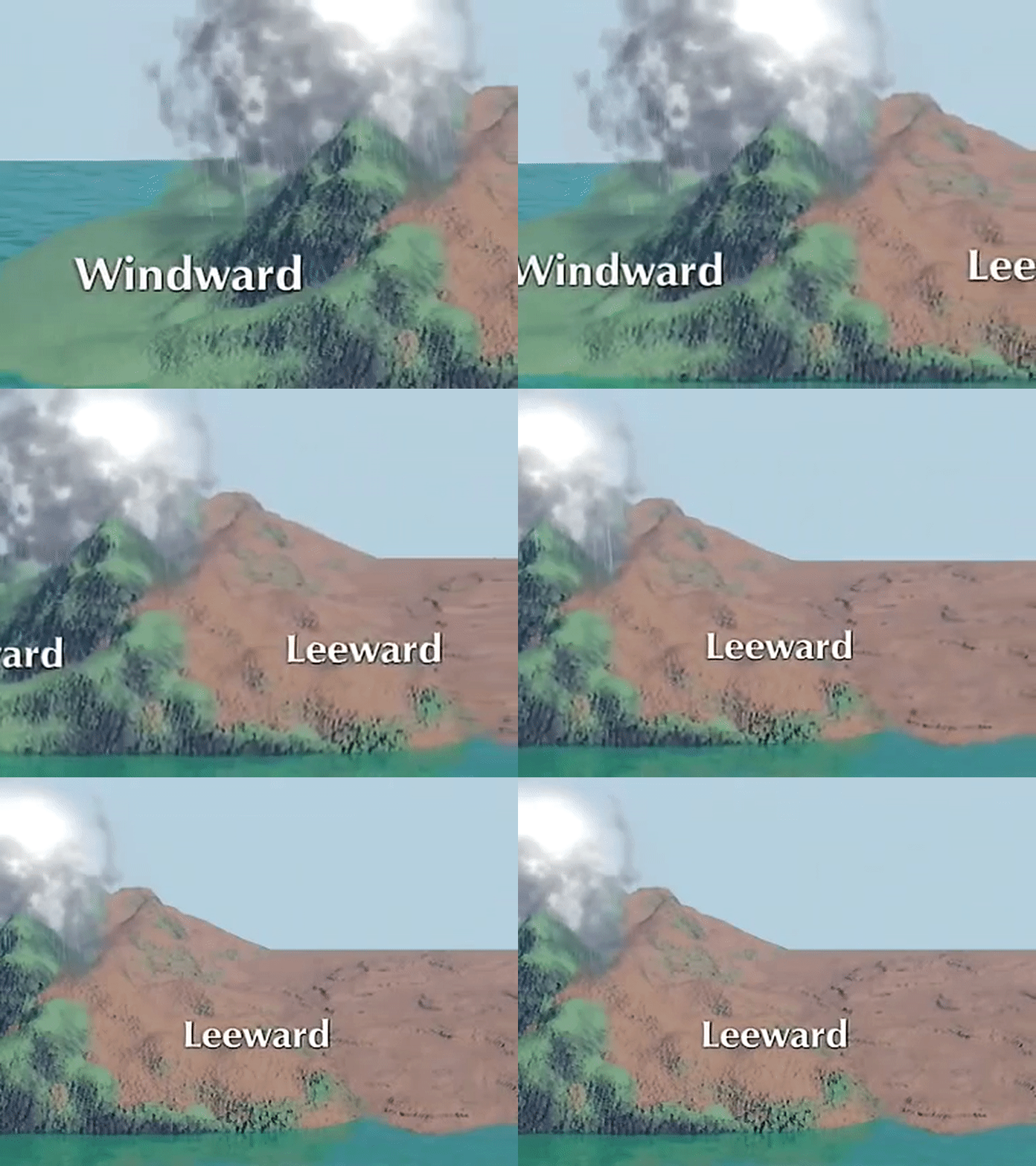
What causes a rain shadow? When wind flows up a mountain, the air is moving into an area that has _______ pressure, making the rising air expand and cool. When air cools, its capacity to hold _______ in the form of water vapor decreases. Water _______ is a gaseous form of water. As air continues to rise up the mountain, it cools to the point where it is at its maximum capacity to hold water vapor.

When air is at its maximum capacity, it is at 100% relative _______ . Further cooling will cause excess water vapor to _______ or turn into liquid water & this forms clouds. If enough condensation occurs, rain or snow will fall out of the clouds. As long as the air continues to rise up the mountain, condensation, clouds, & possibly rain or snow will occur. The side of the mountain where wind is flowing up is called the _______ side. Many areas of the world experience large amounts of rain or _______ where air is forced up mountains. The Western parts of Oregon and Washington are examples of this process.
6

As air flows over the _______ side of the mountain it starts to warm. The warming is caused by air getting _______ together as it moves downward into higher air pressure.

Warmer air can _______ more water vapor so condensation does not occur when air is sinking. If there is no condensation, then there are no clouds and therefore, no _______. Dry or desert conditions prevail on the leeward side and are known as the rain _______ area. Eastern parts of Oregon and Washington are examples of where the rain shadow occurs. While Laurel mountain in Western Oregon receives over 119 inches of yearly precipitation, Bend Oregon on the leeward side only receives about 12 inches a year.

Large differences in _______ will be experienced depending on which side of the mountain you happen to be on.
1

Create your own model to describe why dry weather exists on the leeward sides and high precipitation or snow exists on the windward side of mountains.

3

All of these answers must be in complete full sentences.

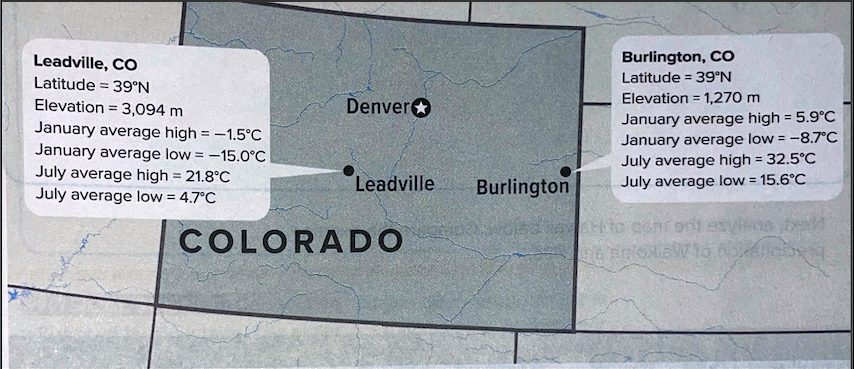
  • A) Which city has a cooler climate? What evidence supports your conclusion?

  • B) Is there a difference between Leadville's and Burlington's climate related to their latitude? Explain your reasoning.

  • C) What affect does elevation have on temperatures? Use evidence in your explanation.

1

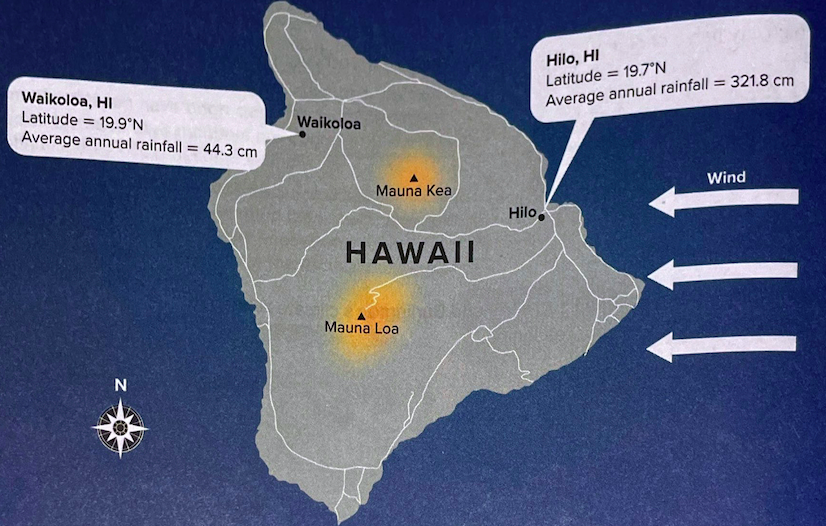
Which city receives less rain? Why do you think this occurs considering what you know about rain shadow (leeward and windward sides of mountains?

Write or illustrate your ideas below.

1

What is the windward side of a mountain?

0

In the video, this gentlemen seeks to answer the question of why water boils at a lower boiling point at higher elevation. He travelled up Mount Everest to test if this statement is true.

Watch the video and takes notes on why water boils at a lower temperature in a place with higher altitude.

3

Explain why water boils at lower temperatures with increased altitude.