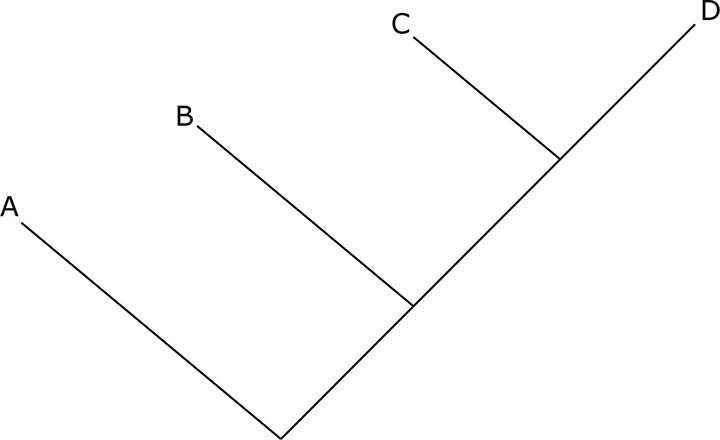
According to this cladogram, which species is the most advanced?
According to this cladogram, which species is the most advanced?
According to this cladogram, which species is the most advanced?
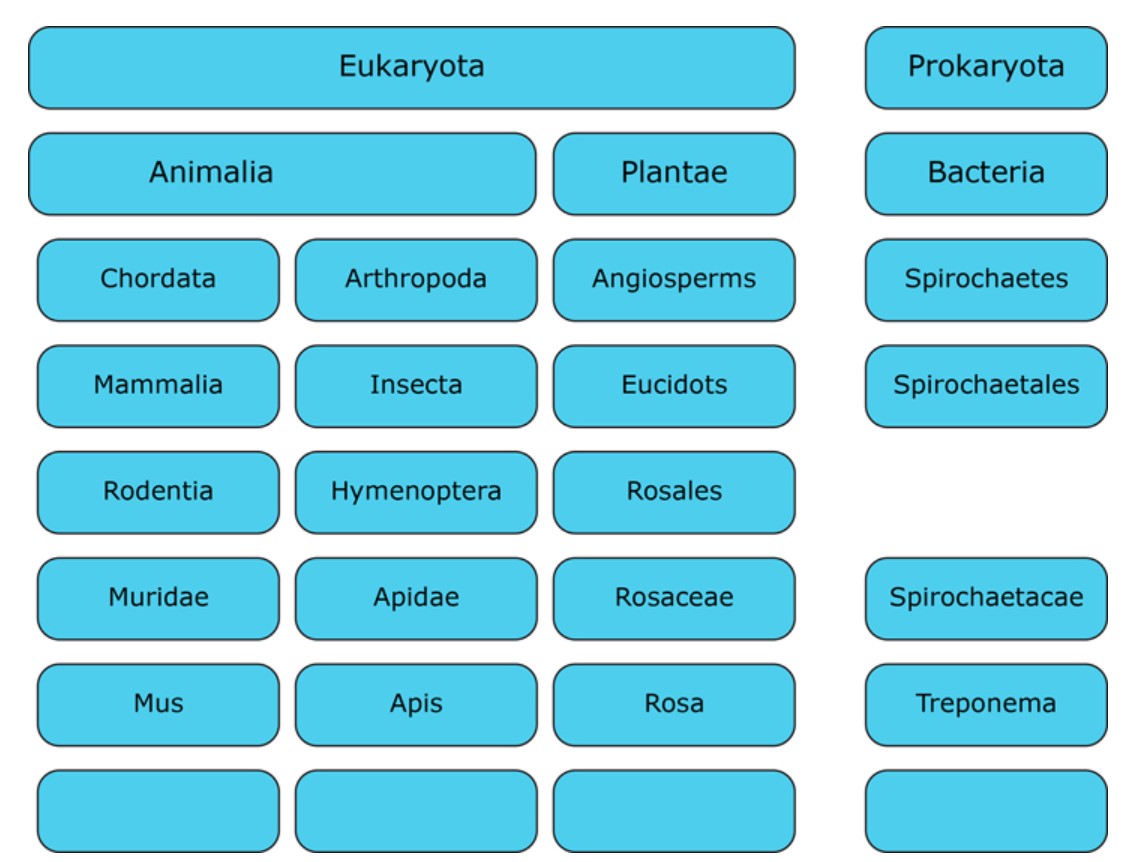
Place each organism in its correct location in the classification system.
For each statement about evolutionary theory, determine whether it is true or false.
Evolutionary theory describes the origin of life on Earth.
Evolutionary theory is invalid because it cannot explain all of the biodiversity that exists on Earth.
The theory states that one species can, over time, give rise to several species.
According to evolutionary theory, humans and chimpanzees are close relatives.
Evolutionary theory states that life evolves randomly, due to chance.
Evolutionary theory describes the relationship between species.
According to evolutionary theory, humans and chimpanzees are distant relatives.
Use 3.1 Explore 1 to help you sequence the events of Earth's history that shows how life formes possibly appeared.
The first animals with bilateral symmetry evolved.
The first simple animals appeared.
Modern humans emerged.
The first primates evolved.
Over the course of several million years, some amphibians evolved into organisms that scientists call “reptile-like amphibians.”
Proto-amphibians (animals having characteristics of both fish and amphibians) first appeared.
Mammals first appeared on Earth. Scientists use fossils to trace the evolution of one group of reptiles into early mammals.
Early arthropods, which are also invertebrates, first appeared.
Amphibians evolved out of their “proto” phase to become some of the most dominant animals on land.
Birds evolved from a different line of reptiles.
The following passage discusses changes in the environment and how living things respond to those changes. Which sentences state incorrect information? Select all that apply.
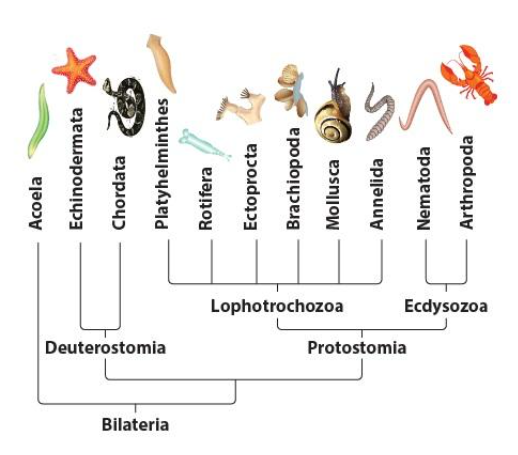
Observe the diagram of the phylogenic tree. Choose the correct word from each drop-down menu to show the relationships between the organisms.
The group is the common ancestor of all other groups in the evolutionary tree shown. Based on the information in the tree, nematodes are most closely related to . Annelids are more distantly related to Echinodermata than to . Chordates are descendants of .
Fossils can be formed from either the
Fossils allow scientists to understand the history of life on Earth. Unfortunately, gaps exist in the fossil record. Which of the following organisms are least likely to form fossils and, therefore, are likely to leave a gap in the fossil record?
bird
jellyfish
earthworm
snail
fish
oyster
More likely to form fossil due to bones
More likely to form fossil due to shell
Most likely not form a fossil because it is soft bodied
Classify the sentences about the water cycle and the carbon cycle as to whether they are true or false.
Liquid H2O is involved in the carbon cycle.
Plants participate in the water cycle.
The water cycle has a steady amount of water stored in each state: solid, liquid, and gas.
The atmosphere has equal amounts of water and carbon.
Temperature affects the absorption of water into the atmosphere.
Choose the phrases that best describe aspects of the cycle that allows Earth’s crust to form and reform.
Match the terms about photosynthesis with their definitions.
| Draggable item | arrow_right_alt | Corresponding Item |
|---|---|---|
carbon storage | arrow_right_alt | a source of energy for many living things |
photosynthesis | arrow_right_alt | a colorless, odorless gas common in the atmosphere |
CO2 | arrow_right_alt | a process where CO2 is removed from the atmosphere and stored in other spheres |
H2O | arrow_right_alt | a molecule that absorbs energy from light in a chemical process |
cellular respiration | arrow_right_alt | a chemical process where the reactants carbon dioxide and water form the products glucose and oxygen |
glucose | arrow_right_alt | a colorless, odorless compound which can exist in a liquid, solid, or gas state under normal conditions on Earth |
chlorophyll | arrow_right_alt | a chemical process where the reactants oxygen and glucose release the products energy, carbon dioxide, and water |
Drag and drop to match the descriptions to the internal layer(s) of Earth that they best describe. Each description may be used for more than one layer.
composed of iron and nickel
solid
liquid
hottest portion of the planet
forms part of the lithosphere
contains the largest mass
causes movement of tectonic plates
Inner Core
Outer Core
Mantle
Crust
Put the various phases of Earth’s formation in the correct order.
The increase of the gravitational forces reduces the volume of Earth.
Primitive marine organisms perform photosynthesis.
Earth is an incandescent molten body.
The oceans are formed, but there is still no free oxygen in the atmosphere.
The denser elements sink toward the inner core.
Rain falls and violent storms occur
Volcanic eruptions send out the lighter elements; some form the early atmospheric gases.
The ozone layer protects Earth's surface and living things from the sun's radiation.
Match each layer with each description.
| Draggable item | arrow_right_alt | Corresponding Item |
|---|---|---|
Outer Core | arrow_right_alt | air with floating liquids and solids |
Inner Core | arrow_right_alt | brittle, hard rock |
Atmosphere | arrow_right_alt | dense, slowly-moving semisolid |
Lithosphere | arrow_right_alt | dense, hot liquid metal |
Mantle | arrow_right_alt | dense, hot solid metal |
A pot of cold water is placed halfway over a gas burner as shown, with the burner turned on. What will happen inside the pot as it heats? Drag the events into the correct order.
Warmed water rises due to lower density.
Bottom of pot heats water near the bottom of pot.
Whole pot is same temperature.
Cooler water sinks due to greater density.
Flame heats the bottom of pot.
Match the terms related to radioactive decay and dating with their descriptions and definitions.
| Draggable item | arrow_right_alt | Corresponding Item |
|---|---|---|
beta decay | arrow_right_alt | release of a helium nucleus |
uranium-238 | arrow_right_alt | release of electron and antineutrino |
alpha decay | arrow_right_alt | half-life of 5,730 years |
carbon-14 | arrow_right_alt | release of radiation |
gamma decay | arrow_right_alt | half-life of 4.5 billion years |
Earth’s magnetic field is generated by the flow and circulation of the liquid
Alfred Wegener developed the continental drift hypothesis with support from evidence found all over the world. This hypothesis stated that the continents had been connected to one another early in Earth’s history, but moved apart over time. Wegener did not have any evidence that could support an explanation for the mechanism behind this continental movement. Much later, the plate tectonics theory was proposed to explain this mechanism. The plate tectonics theory states that the Earth’s crust is divided into separate plates and that mantle convection drives their movement. Use your understanding of these two different ideas to think about evidence that supports each of them. Sort the individual pieces of evidence by deciding if it was originally used to support the continental drift hypothesis or the plate tectonic theory. Note that while plate tectonics theory builds on the continental drift hypothesis, each piece of evidence fits best in one column or the other, not both.
A hot spot under Yellowstone National Park was farther west millions of years ago.
Oceanic crust parallel to a ridge has the same pattern of magnetic polarity on either side of the ridge.
Shapes of present-day continents fit together like a jigsaw puzzle.
Rock strata in the Appalachian Mountains match rock strata in mountains in Scotland.
Locations of volcanoes are not random but tend to be located in chains along boundaries between oceans and continents.
Fossilized plants from Alaska could not have grown in the climate known to exist in that geographical location at the time they lived.
Supports Continental Drift Hypothesis
Supports Plate Tectonics Theory
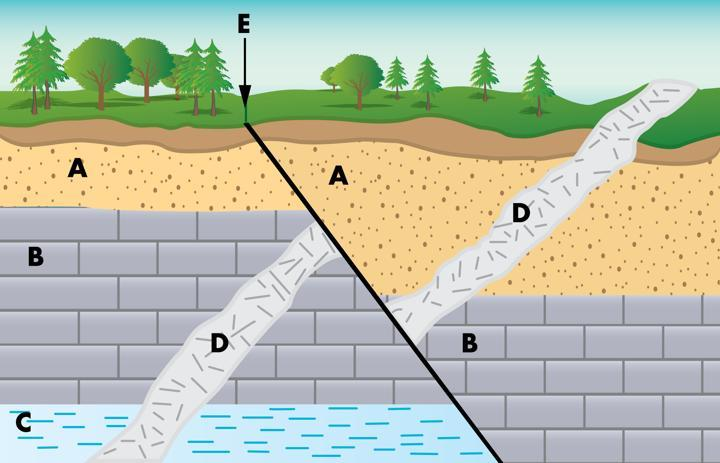
Look at the picture and determine the relative age of the layers. Then write the letters of the layers in order from oldest to youngest rock layer.
B
A
C
D
E
Read the phrases and determine if the property or practice described explains relative age dating or not. Once you have decided, drag the phrase to the appropriate box.
cross-cutting relationships
chemical characteristics
estimated age
exact age
gaps in time occur
fossil study
law of superposition
looking at rock layers
radiometric dating
physical characteristics
Describes Relative Age Dating
Does Not Describe Relative Age Dating
Match the name of each law or principle to the statements it supports.
In an undisturbed sequence of sedimentary rock, each layer is younger than the layer over which it lies.
An intrusion that cuts through a rock layer is younger than the rock layer.
A fault cutting through a rock layer is younger than the rock layer.
Rock layers are deposited horizontally.
Rock layers that are not horizontal have been disturbed.
Undisturbed layers will be horizontal.
Law of superposition
Principle of horizontality
Principle of cross-cutting relationships
The different periods of the Earth’s history have been investigated and interpreted based on the modern geological and biological theories. In the table below, some known and important events of the Earth’s past are placed in chronological order (from top to bottom). For each item, determine the principle that could better help understanding the corresponding period.
The first living organisms begin to populate the water bodies on Earth
Continents move together, generating climate disruptions, extinction of marine invertebrates, and the formation of mountain chains
Ninety percent of the marine species and 70 percent of the land species become extinct in the Great Dying
Dinosaurs proliferate on land and in marine habitats
An asteroid impacts leads to the extinction of more than 75 percent of all species, including the dinosaurs
Mammals become more diverse and widespread on Earth
| Draggable item | arrow_right_alt | Corresponding Item |
|---|---|---|
disconformity | arrow_right_alt | an unconformity in which younger sediments have been deposited on top of the eroded surface of tilted or folded older rock layers |
nonconformity | arrow_right_alt | an unconformity in which the rock layers are parallel |
angular unconformity | arrow_right_alt | an unconformity in which sedimentary rock layers overlie an erosion surface cut into igneous or metamorphic rocks |
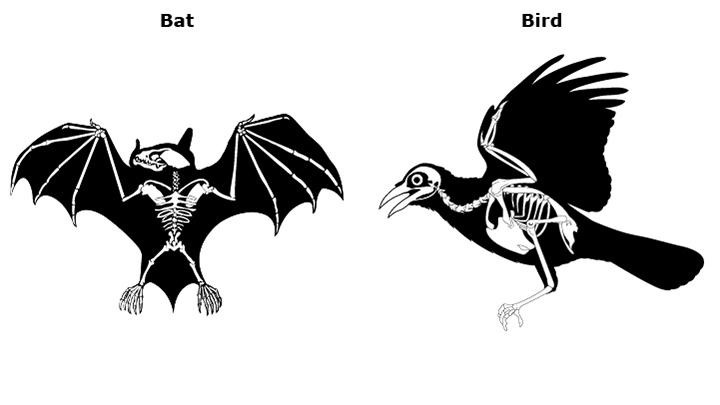
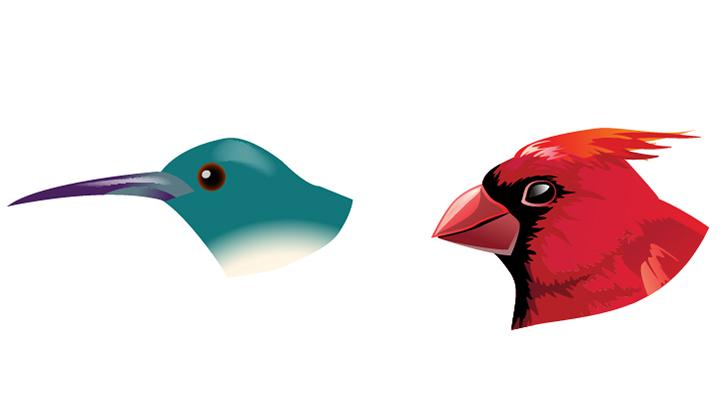
A scientist examines the two animals shown below and concludes that they must have shared a common ancestor at some point. Based on your understanding of homologous structures, determine whether his conclusion is valid. Explain your reasoning.
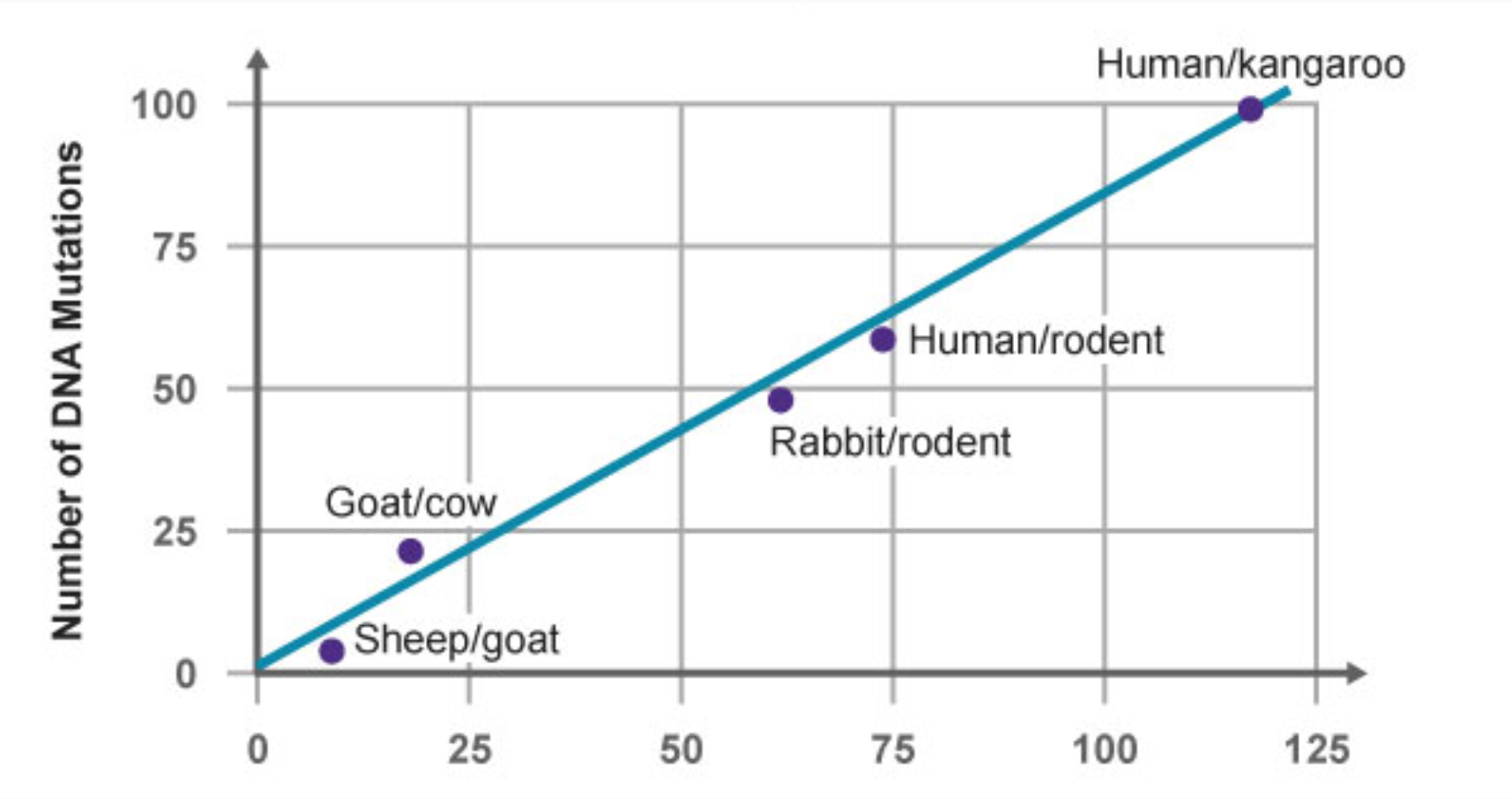
Interpret the molecular clock of Cytochrome c shown here, then select the statements that are true.
Some examples of scientific concepts are listed below. Match each example with the correct concept.
| Draggable item | arrow_right_alt | Corresponding Item |
|---|---|---|
adaptation | arrow_right_alt | In a population of sheep, some are brown and some are white. |
evolution | arrow_right_alt | An insect avoids predators by looking like a leaf. |
variation | arrow_right_alt | A new species ofplant develops and another species of plant dies out. |
Genetic variations allow for an individual to be successful in a particular environment. Which outcomes show where characteristics are likely to be successful for an individual, and which outcomes show where they are not?
an individual is unable to reproduce
an organism dies off before reaching maturity
an offspring living in the Arctic is born with white fur
an individual that lives in the ground has claws
a plant that lives in the desert needs limited water
an individual has less than the average number of offspring
a creature that lives in the ocean has gills to breathe in the water
Successful
Unsuccessful
Choose the best words or phrases to explain how Darwin’s theories have changed our understanding of how life originated on Earth.
Before Darwin's theories, scientists thought that species . Because of Darwin's research, scientists now believe that species . New types of life originate on Earth because they .
Determine whether each of these organisms resulted from natural selection or artificial selection.
A population of birds develop harder beaks in order to eat seeds with hard shells
A farmer sells grapes that are the offspring of crosses between his best strains
Dogs are descendedfrom wolves that have been domesticated
A species of fern that can grow in acidic soil becomes the predominant organism in an ecosystem after the soil becomes acidic
Artificial Selection
Natural Selection
Different birds descended from the same common ancestor can have different traits. Choose the best words or phrases that explain what may cause these differences.
Different populations of birds can diverge into different species with different traits because of . Some populations may live in areas that have plentiful nectar in flowers. In these places, birds with a long, thin beak would have a . In other areas, hard seeds may be plentiful. In these places, birds with short, strong beaks would have a. The populations with the appropriate traits would more often, resulting in an increase in the frequency of birds with strong beaks within the population.
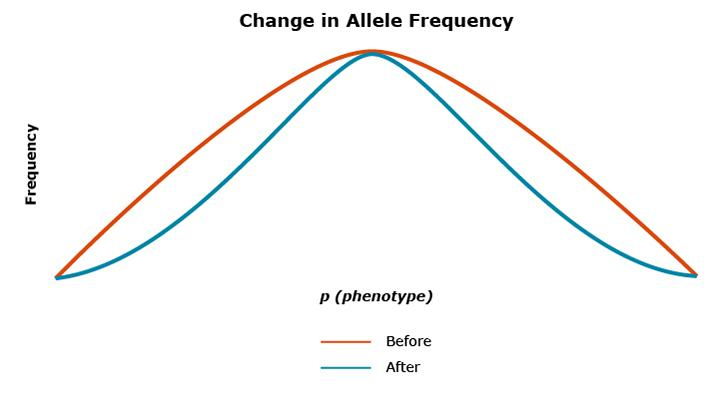
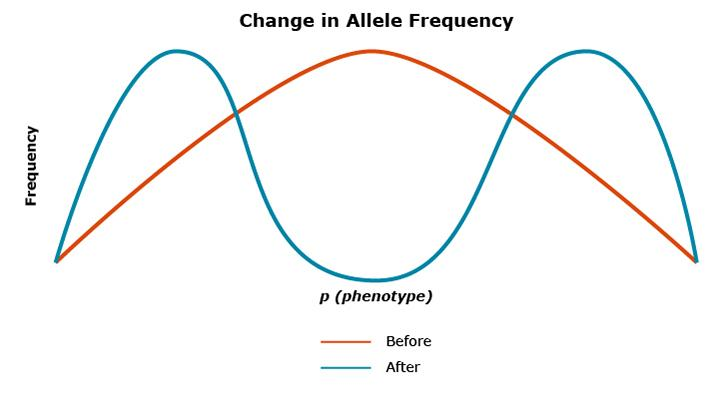
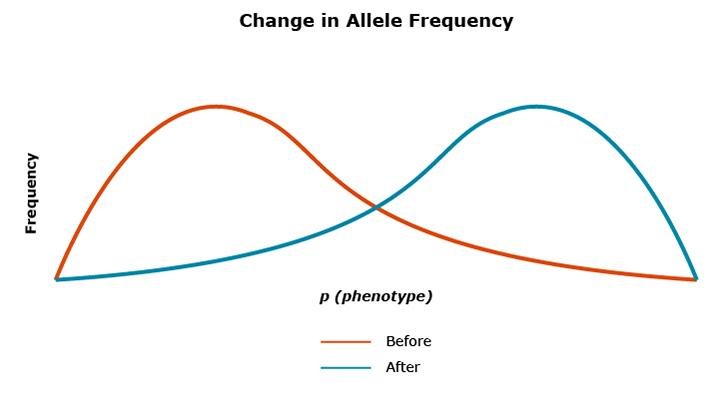
Based on your understanding of natural selection, determine how each of these scenarios would change the allelic distribution of a population.
| Draggable item | arrow_right_alt | Corresponding Item |
|---|---|---|
| arrow_right_alt | An introduction of an invasive predator that eats mainly small fish | |
| arrow_right_alt | An increasing preferencd of females for males with blond fur coloring | |
| arrow_right_alt | The introduction of a new species of mouse that only eats only medium sized seeds |
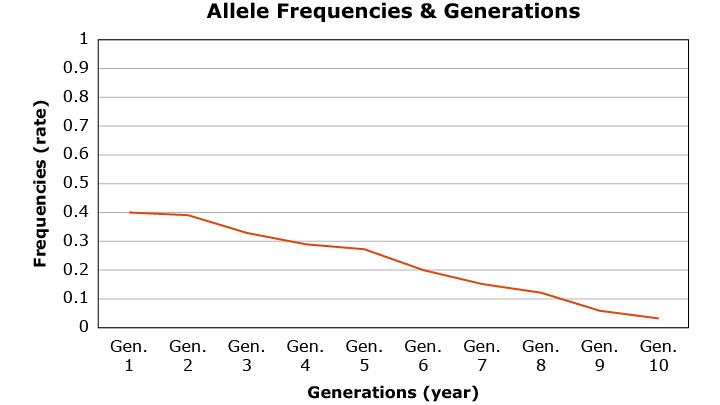
A student breeds a population of flowers with two alleles, red and white. Over time, the white allele, q, decreases in frequency. She plots the frequency of this allele found in her population in the graph below. Assuming that Hardy-Weinberg equilibrium holds, what is the frequency of heterozygotes in generation 6?
Many different sources of evolution can drive changes in a species. Determine what was responsible for population change in each of these cases.
| Draggable item | arrow_right_alt | Corresponding Item |
|---|---|---|
Sexual Selection | arrow_right_alt | The appearance of pink-furred rabbits in a population of white rabbits |
Mutation | arrow_right_alt | A flood drowns most of the grass population in an ecosystem |
Bottleneck Effect | arrow_right_alt | A storm carries a group of butterflies to an unfamiliar forest where they establish a new population |
Founder Effect | arrow_right_alt | A change in the color of a male bird's feathers makes it more attractive to females |