Log in
Sign up for FREE
arrow_back
Library
TEST_DE_LE_Unit4
By Nicholas Meyer
star
star
star
star
star
Share
share
Last updated over 2 years ago
26 questions
Add this activity
1
1
1
1
1
1
1
1
1
1
1
1
1
1
1
1
1
1
1
1
1
1
1
1
Question 1
1.
The blue flowers that a plant inherits from its parents are an example of a
mutation
trait
dihybrid cross
sex-linked disease
Question 2
2.
An individual who expresses a recessive trait is ______ for that trait.
homozygous
both homozygous and heterozygous
heterozygous
neither homozygous nor heterozygous
Question 3
3.
If a person has a dominant allele for brown eyes and a recessive allele for blue eyes, which statement is correct?
The individual has brown eyes.
The individual has blue eyes.
Eye color cannot be determined based on the given information.
The individual has eye color that is a mix of brown and blue.
Question 4
4.
What are the chances that two heterozygous (Bb) parents will have a dominant expressing child?
25 percent
50 percent
75 percent
100 percent
Question 5
5.
If a cow contains two codominant alleles - one fore white hide color and one for red hide color - what would the cow's hide probably look like?
orange
red
patches of white and patches of red
white
Question 6
6.
Which of the following procedures is based largely on Mendel's research?
performing surgery on a broken arm
treating lung cancer with radiation
breeding a dox for floppy ears
using a microscope to study viruses
Question 7
7.
The diagram shows a dihybrid cross of two bean plants. Yellow (Y) is the dominant flower color and smooth (S) is the dominant leaf texture.
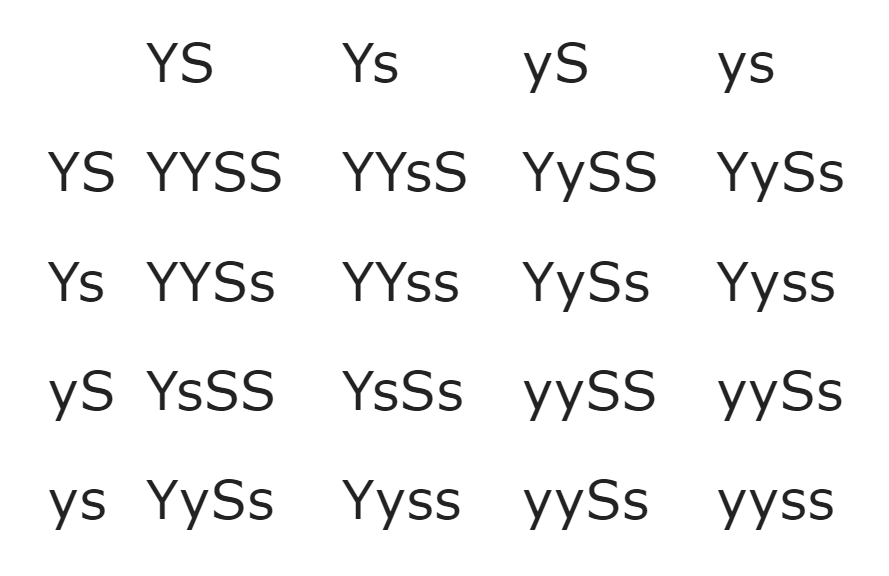
According to the diagram, what are the chances that the offspring will have
smooth leaves
?
25 percent
50 percent
75 percent
100 percent
Question 8
8.
By observing more than one type of trait simultaneously over multiple generations, which law did Mendel discover?
the law of co-dominance
the law of multiple alleles
the law of independent assortment
the law of segregation
Question 9
9.
What are the names of each DNA strand during replication?
up and down
leading and lagging
forward and backward
complete and fragmentary
Question 10
10.
What determines the genetic code of a region of DNA?
the number of phosphate groups
the order of sugar and phosphate groups
the order of nitrogenous bases
the number of base pairs
Question 11
11.
What does a chromosome consist of?
tightly wound DNA and proteins
tightly wound DNA only
loosely dispersed DNA
loosely dispersed DNA and proteins
Question 12
12.
Messenger RNA delivers a "message" from ________ to _________.
DNA; ribosomal RNA
DNA; proteins
ribosomes; transfer RNA
ribosomal RNA; proteins
Question 13
13.
What molecule begins DNA replication?
helicase
mRNA
RNA polymerase
DNA polymerase
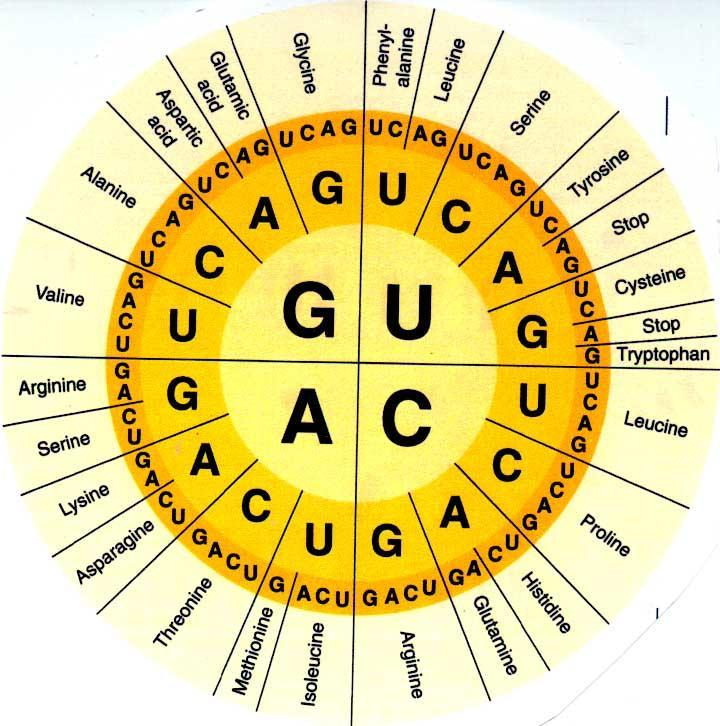
The following is a strand of DNA that is coding for different amino acids.
5' TAC CTC AGC GAT 3'
1
1
Question 16
16.
Place the steps of transcription in order:
RNA polymerase attaches to the DNA template
The DNA strand separates
Base pairing forms mRNA
The mRNA strand moves out of the nucleus
Question 17
17.
Which step begins the process of translation
The ribosome releases the protein and detaches from the mRNA.
tRNA connects an amino acid to the ribosome.
A ribosome reads the codon sequence at the 5' end of mRNA.
A stop codon indicates the end of the polypeptide.
Question 18
18.
Ligases are enzymes that connect strands of nucleic acids. During which step of protein synthesis are ligases used?
RNA processing
transcription
mutation proofreading
peptide bonding
Question 19
19.
One reason chromosomal mutations are considered large-scale is because ____________.
they are always passed onto the offspring
they cannot be proofread and fixed
they affect large organisms
they can affect more than one gene
Question 20
20.
What type of mutation could cause the 3-nucleotide reading frame of tRNA to be shifted?
deletion of one or more nucleotides during replication
incorrect base pairing
replacing an amine group
switching a normal nucleotide for an abnormal one
Question 21
21.
An autosomal dominant disorder requires _______ in order to affect an individual.
a combination of sex-linked and environmental factors
one copy of a mutated gene
a combination of genetic and environmental factors
two copies of a mutated gene
Question 22
22.
Which of the following is
NOT
true about X-linked disorders?
They involve mutations along the X chromosome.
They can affect males or females.
An example of one is Rett syndrome.
They only affect males.
Question 23
23.
Which of the following is an example of an autosomal dominant disorder?
Marfan syndrome
Niemann-Pick disease
Tay-Sachs disease
Williams syndrome
Question 24
24.
The primary goal of gene therapy is to give a patient
a new, normal single gene
new, normal, reproductive organs
a new, normal cell nucleus
a new, normal single chromosome
Question 25
25.
Which of the following is not a category of genetic disorders?
chromosomal
environmental
multi-factorial
single-gene
Question 26
26.
If someone who is homozygous for an autosomal recessive disorder mates with a person who does
NOT
carry the mutated gene, their child will __________.
have a 50 percent chance of developing the disease
have a zero percent chance of developing the disease
have a 25 percent chance of developing the disease
have a 100 percent chance of developing the disease
Question 14
14.
Which of the following provides the correct sequence for a strand of mRNA that was made to be complementary to the DNA strand?
AUC CAC UGC GUA
ATC CAC TGC GTA
ATG GAG TCG CTA
AUG GAG UCG CUA
Question 15
15.
Using the codon chart, drop in the correct sequence of amino acids that correspond to the correct mRNA strand.
_______________ -__________________-___________ -____________
Other Answer Choices:
drag_indicator
Arginine
drag_indicator
Glutamic acid
drag_indicator
Leucine
drag_indicator
Methionine
drag_indicator
Cystein
drag_indicator
Aspartic acid
drag_indicator
Glycine
drag_indicator
Proline
drag_indicator
Valine
drag_indicator
Threonine
drag_indicator
Asparagine
drag_indicator
Serine