UNIT 1 of 2 DoDEA 4th Grade Summative Practice Test 2023
star
star
star
star
star
Last updated about 3 years ago
19 questions
Note from the author:
This was copied over from the DoDEA practice summative test for 4th grade on the website (May 2023) so students can take the test and have their works saved for review and self assessment/reflection. This is Unit 1 of 2 practice units. The standards have been added so help teachers identify areas of strength and challenge. The writing component needs to be manually scored. I will try to add the rubric at a later date. Only have the basic plan limits some features.
English Language
Arts/Literacy
Unit 1
Directions:
Today, you will take Unit 1 of the Grade 4 English Language Arts/Literacy Practice Test.
Read each passage and question. Then, follow the directions to answer each question. Mark your answers by completely filling in the circles in your answer document. Do not make any pencil marks outside of the circles. If you need to change an answer, be sure to erase your first answer completely.
One of the questions will ask you to write a response. Write your response in the space provided in your answer document. Be sure to keep your response within the provided space. Only responses written within the provided space will be scored.
If you do not know the answer to a question, you may go on to the next question. If you finish early, you may review your answers and any questions you did not answer in this unit ONLY. Do not go past the stop sign.
Required
1
RL.4.1
RL.4.4
Required
1
RL.4.1
RL.4.4
Required
1
RL.4.1
RL.4.3
Required
1
Required
1
RL.4.1
RL.4.3
Required
1
RL.4.1
RL.4.3
Required
1
RL.4.1
RL.4.4
Required
1
RL.4.1
RL.4.4
Required
1
RL.4.1
RL.4.2
Required
1
RL.4.1
RL.4.2
Required
1
Question 11
11.
QUESTION 7:
Identify a theme in “Just Like Home” and a theme in “Life Doesn’t Frighten Me.”
Write an essay that explains how the theme of the story is shown through the characters and how the theme of the poem is shown through the speaker.
Include specific details from the story and the poem to support your essay
CCR.W.10
CCR.W.2
…
Required
1
CCR.L.4
CCR.L.5
…
Required
1
CCR.L.4
CCR.L.5
…
Required
1
RL.4.1
RL.4.3
Required
1
RL.4.1
RL.4.3
Required
1
RL.4.1
RL.4.3
Required
1
RL.4.1
RL.4.2
Required
1
RL.4.1
RL.4.2
Required
1
RL.4.1
RL.4.2
Question 1
1.
Question 2
2.
Question 3
3.
Question 4
4.
Question 5
5.
Question 6
6.
Question 7
7.
Question 8
8.
Question 9
9.
Question 10
10.
Question 12
12.
Question 13
13.
Question 14
14.
Question 15
15.
Question 16
16.
Question 17
17.
Question 18
18.
Question 19
19.
Part A1. What is the meaning of the word drift as it is used in paragraph 18 of “Just Like Home”?
A. consider
B. wander
C. change
D. hover
Part B1: Which detail from the story helps the reader understand the meaning of drift?
A. Priya, Enrique, and Farah create drawings that have different colors and shapes.
B. Jasper studies the drawings and decides they look like tropical fish swimming in a coral reef.
C. Lily, Jasper, and Enrique make comments about the drawings as the students come close enough to see them.
D. Priya smiles when her teacher and classmates show an interest in the drawings by describing them to one another.
Part A2. Priya from “Just Like Home” would agree with which statement?
A. Sharing family traditions can bring comfort.
B. Working together is the best way to achieve success.
C. Using imagination often makes ordinary situations exciting.
D. Making quick decisions can sometimes bring the best results.
Part B2: Which paragraph from the story supports the answer to Part A?
A. paragraph 3
B. paragraph 11
C. paragraph 19
D. paragraph 22
Part A3: In “Just Like Home,” what can be learned about Priya from her statement, “It looks like home”?
A. She believes imagination improves art.
B. She realizes many of her classmates have artistic talent
C. She misses the family traditions in India.
D. She wishes she could spend time with her friends in India.
Part B3. Which detail supports the answer to Part A?
A. “At her old school, she spent recess climbing the monkey bars and sharing secrets with her friends.” (paragraph 1)
B. “While she and her classmates filed through the halls and out into the yard, Priya thought about how she and her mother used to draw chalk patterns on the long driveway leading up to their old apartment building.” (paragraph 4)
C. “Then he drew circles inside circles, and surrounded them with small diamonds. Priya kept drawing too, in between and around Enrique’s designs.” (paragraph 11)
D. “Priya, Enrique and Farah stood up and looked at what they had done. The pavement was covered in bright colors and shapes: triangles, circles, squares and diamonds, all mixed together.” (paragraph 18)
PART 4A: What is the meaning of lines 37–38 of “Life Doesn’t Frighten Me”?
Lines 37-38____________________________
"I’ve got a magic charm That I keep up my sleeve,"
__________________________________________
A. a secret talent to use when the time is right
B. a symbol of the speaker’s imagination
C. a special treasure hidden from cruel classmates
D. a scary experience in the speaker’s nightmares
Part 4B Which lines from the poem best demonstrate the answer to Part A?
A. lines 10–11
B. lines 28–29
C. lines 35–36
D. lines 39–40
PART 5A: Which sentence summarizes the speaker’s thoughts in “Life Doesn’t Frighten Me”?
A. Some challenges are much more difficult than others.
B. Dreams can be helpful when solving problems.
C. Confidence is the best weapon against fear.
D. Being alone is the scariest place to be.
PART 5B: Which lines from the poem show evidence of the answer to Part A?
A. lines 1–2
B. lines 10–11
C. lines 19–20
D. lines 35–36
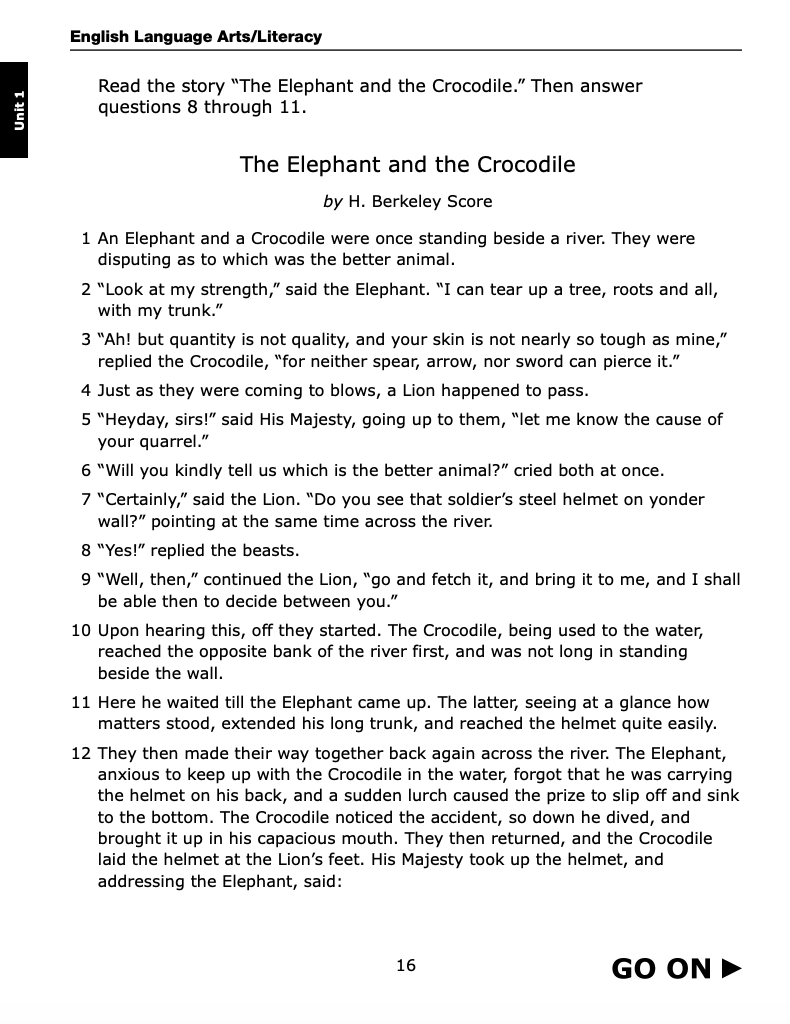
Part 8A: Which sentence from the story helps the reader understand the meaning of disputing as it is used in paragraph 1?
A. “‘Heyday, sirs!’ said His Majesty, going up to them, ‘let me know the cause of your quarrel.’” (paragraph 5)
B. “Upon hearing this, off they started.” (paragraph 10)
C. “The latter, seeing at a glance how matters stood, extended his long trunk, and reached the helmet quite easily.” (paragraph 11)
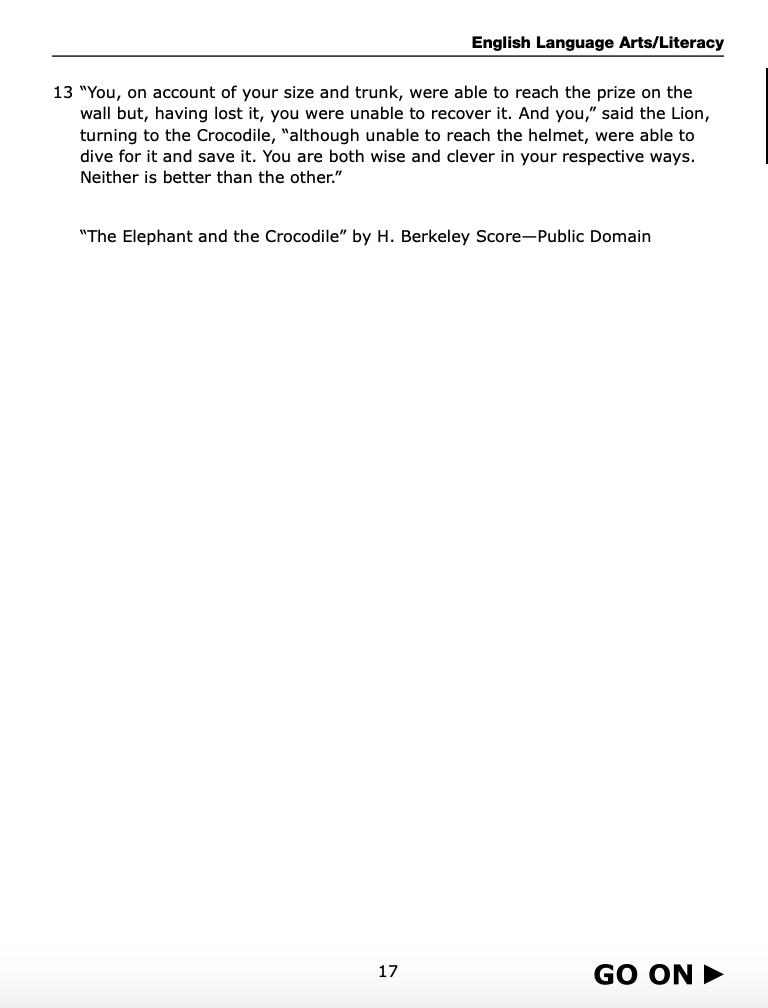
D. “‘And you,’ said the Lion, turning to the Crocodile, ‘although unable to reach the helmet, were able to dive for it and save it.’” (paragraph 13)
PART 8B: Which word has the opposite meaning of disputing?
A. confessing
B. discussing
C. questioning
D. agreeing
Part 9A How does the Lion react to the question the Elephant and the Crocodile ask in paragraph 6?
A. He disappoints them by refusing to answer.
B. He causes conflict by proposing a silly contest.
C. He shows interest in helping them solve their problem.
D. He addresses them as if they are less important than he is.
Part 9B Which detail from the story provides evidence for the answer to Part A?
A. “‘Do you see that soldier’s steel helmet on yonder wall?’” (paragraph 7)
B. “‘. . . go and fetch it, and bring it to me, and I shall be able then to decide between you.’” (paragraph 9)
C. “His Majesty took up the helmet. . . .” (paragraph 12)
D. “‘You, on account of your size and trunk, were able to reach the prize on the wall but, having lost it, you were unable to recover it.’” (paragraph 13)
Part 10A: Which character trait best describes the Lion?
A. wise
B. brave
C. kind
D. humorous
Part 10B: Which quotation from the story supports the answer to Part A?
A. “Just as they were coming to blows, a Lion happened to pass.” (paragraph 4)
B. “‘Do you see that soldier’s steel helmet on yonder wall? . . . .’” (paragraph 7)
C. “‘Well, then,’ continued the Lion, ‘go and fetch it, and bring it to me, and I shall be able to decide between you.’” (paragraph 9)
D. “‘Neither is better than the other.’” (paragraph 13)
Part 11A: Which sentence best states a theme in the story?
A. We all have different strengths.
B. We should try to be patient with others.
C. We all have the power to help others.
D. We should always put forth our best efforts.
Part 11B: Which detail from the story best shows this theme?
A. “‘Ah! but quantity is not quality, and your skin is not nearly so tough as mine. . . .’” (paragraph 3)
B. “The Crocodile, being used to the water, reached the opposite bank of the river first. . . .” (paragraph 10)
C. “. . . a sudden lurch caused the prize to slip off and sink to the bottom.” (paragraph 12)
D. “‘You are both wise and clever in your respective ways.’” (paragraph 13)