Use the compound interest formula given a financial situation and interpret its results
Evaluate expressions given variable definitions
Common Core Math Standards
Link to all CCSS Math
CCSS.HSF.LE.A.1.C
CCSS.HSF.LE.A.2
CCSS.HSF.BF.A.1
Personal Finance Objectives
Demonstrate how compound interest can affect future loan balances
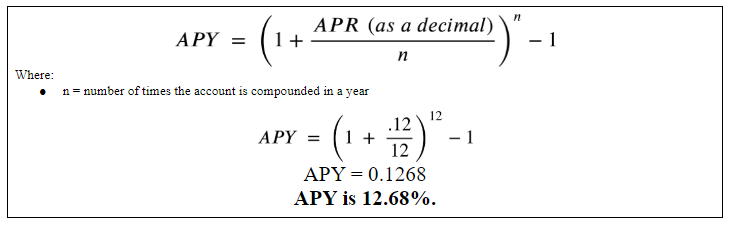
Explain the difference between APR and APY
Calculate the future value of periodic investments
National Standards for Personal Financial Education
Managing Credit
1a: Describe how credit card grace periods, methods of interest calculation, and fees affect borrowing costs
3b: Compare the cost of borrowing $1,000 using consumer credit options that differ in rates and fees
OBJECTIVES & STANDARDS
Math Objectives
Use the compound interest formula given a financial situation and interpret its results
Evaluate expressions given variable definitions
Common Core Math Standards
Link to all CCSS Math
CCSS.HSF.LE.A.1.C
CCSS.HSF.LE.A.2
CCSS.HSF.BF.A.1
Personal Finance Objectives
Demonstrate how compound interest can affect future loan balances
Explain the difference between APR and APY
Calculate the future value of periodic investments
National Standards for Personal Financial Education
Managing Credit
1a: Describe how credit card grace periods, methods of interest calculation, and fees affect borrowing costs
3b: Compare the cost of borrowing $1,000 using consumer credit options that differ in rates and fees
Intro
CALCULATE: Calculating Interest
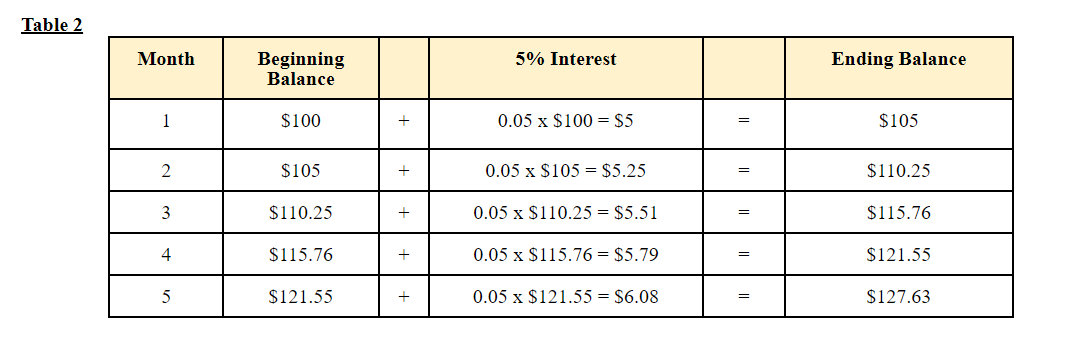
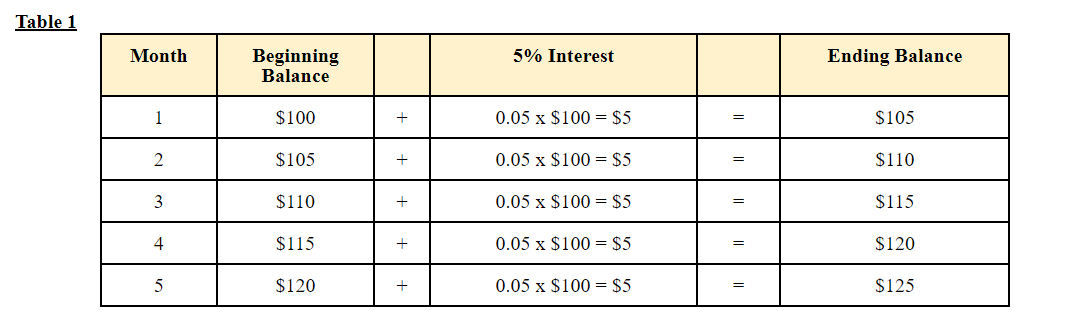
Interest on a loan can be calculated in a variety of ways. Examine the two tables and use them to answer the questions below.
Required
1 point
1
Question 1
1.
Briefly describe how each month’s interest is calculated in Table 1.
Required
1 point
1
Question 2
2.
How is Table 2’s calculation different?
Required
1 point
1
Question 3
3.
Would you prefer Table 1 or Table 2 if you were earning interest on an investment? Explain your answer.
Required
1 point
1
Question 4
4.
Would you prefer Table 1 or Table 2 if you were being charged interest on a credit card or loan? Explain your answer.
Explore It
Compound Interest
The process of including interest in the balance when calculating new interest, like we did in Table 2 above, is called Compounding Interest. In that table, interest was compounded one time each year. What happens if we decide to compound the accumulated interest more frequently, like monthly or daily? Is there an easy way to calculate your balance when compounding? Let’s explore these questions.
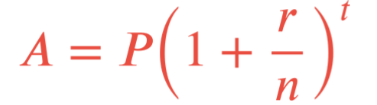
Let’s start with the exponential growth equation that you’ve used many times before:
Where:
A = Total Balance after interest has accrued
P = Principal (This may be referred to by other terms such as starting balance or loan amount)
r = the annual interest rate
t = the amount of time in years
Required
1 point
1
Question 5
5.
If the annual interest rate was 8%,
a. How would you calculate the monthly interest rate?
b. How would you calculate the daily interest rate?
Required
1 point
1
Question 6
6.
Write a general expression for converting an annual interest rate into other time intervals where n is used to represent the time interval.
If we update the formula above to include this time interval, it looks like this now:
We have one more problem. The variable t represents years, but if we’re compounding monthly or daily, we need the exponent to reflect the number compounds, NOT the number of years.
Required
1 point
1
Question 7
7.
If you are compounding monthly over 3 years, how many times do you compound?
Required
1 point
1
Question 8
8.
If you are compounding daily for 3 years, how many times do you compound?
Required
1 point
1
Question 9
9.
If n represents the time interval and t represents time in years, write an expression that calculates the number of times you compound in t years.
Learn It
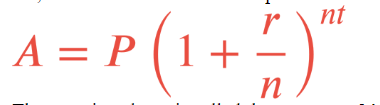
Ok, we’re almost there. Let’s update our formula one more time.
The equation above is called the compound interest formula and it can be used to calculate the account balance when interest is compounded n times per year.
Using the Compound Interest Formula
Now that we have a formula that can be used to calculate balances that use compound interest, let’s put it into practice.
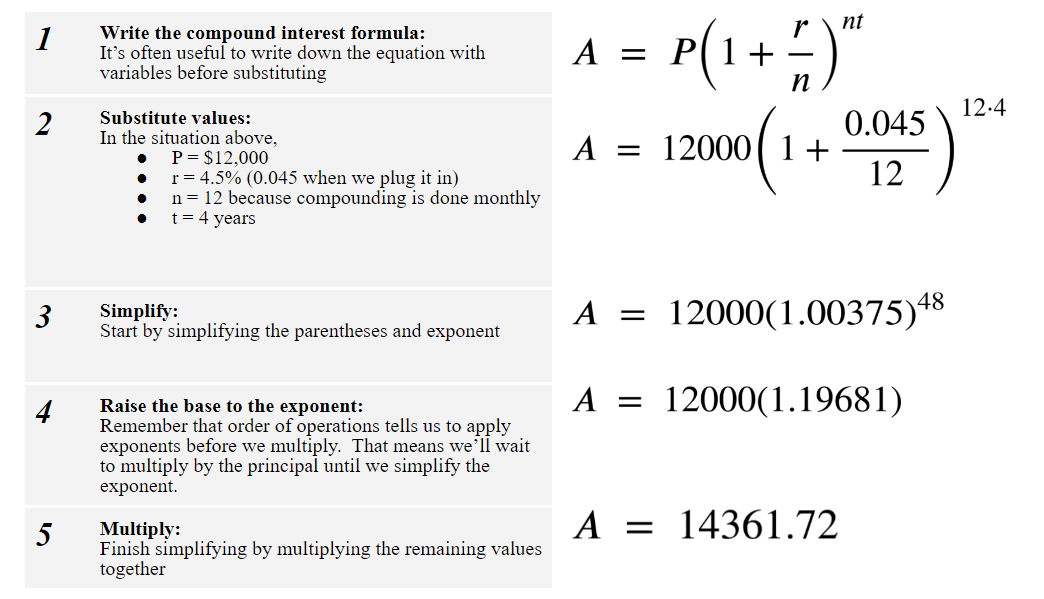
If Alana has a loan balance of $12,000 that is compounded monthly at a rate of 4.5%. Assuming that she makes no payments on the account, what will her balance be in 4 years?
Review the completed example below.
Required
1 point
1
Question 10
10.
Example 1
P = $5000
r = 6.25%
Compounded daily for 5 years
Required
1 point
1
Question 11
11.
Example 2
Carmine takes a loan for $11,500 at a rate of 8% that is compounded quarterly. Assuming she makes no payments for the first 2 years, what is her loan balance?
Practice It
Required
1 point
1
Question 12
12.
P = $8,500
r = 3.175%
Compounded monthly for 10 years
Required
1 point
1
Question 13
13.
P = $28,000
r = 9%
Compounded annually for 5 years
Required
1 point
1
Question 14
14.
P = $275
r = 6.25%
Compounded daily for 20 years
Required
2 points
2
Question 15
15.
Marko has a credit card balance of $875 that is compounded daily at an annual percentage rate (APR) of 19.62%. If he makes no payments, what will his balance be in 2 years?
Required
2 points
2
Question 16
16.
Bethany has $37,525 in student loans that accumulate interest at 3.73% annualized interest that is compounded monthly. If she starts making payments in 4 years, what will her loan balance be?
Required
3 points
3
Question 17
17.
Camilla took a $23,500 secured auto loan that allows her to make no payments for 18 months. If interest is still compounded monthly at a rate of 6.3%, what will her balance be in 18 months when she starts making payments?
Required
3 points
3
Question 18
18.
Shawn’s mortgage balance of $263,000 is compounded daily at a rate of 4.075% annualized interest. If no payments are made for 6 months, what will the balance be after this time has passed?
Learn It
VIDEO:APR vs APY
When shopping for a loan, you may see the terms APR and APY. What are these terms and how do they apply to compound interest? Watch the video at the top of the linked article, then use it to answer the questions.
Example:
If a loan charges 1% interest per month, what is its APR and APY?
Required
1 point
1
Question 19
19.
What do APR and APY stand for?
Required
1 point
1
Question 20
20.
What is the key difference between APR and APY?
Required
3 points
3
Question 21
21.
Shawn knows that his student loan interest is calculated at a rate of 0.35% per month.
a. What is Shawn's APR?
b. What is Shawn's APY?
c. Which of the percentages represents the actual cost that Shawn will pay for his student loans if he makes no payments?
Required
1 point
1
Question 22
22.
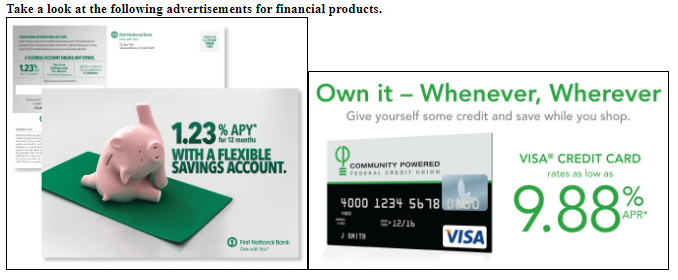
Why does the savings account advertise using APY while the credit card company uses APR?
Application: Loans and the Compound Interest Formula
Level 1
Frequency of Compounding and APY
We’ve seen that the frequency of compounding can have a significant effect on the overall interest accumulated. Let’s take a deeper dive by calculating the APY of the same situation using different compounding periods.
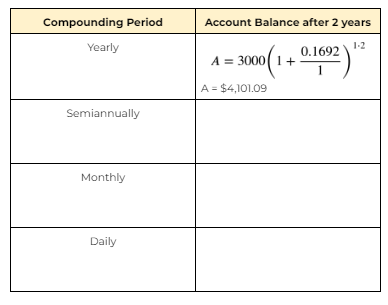
Scenario: Alonso bought a $3,000 gaming computer using his credit card. A special financing offer allows him to make no payments for 2 years but interest will still accrue at a rate of 16.92% APR and be added to the bill if he doesn't pay full balance in 2 years.
Required
3 points
3
Question 23
23.
Use the compound interest formula to calculate Alonso’s balance after 2 years using each compounding period, assuming he makes no payments. Write your answer to fill in the Account Balance column, make sure to show your work.
Required
1 point
1
Question 24
24.
How much more is Alonso paying by having his interest compounded daily versus yearly?
Required
1 point
1
Question 25
25.
How does the frequency of compounding impact the overall cost of Alonso’s total interest?
Required
4 points
4
Question 26
26.
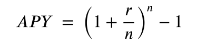
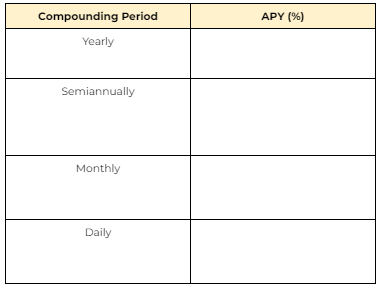
Now let’s calculate the APY of each compounding period to see what percentage rate Alonso is actually paying annually. Recall the formula:
Where:
r = Annual Percentage Rate
n = number of times the account is compounded
Calculate the APY for each compounding period.
Required
1 point
1
Question 27
27.
Most credit cards are compounded monthly or daily, which means that Alonso is paying about 1.5% more annually than the advertised APR. What effect could this knowledge have had on Alonso’s purchasing decisions?
Level 2:
Compound Interest Over Irregular Periods
Many scenarios given to you when learning about the compound interest formula include whole years. Life doesn’t always work in nice whole numbers! How would we handle a situation where we wanted to calculate a balance after 19 months or 27 months?
Scenario: Kira takes a $12,000 loan that has a 5 year term at 4.25% compounded daily. The terms of the loan state that she can make no payments for 6 months. After reading the fine print, Kira notices that interest will continue to accumulate during this 6 month grace period that will be rolled over into her loan balance.
Required
1 point
1
Question 28
28.
If the compound interest formula is written in years, what value should you use for t to represent 6 months?
Required
1 point
1
Question 29
29.
What will Kira’s loan balance be after 6 months?
Required
1 point
1
Question 30
30.
How much interest will be accumulated during this 6 month grace period?
Scenario: Lindsay makes an investment of $5,000 in an account that yields 2.25% annual rate of return compounded monthly.
Required
1 point
1
Question 31
31.
Assuming that she makes no additional deposits or withdrawals, what is Lindsay’s investment balance after 18 months?
Required
1 point
1
Question 32
32.
After 18 months, Lindsay decides to deposit an additional $6,500 into this account. What will her balance be if she makes no changes for 28 additional months?
Required
1 point
1
Question 33
33.
Lindsay got her tax return of $2,357 halfway through February. She deposits these funds into a short term money market account with an expected annual return of 0.8% and lets it sit there until it’s time to start holiday shopping at the start of December. How much money does Lindsay have at the beginning of December if the account compounded monthly?
Level 3:
Compound Interest and Student Loans
One form of student loan, called an unsubsidized loan, allows you to defer payments until after you graduate from college. The catch is that you will still accumulate interest during this time. Let’s look at a scenario where we will need to use a variation of the compound interest formula.
Scenario
Maya has been accepted to her dream school. She received federal aid, scholarships and other forms of financial aid. After applying these to her tuition, she is still responsible for $11,500 per semester. She is approved for an unsubsidized loan at a rate of 3.73% compounded semiannually to cover the remaining costs. Based on her course catalog, Maya plans to attend school two semesters per year for four years.
Required
1 point
1
Question 34
34.
What is Maya’s student loan balance after one semester?
Required
1 point
1
Question 35
35.
Why can’t we use the compound interest formula to calculate Maya’s balance after graduation?
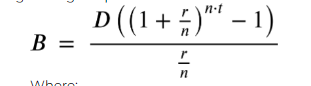
Maya wants to know how much she will owe at the end of 4 years, including any accumulated interest. The Future Value of a Periodic Deposit Formula can be used in situations like this where her loan balance will change at regular periods of time.
Where:
B = balance at the end of the investment period
D = periodic deposit amount
r = annual interest rate or rate of return
n = number of times interest is compounded annually
t = length of investment in years
Required
1 point
1
Question 36
36.
Use this formula to calculate Maya’s student loan balance after 4 years of undergraduate education.
Required
1 point
1
Question 37
37.
How much interest has accumulated in 4 years?
Required
2 points
2
Question 38
38.
Use the Student Loan Calculator to calculate how much Maya’s monthly payment will be after school is done, assuming she has a 10 year term to pay it off.
a. How much is Maya’s student loan payment each month?
b. What is the total cost of her initial $92,000 in loans?
Required
3 points
3
Question 39
39.
After seeing her monthly payment amount, Maya checks out her second choice school. If she chooses this school, she will only need to take out $4,500 per semester using the same loan terms.
a. What will Maya’s loan balance be at graduation?
b. What is the total cost of her initial $36,000 in loans over 10 years?
c. Use the Student Loan Calculator to calculate how much less Maya’s student loan payment is at her second choice school.
Required
1 point
1
Question 40
40.
What conclusions could Maya draw from comparing her student loan options at her top two schools?