Asemmisa {{asɛmmisaAhyɛnsode}}
6.
Which of the following is a good example of a hypothesis?
When doing a statistical study, it is important to keep the goal of the study in mind.
Representative samples give us the best information about the distribution of the population as a whole, but sometimes a representative sample won't work for the goal of a study!
For example, suppose you want to study how discrimination affects people in your town. Surveying a representative sample of people in your town would give information about how the population generally feels, but might miss some smaller groups.
Describe a way you might choose a sample of people to address this question.
What does it mean for a sample to be representative of the population?
Calculate the MEAN & MODE of this set of data: 24, 32, 15, 28, 32, 75, 21, 15, 41, 32, 15, 82
Calculate the MEDIAN & RANGE of this set of data: 32, 41, 43, 48, 57, 62, 69, 74, 78, 90, 101
During lunch, students were comparing how far their bus rides are to school each day. The distances, in miles, were: 8, 3, 6, 4, 6, 5, 6, 7, 2, 4, 6, and 8. Which of the following statements is true?
A public interest group is calling households asking, “Do you support the governor’s plan to provide better, higher paying jobs to hard-working families?” Is the question biased? Explain your answer.
How well do you know mean, median, mode, and range?
Match the word on the left to the definition on the right.
Mean
Median
Mode
Range
the numerical average of the data given
the middle of the set after the set is in numerical order
the value(s) that occur the most often; possible none, and range is the spread of the data.
the spread of the data
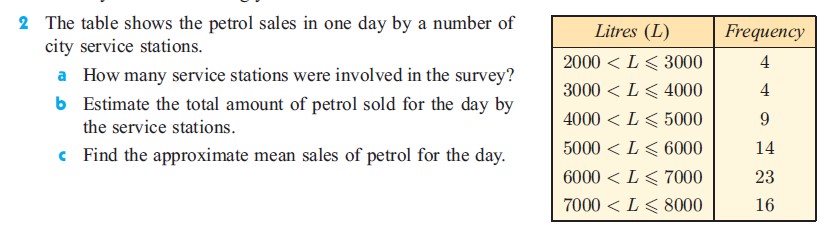
Based on the table below, find the mean number of pets.
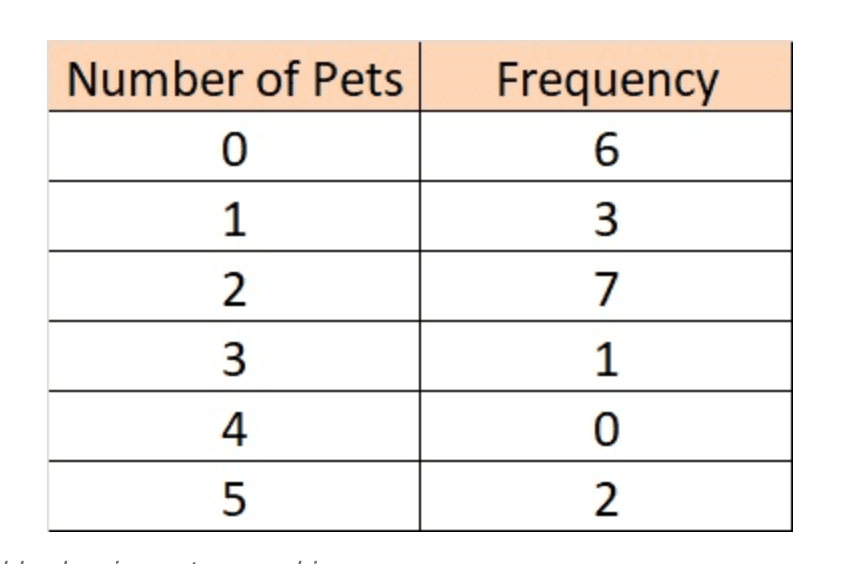
What is the median number of pets?
What is the mode for the number of pets.
What is the range for the number of pets?