Log in
Sign up for FREE
arrow_back
Library

Mitosis and Meiosis MCAS Review

star
star
star
star
star
Last updated almost 2 years ago
15 questions
Note from the author:
1
1
1
1
1
1
1
1
1
1
1
1
1
1
1
Review mitosis and meiosis review for the MCAS
Question 1
1.

Question 2
2.

Question 3
3.

Question 4
4.

Question 5
5.

Question 6
6.

Question 7
7.

Question 8
8.

Question 9
9.

Question 10
10.

Question 11
11.

Question 12
12.

Question 13
13.

Question 14
14.

Question 15
15.

Which of the following types of cells is a direct product of meiosis?
egg
muscle
nerve
skin
Which process is directly responsible for the formation of new root cells as a plant grows larger?
meiosis
mitosis
nitrogen fixation
osmosis
The diagram below show different stages in a plant cell cycle.
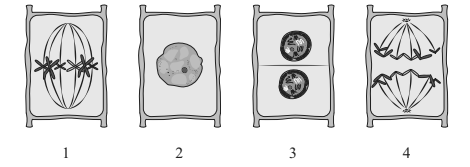


Which set of number lists the diagrams in the order in which a plant cell changes as it undergoes mitosis?
1, 2, 3, 4
1, 3, 2, 4
2, 4, 1, 3
2, 1, 4, 3
Strawberry plants can reproduce both sexually and asexually. Strawberry farmers use both kinds of reproduction, depending on the desired outcome.

In which of the following situations would a farmer most likely want the strawberry plants to reproduce sexually?
when developing new varieties of fruit
when making identical copies of a plant
when producing fruit that is all the same size
when growing many new plants from cuttings
Which of the following is a reason for DNA replication in skin cells?
to enable the skin cells to make more proteins
to produce identical daughter skin cells
to allow the skin cells to adapt to a changing environment
to ensure daughter skin cells will have higher genetic diversity
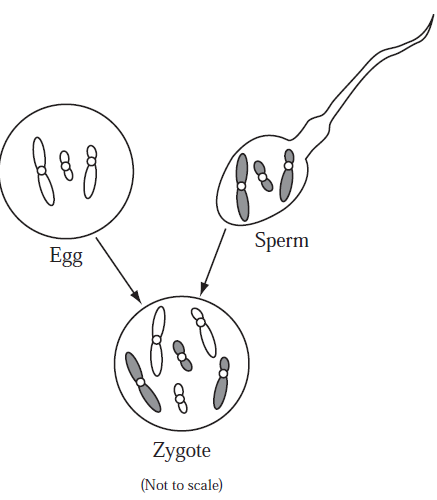
A biological process is represented in the diagram. Which of the following concepts is BEST illustrated by the diagram?
crossing over creates new genetic diversity in gametes
mitosis increases the number of chromosomes in zygote cells
in asexual reproduction, the offspring produced are genetically identical to the parent
in sexual reproduction, the offspring receive the same number of chromosomes from each parent
Because most nerve cells do not typically undergo mitosis, they are generally not capable of which of the following?
generating more nerve cells
producing enzymes
performing cellular respiration
transporting ions against a concentration gradient
Mice with the same parents can have different traits. Which of the following best explains how most of these differences occur?
Gametes join by binary fission.
Cells divide by asexual reproduction.
Spontaneous mutations occur during mitosis.
Genes assort independently during meiosis.
Which of the following is always part of normal sexual reproduction?
the male produces gametes by mitosis
an offspring looks identical to the parents at birth
the female carries only one fertilized egg at a time
an offspring receives half its chromosomes from each parent
The illustration below shows one chromosome pair in a zygote. The zygote was produced by sexual reproduction.


Assuming normal meiosis and fertilization occurred, which illustration shows the egg and sperm that produced this zygote?
An unfertilized egg cell has six chromosomes. After fertilization, how many chromosomes should the zygote have?
3
6
12
24
In a certain species of bat, females normally produce sex cells containing 22 chromosomes. After successful fertilization, how many chromosomes should be present in the zygote?
11
22
44
88
A body cell of a sand dollar has 52 chromosomes. How many chromosomes should a sand dollar gamete contain?
26
52
78
104
Which of the following normally results from meiosis in a human cell that contains 46 chromosomes?
an egg cell with 46 chromosomes
a liver cell with 23 chromosomes
a blood cell with 46 chromosomes
a sperm cell with 23 chromosomes
An egg cell in a gorilla contains 24 chromosomes. When the egg cell is fertilized, which of the following occurs?
The 24 original chromosomes replicate, resulting in 48 chromosomes in the fertilized egg.
The 24 original chromosomes split at the centromere, resulting in 48 chromosomes in the fertilized egg.
The nucleus of a sperm cell fuses with the nucleus of the original egg cell, resulting in 48 chromosomes in the fertilized egg.
The nucleus of another egg cell pairs with the nucleus of the original egg cell, resulting in 48 chromosomes in the fertilized egg