Move the tiles to show the difference between mitosis and meiosis
For growth and repair
Makes 2 cells
Makes 4 cells
Makes gametes
For sexual reproduction
Makes identical cells
Makes different cells
Mitosis
Meiosis
1 point
1
Question 2
2.
Which of the following types of cells is a direct product of meiosis?
1 point
1
Question 3
3.
Which process is directly responsible for the formation of new root cells as a plant grows larger?
1 point
1
Question 4
4.
The diagram below show different stages in a plant cell cycle.
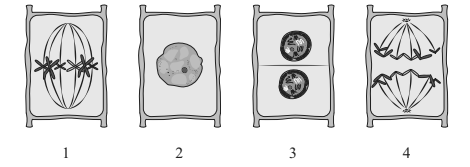
Which set of number lists the diagrams in the order in which a plant cell changes as it undergoes mitosis?
1 point
1
Question 5
5.
Strawberry plants can reproduce both sexually and asexually. Strawberry farmers use both kinds of reproduction, depending on the desired outcome.
In which of the following situations would a farmer most likely want the strawberry plants to reproduce sexually?
1 point
1
Question 6
6.
Which of the following statements describes how human traits are inherited?
1 point
1
Question 7
7.
Which of the following is a reason for DNA replication in skin cells?
1 point
1
Question 8
8.
A biological process is represented in the diagram. Which of the following concepts is BEST illustrated by the diagram?
1 point
1
Question 9
9.
Because most nerve cells do not typically undergo mitosis, they are generally not capable of which of the following?
1 point
1
Question 10
10.
Mice with the same parents can have different traits. Which of the following best explains how most of these differences occur?
1 point
1
Question 11
11.
A barely plant has 14 chromosomes in its diploid cells. At a particular stage in its life cycle, the barely plant produces haploid cells (gametes).
Identify the expected number of chromosomes in a haploid cell of a barley plant.
1 point
1
Question 12
12.
A barely plant has 14 chromosomes in its diploid cells. At a particular stage in its life cycle, the barely plant produces haploid cells (gametes).
Identify and generally describe the cellular process by which the haploid cells are produced.
1 point
1
Question 13
13.
A barely plant has 14 chromosomes in its diploid cells. At a particular stage in its life cycle, the barely plant produces haploid cells (gametes).
Describe what a barley plant uses the haploid cells for and explain why the cells must be haploid for this purpose.
1 point
1
Question 14
14.
Which of the following is always part of normal sexual reproduction?
1 point
1
Question 15
15.
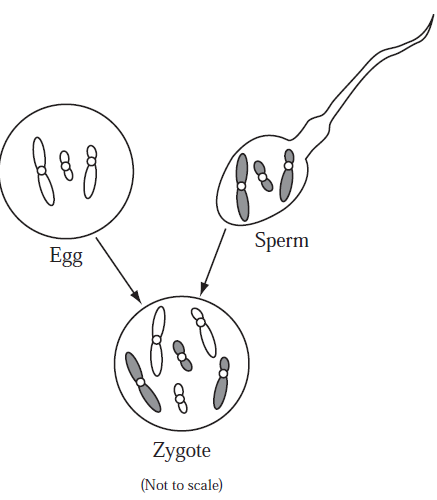
The illustration below shows one chromosome pair in a zygote. The zygote was produced by sexual reproduction.
Assuming normal meiosis and fertilization occurred, which illustration shows the egg and sperm that produced this zygote?
1 point
1
Question 16
16.
An unfertilized egg cell has six chromosomes. After fertilization, how many chromosomes should the zygote have?
1 point
1
Question 17
17.
In a certain species of bat, females normally produce sex cells containing 22 chromosomes. After successful fertilization, how many chromosomes should be present in the zygote?
1 point
1
Question 18
18.
A body cell of a sand dollar has 52 chromosomes. How many chromosomes should a sand dollar gamete contain?
1 point
1
Question 19
19.
Which of the following normally results from meiosis in a human cell that contains 46 chromosomes?
1 point
1
Question 20
20.
An egg cell in a gorilla contains 24 chromosomes. When the egg cell is fertilized, which of the following occurs?
1 point
1
Question 21
21.
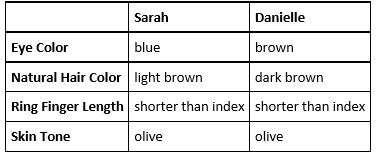
Sarah and her biological sister Danielle have some physical characteristics that are the same and some that are different, as shown in the table below.
Identify the molecule that stores the hereditary information for these characteristics in the chromosomes of every body cell.
1 point
1
Question 22
22.
Sarah and her biological sister Danielle have some physical characteristics that are the same and some that are different, as shown in the table below.
Identify the total number of chromosomes that should be in one of Sarah’s body cells and the number of chromosomes that should have been contributed by each biological parent.
1 point
1
Question 23
23.
Sarah and her biological sister Danielle have some physical characteristics that are the same and some that are different, as shown in the table below.
Explain the roles of meiosis and fertilization in achieving the chromosome numbers found in Sarah's body cell.
1 point
1
Question 24
24.
Sarah and her biological sister Danielle have some physical characteristics that are the same and some that are different, as shown in the table below.
Explain why Sarah and Danielle have some physical characteristics that are different from each other, even though they have the same biological parents.