Log in
Sign up for FREE
arrow_back
Library

MCAS Ecology Review (2023)

star
star
star
star
star
Last updated almost 2 years ago
20 questions
3
3
1
1
1
1
1
1
1
Question 1
1.

Draggable itemarrow_right_altCorresponding Item
arrow_right_alt
arrow_right_alt
arrow_right_alt
Question 2
2.

Draggable itemarrow_right_altCorresponding Item
arrow_right_alt
arrow_right_alt
arrow_right_alt
Question 3
3.

Question 4
4.

Question 5
5.

Question 6
6.

Question 7
7.

Question 8
8.

1
1
1
1
1
1
1
1
1
1
1
Question 20
20.

Match the vocabulary to the definition
Commensalism
Relationship where both organisms benefit
Parasitism
Relationship where one organism benefits and the other is neither helped nor harmed
Mutualism
Relationship where one organism harms another
Match the word with the definition
Carrying capacity
Amount of organisms that enter a population
Immigration
Amount of organisms that exit a population
Emigration
The maximum number of organisms that an area can support
Look at the food web below to answer the following question:

What would happen to the hawk population if there was a decrease in grouse population?

the hawk population will decrease
the hawk population will increase
the hawk population will remain the same
Determine how much energy is transferred to the ladybug, if plants contain 50,000 calories

5000
50,000
500
5
Remora fish can attach themselves to larger aquatic animals, such as whales. When the whales eat, the fish detach themselves and eat leftover scraps of food. These fish do not harm or help the whales.
What is the ecological relationship between the remora fish and the whales?
competition
commensalism
parasitism
predation
The Karner blue butterfly has been listed as an endangered species since 1992. Karner blue butterfly larvae feed only on wild lupine plants, which require a habitat with dry soil and exposure to direct sunlight.
Which of the following would be the best habitat for wild lupine that could help Karner blue butterfly populations recover?
a mountain top that is covered in snow
a river bank that was flooded by high water
an open area in a forest that was cleared by fire
an isolated area in a jungle that has many large trees
Which of the following statements best describes how an increase in the size of a mammal population could be related to a large surplus of food?
With an abundance of food, adults now outnumber predators.
With enough to eat, more females are healthy and the birth rate increases.
Since there is no competition for food, most individuals develop mutualistic relationships.
Since they no longer need to hunt, some males increase their territories and cause other males to move away.
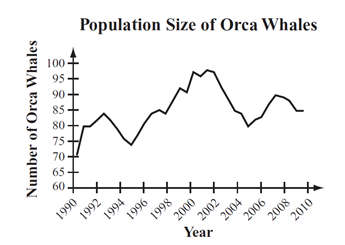
The graph below shows the estimated number of orca whales off the coast of Washington State over a 20-year period
Which of the following best explains the orca population changes between 1996 and 2002?
The number of orcas born was less than the number of orcas that died.
The number of orcas emigrating was higher than the number of orcas immigrating.
The total number of orca births and immigrants was more than the total number of orca deaths and emigrants.
The total number of orca births and deaths was greater than the total number of orca immigrants and emigrants.
Question 9
9.

Question 10
10.

Question 11
11.

Question 12
12.

Question 13
13.

Question 14
14.

Question 15
15.

Question 16
16.

Corn is one of the most important crops grown in the United States. Corn, which is mostly starch, is used as a food source for humans and other animals.

Humans first developed corn as a food crop over 8000 years ago. These early farmers produced corn by selectively breeding a wild grass called teosinte. The kernels of teosinte have a hard coating that makes them difficult for humans to eat. A key step in developing corn as a food crop was selecting individual plants that produced kernels without this coating so that they could more easily be used as a food source. The illustrations show the kernels on an ear of corn and the kernels on an ear of teosinte.
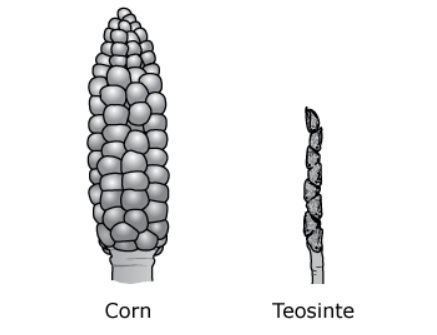


Corn and teosinte share the scientific name Zea mays. A single gene with two alleles codes for kernel coating (H) or no kernel coating (h) in Zea mays. To determine the inheritance pattern of this gene, scientists crossed teosinte that is true-breeding (homozygous) for kernel coating and domestic corn that is true-breeding for no kernel coating to produce offspring with partially formed kernel coatings. The three phenotypes and their genotypes are shown in the table.
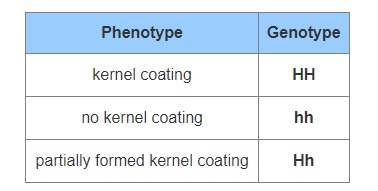


This question has three parts.

Corn plants produce their own food through a chemical process.
Question 17
17.

Question 18
18.

Question 19
19.

A major reservior for oxygen is the atmosphere. Which of the following processes adds oxygen to the atmosphere?
cellular respiration
combustion
decomposition
photosynthesis
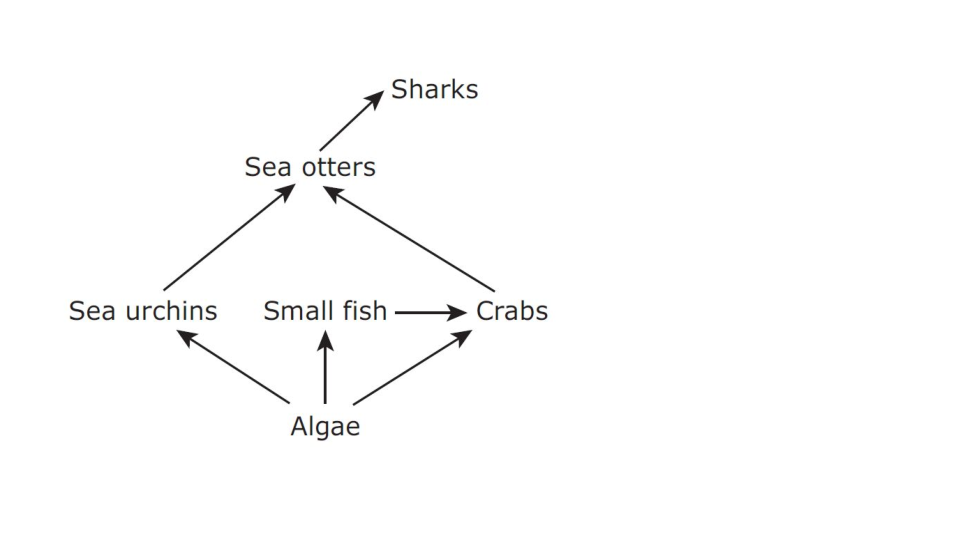
In this food web, which organism is both a primary and secondary consumer?
A. shark
B. sea urchin
C. sea otters
D. crabs
Determine if the following situation will lead to an increase or decrease in sea otter population.
A law passed that results in less fishing in the area
A. increase the sea otter population
B. decrease the sea otter population
Determine if the following situation will lead to an increase or decrease in sea otter population.
Chemical runoff from a factory kills small fish and crabs
A. increase the sea otter population
B. decrease the sea otter population
Determine if the following situation will lead to an increase or decrease in sea otter population.
Warmer ocean temperatures cause more algae in the area
A. increase the sea otter population
B. decrease the sea otter population
Determine if the following situation will lead to an increase or decrease in sea otter population.
Invasive species of sea star preys on sea urchins in the area
A. increase the sea otter population
B. decrease the sea otter population
Determine if the following situation will lead to an increase or decrease in sea otter population.
More sharks migrate to the area
A. increase the sea otter population
B. decrease the sea otter population
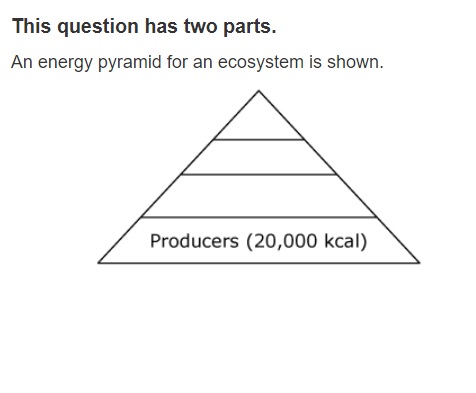
Based on the energy pyramid, how much energy would be stored in the tertiary consumers in this ecosystem?
A. 2000 kcal
B. 200 kcal
C. 20 kcal
D. 2 kacl
Select two factors that are responsible for the inefficiency of energy transfer from one trophic level to another.
A. carnivores obtain energy from consumers only
B. organisms lose energy to the environment as heat
C. some parts are not eaten by consumers
D. omnivores get energy from producers and consumers
Which equation correctly shows how the chemical reaction corn plants use to make energy?
A. 6CO2 + 6O2 --> C6H12O6 + 6H2O
B. 6H2O + 6CO2--> C3H8O3 + 6O2
C. 6H2O + 6CO2 --> C6H12O6 + 6O2
D. 6O2 + C6H12O6 --> 6CO2 + 6H2O
Identify the source that provides energy for the chemical reaction for photosynthesis.
A. glucose
B. sunlight
C. carbon dioxide
D. methane
How do human cells use the products from photosynthesis?
A. For osmosis
B. For cellular respiration
C. For facilitated diffusion
D. For fermentation