5/10 FA 7.5 Recursive Sequences
star
star
star
star
star
Last updated about 3 years ago
14 Nsɛmmisa
Hyɛ no nsow a efi ɔkyerɛwfo no hɔ:
Intro
Learn It
Explore It
Learn It

Practice It
Ɛhia
25
The End!
OBJECTIVES & STANDARDS
Math Objectives
Write recursive formula for a given sequence
Use a recursive formula to model debt repayment
Common Core Math Standards
Personal Finance Objectives
Calculate how a debt amount decreases over time, given the interest rate and regular payment amounts
National Standards for Personal Financial Education
Managing Credit
1b: Compare the cost of borrowing $1,000 using consumer credit options that differ in rates and fees
OBJECTIVES & STANDARDS
Math Objectives
Write recursive formula for a given sequence
Use a recursive formula to model debt repayment
Common Core Math Standards
Personal Finance Objectives
Calculate how a debt amount decreases over time, given the interest rate and regular payment amounts
National Standards for Personal Financial Education
Managing Credit
1b: Compare the cost of borrowing $1,000 using consumer credit options that differ in rates and fees
INTERACTIVE: Tower of Hanoi
The Tower of Hanoi is a mathematical puzzle that has inspired many myths about its origins. According to one version, priests were tasked with solving this puzzle using 64 disks and when the puzzle was completed, the world would end. Explore this classic puzzle to see what patterns you can discover!
Complete the puzzle using 4 disks, and then 5 disks. Record any observations below, like how many moves you took or what patterns you noticed.
Recursive Sequences
As you add more disks to the Tower of Hanoi, you can use the previous solutions that had fewer disks to help you figure out the puzzle. The pattern we discovered for the minimum number of moves is an example of a recursive sequence.
Sequence: a list of numbers
Term: a number in a sequence
Recursive sequence: a sequence in which a term is defined using a previous term.
Example
Here is a sequence: 11, 13, 15, 17, 19, 21…
We could define this sequence recursively by saying it starts with 11 and each term is 2 greater than the previous term.
Write a sequence of numbers where the first term is 5 and each term is 2 times the previous term.
Describing Sequences
Let’s practice describing recursive sequences and finding patterns in them.
Given the sequence: 20, 10, 5, 2.5, 1.25, 0.625…
What is the 4th Term?
Describe the pattern used to get from one term to the next.
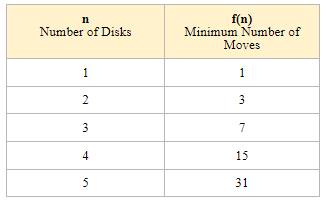
Given the sequence f(n) below.
What is the 3rd term?
What is the 5th term?
Describe the pattern used to get from one term to the next.
The Tower of Hanoi
Let’s write a recursive formula for the Tower of Hanoi problem in the Intro.
Write a recursive formula for the sequence of minimum moves in the Tower of Hanoi. You can use this video walkthrough to guide you through the process.
Check your formula by using f(4) to find f(5). Show your work.
ACTIVITY: DESMOS LINK: MOVE: Matching Recursive Sequences
Let’s practice matching recursive formulas with their sequences. 20 POINTS
This link completes 3 desmos in 1:
1. Card Sort
2. Application Level 1
3. Application Level 2
Write a brief reflection of the desmos activities and I will transfer your Desmos grade here.
Complete the puzzle using 3 disks. Try to complete it in the minimum number of moves possible (7). Did you complete it in less than 7 moves?
Patrice says she used the solution for 3 discs to help her solve the puzzle for 4 discs. How could she do that?
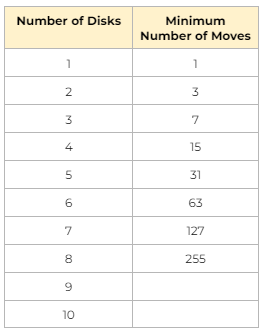
The table below shows the minimum number of moves required to solve the puzzle with each number of disks. Complete the last two rows: How many moves would it take to complete the puzzle with 9 disks?
Describe the pattern for the number of moves as required the number of disks increases. If you prefer, you can draw a representation instead.