5/12 FA 7.7 Credit Cards
star
star
star
star
star
Last updated over 2 years ago
38 questions
Note from the author:
OBJECTIVES & STANDARDS
Math Objectives
- Solve multi-step word problems
- Use a recursive sequence to model debt repayment
Common Core Math Standards
- Link to all CCSS Math
- CCSS.HSA.SSE.A.1
- CCSS.HSF.BF.A.1.A
Personal Finance Objectives
- Explain why a person may need or want a credit card
- Explain how a credit card works in terms of making purchases, calculating interest, and managing payments
- Read a Schumer box
National Standards for Personal Financial Education
Managing Credit
- 1a: Describe how credit card grace periods, methods of interest calculation, and fees affect borrowing costs
OBJECTIVES & STANDARDS
Math Objectives
- Solve multi-step word problems
- Use a recursive sequence to model debt repayment
Common Core Math Standards
- Link to all CCSS Math
- CCSS.HSA.SSE.A.1
- CCSS.HSF.BF.A.1.A
Personal Finance Objectives
- Explain why a person may need or want a credit card
- Explain how a credit card works in terms of making purchases, calculating interest, and managing payments
- Read a Schumer box
National Standards for Personal Financial Education
Managing Credit
- 1a: Describe how credit card grace periods, methods of interest calculation, and fees affect borrowing costs
Intro
QUESTION OF THE DAY: What do cardholders fear most when using a credit card?
Write your answer to the questions 1 & 2 below. Then, compare your answers to the answer on the second slide. Finally, answer question 3 below.
Required
1
For you, personally, what would be your biggest concern about opening and using a credit card?
Required
1
When Americans as a whole are surveyed, what do you think they fear most about credit card usage?
Required
1
On slide 2, how would you categorize the difference between the #1 fear and the entire rest of the list (fears 2-5)?
Learn it
VIDEO: Why Do We Use Credit Cards?
As you saw in the INTRO, many Americans fear their own overspending or money habits could make incurring debt on credit cards dangerous. Now, watch this clip from a longer video to see three reasons it might be a GOOD idea to open a credit card.
Required
1
If one reason to open a credit card is to build credit for bigger, larger loans you might need in the future, does that mean you shouldn’t bother with a credit card if you don’t ever anticipate needing a car loan or mortgage? What do you think?
Required
1
How is a credit card actually more secure than a debit card?
Required
1
Lance has a credit card that gives him 1% cash back on all his purchases, so he’s thinking it's the perfect time to charge a bunch of big ticket items he can’t currently afford. He’ll get tons of rewards! What’s the flaw in Lance’s strategy?
Explore It
VIDEO: Schumer Box
ACTIVITY: FINE PRINT: Schumer Box
If you were going to open a credit card account, you’d need to know what to look for (besides reward programs) in a “good card.” The first place to look is at a credit card’s Schumer box, which summarizes the terms of that specific card. Watch this video on what you can expect in a Schumer box, and then complete the FINE PRINT activity.
Part I: Read The Fine Print
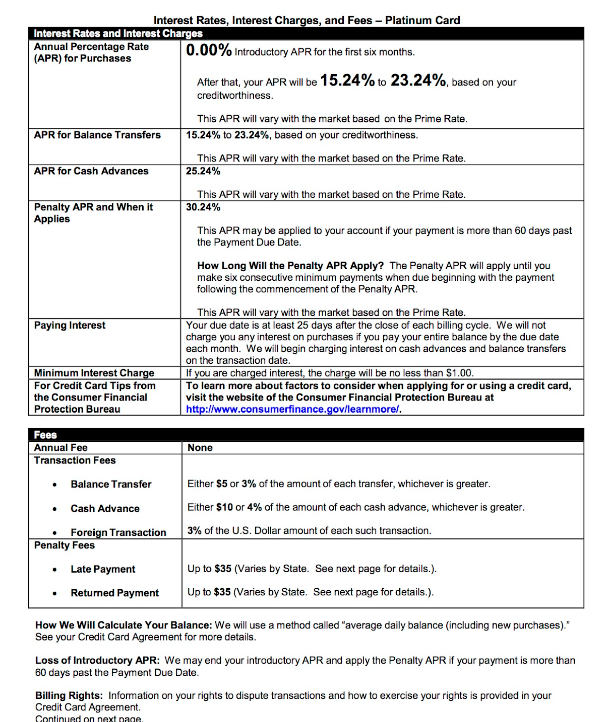
Analyze this sample Schumer Box and answer the questions that follow.
1
What is the APR (interest rate) on this card for Purchases made during the first six months that a cardholder has this card?- 0%
- 15.24%
- 23.24%
- 25.24%
What is the APR (interest rate) on this card for Purchases made during the first six months that a cardholder has this card?
- 0%
- 15.24%
- 23.24%
- 25.24%
1
Jordan gets confused and uses his credit card to get $40 in cash from an ATM instead of using his debit card. Based on this agreement, what is the impact of this decision?- There is no impact since credit card and debit card terms tend to be the same.
- A $10 cash advance fee will be charged ONLY.
- An A.P.R. of 25.24% will be applied on the $40 until it is paid back ONLY.
- A $10 cash advance fee will be charged AND an A.P.R. of 25.24% will be applied on the $40 until it is paid back.
Jordan gets confused and uses his credit card to get $40 in cash from an ATM instead of using his debit card. Based on this agreement, what is the impact of this decision?
- There is no impact since credit card and debit card terms tend to be the same.
- A $10 cash advance fee will be charged ONLY.
- An A.P.R. of 25.24% will be applied on the $40 until it is paid back ONLY.
- A $10 cash advance fee will be charged AND an A.P.R. of 25.24% will be applied on the $40 until it is paid back.
1
Assume that Louisa carried an average balance of $1,000 from her credit card purchases over the past year. The A.P.R. on her credit card for the past year was 19.99%. Approximately how much interest would Louisa have paid over the course of the year?- She would have paid interest charges of $2,000.
- She would have paid interest charges of $20.
- The credit card company would have paid Louisa $20.
- She would have paid interest charges of $200.
Assume that Louisa carried an average balance of $1,000 from her credit card purchases over the past year. The A.P.R. on her credit card for the past year was 19.99%. Approximately how much interest would Louisa have paid over the course of the year?
- She would have paid interest charges of $2,000.
- She would have paid interest charges of $20.
- The credit card company would have paid Louisa $20.
- She would have paid interest charges of $200.
1
After the introductory period, all consumers who have this Platinum Card will...- Pay the same A.P.R.
- Qualify for an A.P.R. based on their creditworthiness
- Pay the Penalty A.P.R. of 30.24%
- Be charged an Annual Fee
After the introductory period, all consumers who have this Platinum Card will...
- Pay the same A.P.R.
- Qualify for an A.P.R. based on their creditworthiness
- Pay the Penalty A.P.R. of 30.24%
- Be charged an Annual Fee
1
As you will see from this agreement, there are different A.P.R.s applied based on how the credit card is used. Which transaction type has the highest A.P.R.?- A.P.R. triggered by a late payment
- A.P.R. applied on Purchases made during the Introductory Period
- A.P.R. applied to a Balance Transfer
- A.P.R. applied to a Cash Advance
As you will see from this agreement, there are different A.P.R.s applied based on how the credit card is used. Which transaction type has the highest A.P.R.?
- A.P.R. triggered by a late payment
- A.P.R. applied on Purchases made during the Introductory Period
- A.P.R. applied to a Balance Transfer
- A.P.R. applied to a Cash Advance
1
Devon forgets to pay his credit card bill for three months. Which of the following statements is TRUE?- A Late Payment fee will not be charged to his account.
- A Balance Transfer fee will be charged to his account.
- His A.P.R. (interest rate) will rise to 30.24% until he pays back the amount he owes.
- His A.P.R. (interest rate) will rise to 30.24% and stay there until he makes six consecutive minimum payments.
Devon forgets to pay his credit card bill for three months. Which of the following statements is TRUE?
- A Late Payment fee will not be charged to his account.
- A Balance Transfer fee will be charged to his account.
- His A.P.R. (interest rate) will rise to 30.24% until he pays back the amount he owes.
- His A.P.R. (interest rate) will rise to 30.24% and stay there until he makes six consecutive minimum payments.
1
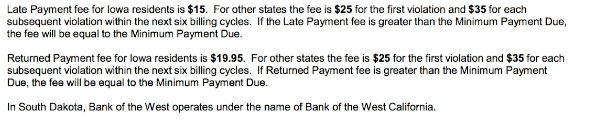
Tamara goes on a spring break trip with her school to visit historical sites in Italy. She purchases $200 of souvenirs while on the trip. She gets back to the U.S. and opens her credit card statement. What will be the balance in her account, assuming she had a zero balance prior to making these purchases and didn't make any other purchases?- $0.00
- $200.00
- $206.00
- $6.00
Tamara goes on a spring break trip with her school to visit historical sites in Italy. She purchases $200 of souvenirs while on the trip. She gets back to the U.S. and opens her credit card statement. What will be the balance in her account, assuming she had a zero balance prior to making these purchases and didn't make any other purchases?
- $0.00
- $200.00
- $206.00
- $6.00
1
All of the following actions lead to the payment of a credit card fee EXCEPT...- Using your credit card to get cash from an ATM.
- Using your credit card to purchase items in a foreign country.
- Paying your credit card bill ten days after the Due Date.
- Paying your credit card bill in full and on time every month.
All of the following actions lead to the payment of a credit card fee EXCEPT...
- Using your credit card to get cash from an ATM.
- Using your credit card to purchase items in a foreign country.
- Paying your credit card bill ten days after the Due Date.
- Paying your credit card bill in full and on time every month.
1
Josephine decided to get this Platinum card since she saw the ads touting the "0% A.P.R. Platinum. Sign Up Now." After reading this agreement, which of the following statements is TRUE?- Her A.P.R will change after six months and be between 15.24% to 23.24% assuming that she has been making on-time payments during those first six months.
- She will not pay interest on any of the purchases she makes on this credit card for the first year.
- All her purchases on this credit card are FREE for the first six months.
- All her purchases on this card are FREE
Josephine decided to get this Platinum card since she saw the ads touting the "0% A.P.R. Platinum. Sign Up Now." After reading this agreement, which of the following statements is TRUE?
- Her A.P.R will change after six months and be between 15.24% to 23.24% assuming that she has been making on-time payments during those first six months.
- She will not pay interest on any of the purchases she makes on this credit card for the first year.
- All her purchases on this credit card are FREE for the first six months.
- All her purchases on this card are FREE
1
Which of the following statements is TRUE?- Assume that Josie has had this credit card for a year. The A.P.R. on her card will remain the same as long as she has the card.
- If Josie misses a payment during the Introductory Period, her late payment fee will be waived for this period since she is a new customer.
- Assume that Josie only uses her credit card to make purchases. She pays the balance on her credit card in full and on time every month. As a result, she pays no interest to the credit card company.
- Josie pays an annual fee to use this credit card.
Which of the following statements is TRUE?
- Assume that Josie has had this credit card for a year. The A.P.R. on her card will remain the same as long as she has the card.
- If Josie misses a payment during the Introductory Period, her late payment fee will be waived for this period since she is a new customer.
- Assume that Josie only uses her credit card to make purchases. She pays the balance on her credit card in full and on time every month. As a result, she pays no interest to the credit card company.
- Josie pays an annual fee to use this credit card.
5
Part II: What Did You Learn?Use what you learned from analyzing the credit card agreement to answer this question.
List three pieces of information listed in a credit card agreement that you believe are important to review before signing up for a credit card. Explain why you chose these three areas/fees.
Part II: What Did You Learn?
Use what you learned from analyzing the credit card agreement to answer this question.
List three pieces of information listed in a credit card agreement that you believe are important to review before signing up for a credit card. Explain why you chose these three areas/fees.
Learn It
ARTICLE: How Is Credit Card Interest Calculated?
The Schumer box lays out the all-important costs of your credit card: What are the flat fees? And what is the interest rate charged? But, HOW is that interest calculated when you’re buying new stuff all month long? It’s a multi-step process, which you can read about here before answering the questions that follow.
Albert has a credit card with an APR of 20.7% and the following daily balances for this billing period:
Days 1-3: $50
Days 4-10: $100
Days 11-25: $175
Days 26-30: $225
Required
1
What is Albert’s daily rate? Round to the nearest ten thousandth.
Required
1
What is his average daily balance?**TEACHER TIP: Students may mistakenly think Days 1-3 is 2 days, when really it’s 3 (and so forth for each range).
What is his average daily balance?
**TEACHER TIP: Students may mistakenly think Days 1-3 is 2 days, when really it’s 3 (and so forth for each range).
Required
1
Assuming Albert doesn’t pay it off in full, how much interest is Albert charged for this billing period?_______
Required
1
Before making his minimum monthly payment, what would Albert’s total credit card balance be for this billing period?_______
Required
1
Your calculations calculate interest only for the entire month. Most credit card companies compound interest daily. What effect would that have on Albert’s total balance for this billing period?
VIDEO: Credit Card Debt Explained
OK, in the previous problem, you saw that Albert’s interest actually wasn’t all that high, right? Why is it the case that we’re constantly hearing about the dangers of credit card debt? How do you prevent getting sucked in? Watch this video to find out.
Required
1
What is the #1 reason you should plan to pay your full credit card balance every single month?
Required
1
If paying the entire balance off every month is the most financially advantageous way to use a credit card, why would anyone charge MORE than they can pay off in a given month?
Required
1
Explain how your credit limit (also known as your line of credit) and your credit card balance impact one another.
Required
1
Let’s say you can only afford to pay the minimum monthly payment every month. Will you ever pay your balance back down to $0? Explain.
Required
1
If you owed the $3500 suggested in the video and you could not afford to pay the full balance in just one month, what would you do to get out of debt?
Required
1
What is the difference between a traditional credit card and a predatory lender?
MATH: The Cost of Minimum Payments
Paying the minimum on a credit card can feel a bit like running on a treadmill - you will keep chasing that balance but won’t get very far! In this activity, you will learn how compound interest works by comparing monthly interest and credit card balances to see just how costly making only the minimum payments can be.

Part I: Interactive Examples
These two videos provide information on how to calculate the cost of minimum payments. Follow your teacher’s directions on which video(s) you should watch or skip ahead to the next section.
Learn it: Paying the minimum payment
Practice it: Paying ABOVE the minimum payment
MATH: The Cost of Minimum Payments
Part II: Practice Problem
Complete the following practice problem to fill in the Interest, Monthly Payment, and Balance for each character on questions 29-31.
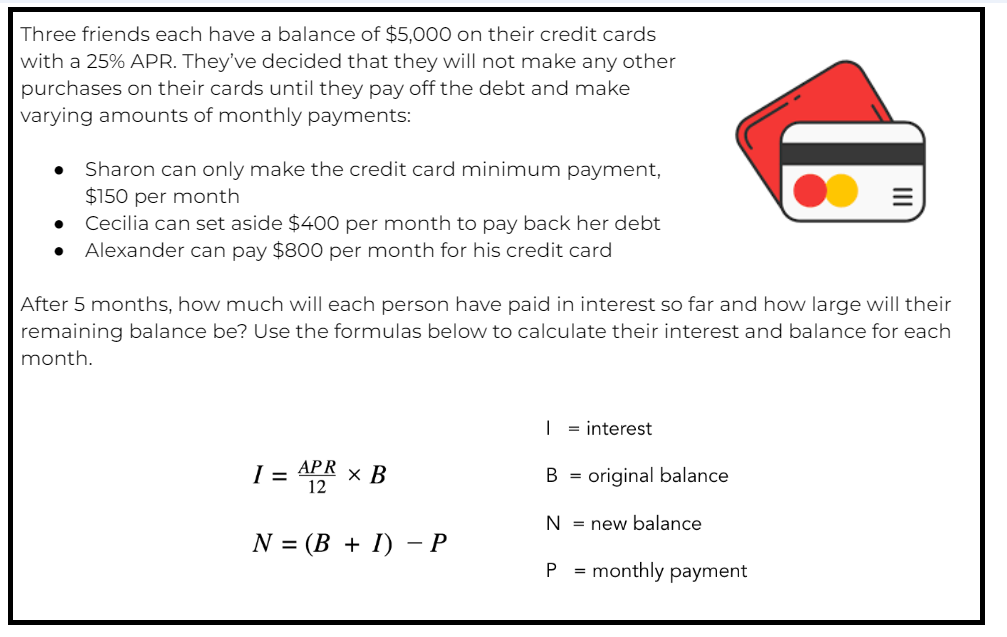
Use this amorization calculator to get your answers for 29-31. *Hint use 30 years, then add extra payments a month to get the total for each scenario.
https://www.bankrate.com/mortgages/amortization-calculator/
16
Sharon- Pays $150/Month
Month/ Monthly
Billing Cycle Interest Pmt Balance
1 _______ _______ _______
2 _______ _______ _______
3 _______ _______ _______
4 _______ _______ _______
5 _______ _______ _______
Total: _______
*Only enter numbers, no $ or commas: Ex. 200 or 200.05
16
Celia- Pays $400/Month
Month/ Monthly
Billing Cycle Interest Pmt Balance
1 _______ _______ _______
2 _______ _______ _______
3 _______ _______ _______
4 _______ _______ _______
5 _______ _______ _______
Total: _______
*Only enter numbers, no $ or commas: Ex. 200 or 200.05
16
Alexander- Pays $800/Month
Month/ Monthly
Billing Cycle Interest Pmt Balance
1 _______ _______ _______
2 _______ _______ _______
3 _______ _______ _______
4 _______ _______ _______
5 _______ _______ _______
Total: _______
*Only enter numbers, no $ or commas: Ex. 200 or 200.05
Required
1
What was each character’s total interest and balance?
Character Total Interest Balance
Sharon _______ _______
Cecilia _______ _______
Alexander _______ _______
Required
1
Graph the data from question 32 below.
Required
1
Explain why it’s more costly to only pay the minimum payment amount for a credit card.
Required
1
What advice might you give these 3 friends?
Exit Ticket
Required
1
Celeste uses a credit card to buy a new suitcase for an upcoming trip. Dory buys the same suitcase but uses her debit card instead. Which statement describes how these two actions differ?- Dory’s purchase will be safer because it’s tied directly to her bank account
- Dory’s purchase will either help or hurt her efforts to build credit, depending on how responsibly she pays her bill
- Celeste’s purchase will be more expensive, because she will automatically be charged interest as soon as she makes the purchase
- Celeste’s purchase could earn her rewards or perks toward her trip, while Dory’s purchase will not
Celeste uses a credit card to buy a new suitcase for an upcoming trip. Dory buys the same suitcase but uses her debit card instead. Which statement describes how these two actions differ?
- Dory’s purchase will be safer because it’s tied directly to her bank account
- Dory’s purchase will either help or hurt her efforts to build credit, depending on how responsibly she pays her bill
- Celeste’s purchase will be more expensive, because she will automatically be charged interest as soon as she makes the purchase
- Celeste’s purchase could earn her rewards or perks toward her trip, while Dory’s purchase will not
Required
1
Which piece of information would you expect to find on your credit card’s Schumer box?- The amount of money you owe next month
- The range of interest rates you will be charged if you carry a balance
- The date your next payment is due
- The terms and agreements on how the credit card perks program works
Which piece of information would you expect to find on your credit card’s Schumer box?
- The amount of money you owe next month
- The range of interest rates you will be charged if you carry a balance
- The date your next payment is due
- The terms and agreements on how the credit card perks program works
Required
1
Akiva’s credit card APR is 22.9%. How will that be used to calculate the interest added to Akiva’s credit card bill?- Multiply every purchase by 22.9% to determine the total interest for the month
- Multiply his average daily balance by 22.9% to determine the interest for the month
- Multiply his total bill at the end of the year by 22.9% to determine his interest for the year
- Multiply his average daily balance by his daily interest rate (22.9%/365) to determine his interest for the day
Akiva’s credit card APR is 22.9%. How will that be used to calculate the interest added to Akiva’s credit card bill?
- Multiply every purchase by 22.9% to determine the total interest for the month
- Multiply his average daily balance by 22.9% to determine the interest for the month
- Multiply his total bill at the end of the year by 22.9% to determine his interest for the year
- Multiply his average daily balance by his daily interest rate (22.9%/365) to determine his interest for the day