Construct an explanation based on evidence to illustrate the role of nuclear fusion in the life cycle of a star.
Essential HS.E2U1.16
Construct an explanation of how gravitational forces impact the evolution of planetary motion, structure, surfaces, atmospheres, moons, and rings.
Essential HS.E2U1.17
Construct an explanation of the origin, expansion, and scale of the universe based on astronomical evidence.
Required
1 point
1
Question 1
1.
Briefly state the main reason that most scientists rejected Wegener's hypothesis when he first proposed Continental Drift?
Required
3 points
3
Question 2
2.
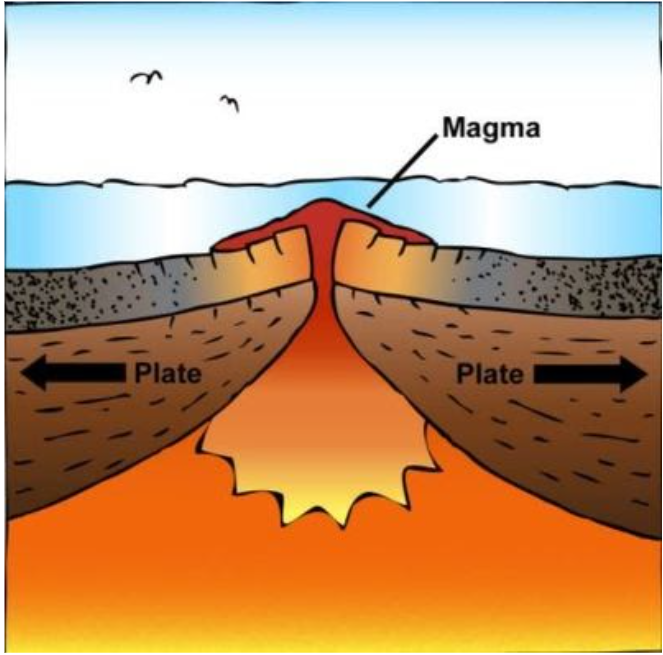
Using jargon (terms specific to this type of science) describe what is happening in the image below. State a minimum of 3 supporting details.
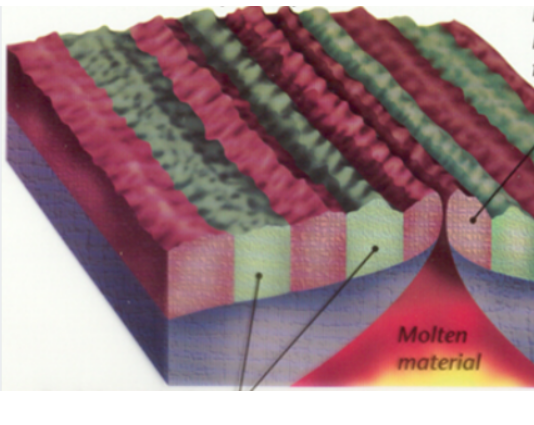
Required
1 point
1
Question 3
3.
Draw an image that represents Newton's Law of Gravitational Force. Be sure to (1.) label all of the parts, (2.) show all necessary arrows appropriately, and (3) contain enough information that you would be able to solve the problem. Do NOT solve the problem.
Required
3 points
3
Question 4
4.
Explain how activities of humans have impacted the rate at which climate change is happening. State at least 3 supporting details.
Required
3 points
3
Question 5
5.
Make comparisons between the solar nebula theory to that of the genesis (beginning) of a new star? Use jargon (specific terms for this area of science) appropriately in your answer.
Required
1 point
1
Question 6
6.
Two balls have their centers 5.0 m apart. One ball has a mass of 3.5 kg. The other has a mass of 7.6 kg. What is the gravitational force between them? Take a picture of your work and upload the picture. Also turn in your work to your instructor.
Required
2 points
2
Question 7
7.
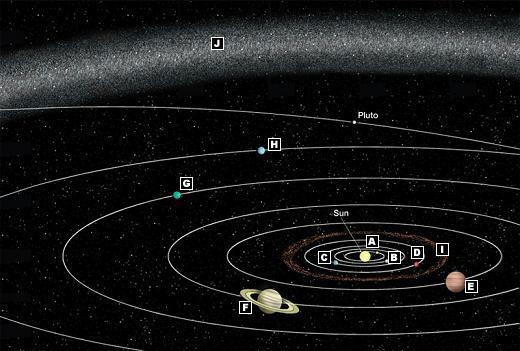
Match the letter to the planet's name.
A
B
C
D
E
F
G
H
Mercury
Mars
Jupiter
Venus
Uranus
Neptune
Earth
Saturn
Required
1 point
1
Question 8
8.
Which statement(s) about the heliocentric and geocentric models are correct. Select all that apply
Required
1 point
1
Question 9
9.
The Solar Nebula collapsed on itself after circling at high velocity, creating enormous solar winds that gave way to which of the following features of the universe?
Required
3 points
3
Question 10
10.
Compare and contrast Jovian and Terrestrial Planets
Jovian
Terrestrial
Atmospheres of these planet's are distinct and do not blend into the planet's surfaces.
Typically has multiple moons and can have rings.
After the collapse of the solar nebula, these landed furthest from the sun.
Mostly ice, rocks, and light weight gasses like hydrogen and helium.
These planet's cores are made of molten metal that are very hot.
These planets are smaller than the others.
Required
1 point
1
Question 11
11.
If the mass of a planet near the Sun were doubled, the force of attraction would __________.
Required
1 point
1
Question 12
12.
According to Kepler's laws, which of the following statements is true?
Required
1 point
1
Question 13
13.
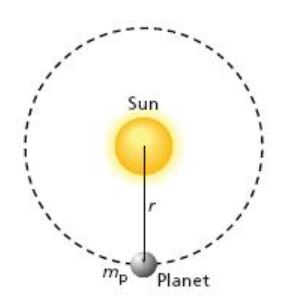
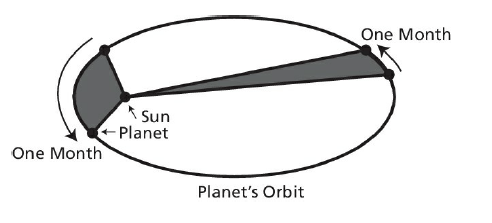
If the radius of the planet's orbit were doubled in the diagram below, what effect would it have on its period of orbit?
Required
1 point
1
Question 14
14.
The time it takes a planet to complete one revolution is called the _______.
Required
1 point
1
Question 15
15.
How do Kepler’s laws of planetary motion compare to Newton’s laws of motion and Newton’s law of universal gravitation?
Required
1 point
1
Question 16
16.
Uranus takes 84.0 earth years to orbit the Sun. Determine the average distances from the sun for this planet. SHOW YOUR WORK
Required
1 point
1
Question 17
17.
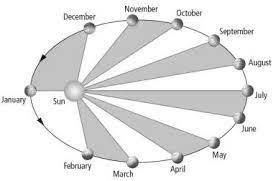
The drawing below shows Earth's orbit. In this case, the twelve positions are each exactly 30 days apart. Comparing the arc of September to October the arc from December to January the
Required
1 point
1
Question 18
18.
Because of its changing proximity to the Sun, which property does Kepler's Second Law of Planetary Motion predict will change during a planet's orbit?
Required
1 point
1
Question 19
19.
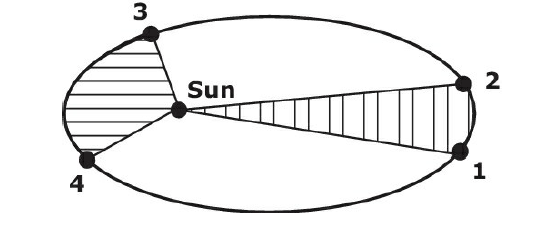
The diagram below shows four points along Earth's orbit as it revolves around the Sun. The shaded area in the section bounded by points 1 and 2 is the same as the shaded area in the section bounded by Points 3 and 4.
Which statement accurately compares the conditions at these four points?
Required
1 point
1
Question 20
20.
Which statement is a direct implication of Kepler's Second Law of Planetary Motion?
Required
1 point
1
Question 21
21.
In this drawing, a planet is orbiting around the Sun. How does Newton’s universal gravitation affect the movement of the planet as it approaches the Sun?
Required
1 point
1
Question 22
22.
Which of the following describes the relationship between Kepler's first law and Newton's law of gravitation.
Required
1 point
1
Question 23
23.
Given the following information, calculate the eccentricity Planet QRZTA's orbit. The mathematically calculated foci is 15 kilometers from the sun. The minor axis of the orbit is 20 kilometers and the major axis is 50 kilometers.
Required
1 point
1
Question 24
24.
Nuclear fission involves
Required
1 point
1
Question 25
25.
Why does nuclear fusion require high pressures and temperatures?
Required
7 points
7
Question 26
26.
Match the following to the correct nuclear reaction:
Nuclear Fission
Nuclear Fusion
Heavy nuclei splitting into two lighter ones
Provides a greater energy output
Radioactive waste byproducts
Helium as a byproduct
Occurs in Stars and the Sun
Controlled energy
Combining lighter nuclei together
Required
1 point
1
Question 27
27.
Do all stars make energy through fusion?
Required
1 point
1
Question 28
28.
Which reaction does not occur naturally?
Required
1 point
1
Question 29
29.
Isotopes are...
Required
1 point
1
Question 30
30.
What isotope(s) are used during stellar fusion to form the byproduct?
Required
1 point
1
Question 31
31.
The main sequence of a star is an important part of a star's life cycle because...
Required
4 points
4
Question 32
32.
List the order of the life cycle of an average size star
white dwarf
red giant
planetary nebula
stellar nebula
Phase 1
Phase 2
Phase 3
Phase 4
Required
1 point
1
Question 33
33.
A young star that has just started the fusion of hydrogen is called a ____________________.
Required
4 points
4
Question 34
34.
Match the description with the stage
Protostar
Main sequence
Red Giant
Neutron star
Collection of gas, dust and molecules
All parts of the atom explodes leaving only neutrons behind
Core temperature and pressure is high enough to initiate nuclear fusion
core collapses and outer shell sheds
Required
4 points
4
Question 35
35.
Match the process with the correct star cycle
Massive Star Cycle
Average Star Cycle
Supernova
White Dwarf
Neutron Star
Red Giant
Required
1 point
1
Question 36
36.
Which type of tectonic plates go under other tectonic plates?
Required
1 point
1
Question 37
37.
Drilling samples revealed that rock samples taken farther from a mid-ocean ridge are
Required
1 point
1
Question 38
38.
When continental plates collide what landform is made?
Required
1 point
1
Question 39
39.
Rocks on the sea-floor that lie in a pattern, show a record of the reversals of
Required
1 point
1
Question 40
40.
Magnetic stripes are ____________ on opposite sides of the mid ocean ridge.
Required
1 point
1
Question 41
41.
What helped the scientists to figure out that seafloor is not flat?
Required
1 point
1
Question 42
42.
What broke apart to form the current continents?
1 point
1
Question 43
43.
What were Wegner's lines of evidence? Select ALL that apply
Required
1 point
1
Question 44
44.
Name the type of boundary seen in the diagram.
Required
1 point
1
Question 45
45.
Which gases contribute to green house effect? Select all that apply
Required
1 point
1
Question 46
46.
As the human population grows, what happens to our natural-resource requirements?
Required
1 point
1
Question 47
47.
One reason why people should be aware of the impact of their actions on the environment is that...
Required
1 point
1
Question 48
48.
Human Activity that would have a negative impact on the Earth includes which of the following?
Required
1 point
1
Question 49
49.
Which of the following would be considered a renewable resource? Select ALL that apply.
Required
1 point
1
Question 50
50.
What is a positive for increased human population?