Homework - Air pollution

Last updated 11 months ago
4 questions
Note from the author:
https://discoveringantarctica.org.uk/wp-content/uploads/2015/11/9.-ozone.pdf
As the human population grows, people use more energy to heat and cool homes; to fuel cars, airplanes, and other forms of transportation; and to produce energy. This energy use contributes to air pollution that affects the composition and viability of the atmosphere. The contamination of air by harmful substances including gases and smoke is called air pollution. Types of air pollution including smog, chlorofluorocarbons (CFCs), particulate matter, and acid precipitation.

Photochemical smog
The brownish haze in the sky pictured in the right image on the photo below is photochemical smog. Photochemical smog is caused when Nitrogen and carbon compounds are released when fossil fuels are burned to provide energy for vehicles and power plants. These compounds react in sunlight and form other substances. One of these substances is ozone. Ozone close the Earth's surface makes air difficult to breathe. It can also damage the tissues of plants and animals.

While ozone in the lower atmosphere is harmful, ozone high in the atmosphere in the ozone layer helps protect living things from the Sun's ultraviolet (UV) radiation.

1
CFCs
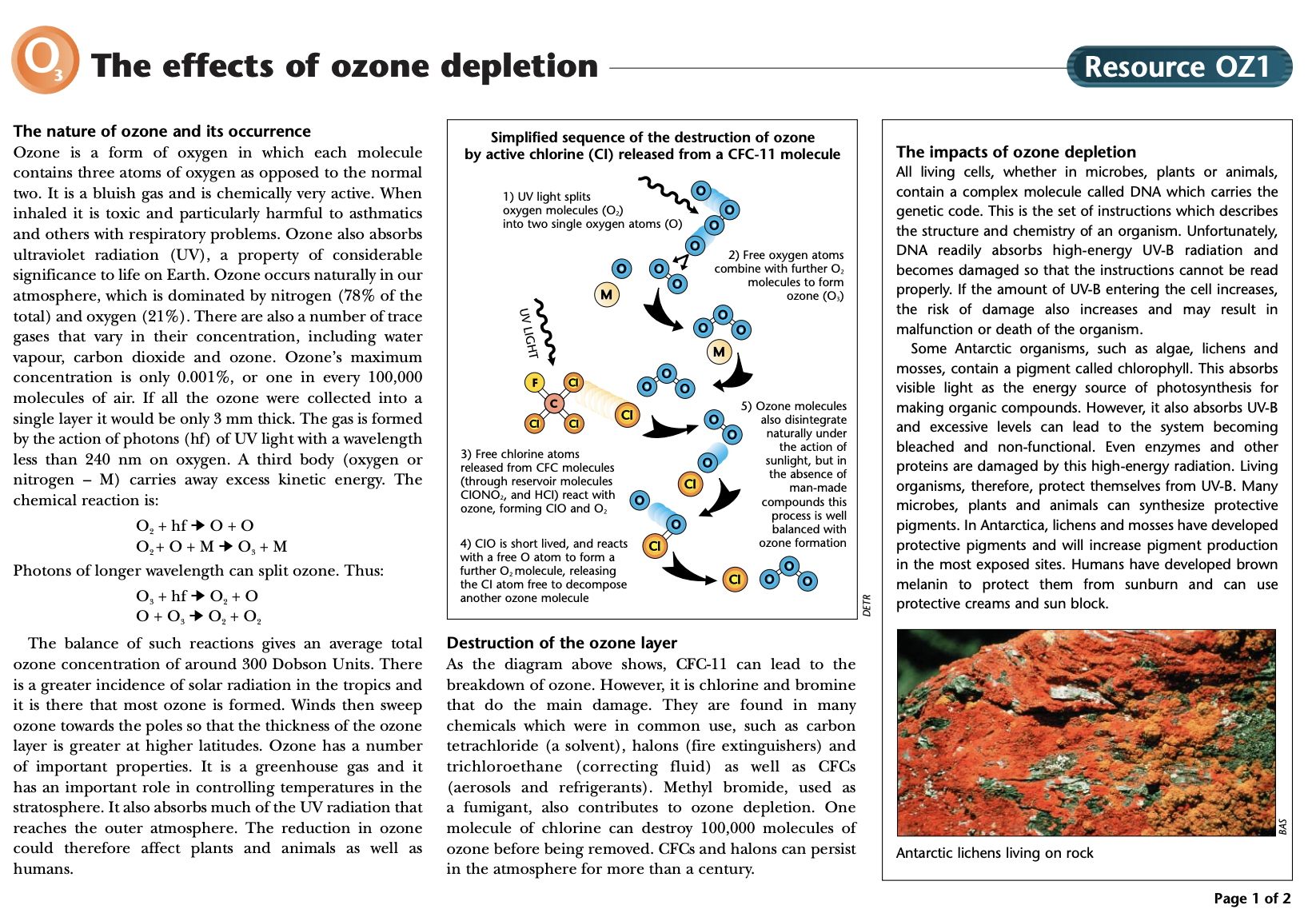
In the 1970s, scientists suggested that CFCs could destroy ozone in the upper atmosphere. Studies revealed a thinning of the ozone layer, particularly over Antarctica.

All of the CFCs in the atmosphere are a result of human activity. CFCs are released form products such as old refrigerators and air conditioners, and propellants in aerosol cans. Ozone in the upper atmosphere absorbs harmful UV rays from the Sun. CFCs react with sunlight and destroy ozone molecules. As a result, the ozone layer thins and more UV rays reach Earth's surface. This, in turn, can harm the tissues of plants and animals.

While CFCs indirectly harms organisms, another form of pollution has a direct effect on Earth's biosphere.
1
Particulate Matter
The mix of both solid and liquid particles in the air is called particulate matter. Solid particles include smoke, dust, and dirt. These particles enter the air from natural processes, such as volcanic eruptions and forest fires. Human activities, such as burning fossils fuels at power plants and in vehicles, also release particular matter. Inhaling particulates can cause asthma, bronchitis, and lead to heart attacks. It can also interfere with the processes of cellular respiration and photosynthesis in plants.
1
1

Summarize your understanding of the cause-and-effect relationships between human activities and/or natural events and the environmental impacts on the atmosphere