How do atoms form bonds? What types of bonds can atoms form?
Objectives:
Students will:
explain the difference between ionic, covalent and metallic bonding.
identify whether a compound forms an ionic, covalent, or metallic bond.
Why?
In the last unit, you learned about valence electrons. In the previous activity, you learned about how atoms form ions. In this activity, you will learn how valence electrons are involved in forming chemical bonds. Chemical bonding is all about having a full valence shell of electrons. However, there are various ways to accomplish this goal. Atoms can share valence electrons with other atoms, or valence electrons can be transferred from one atom to another atom.
Model 1 - Electronegativites for Selected Elements
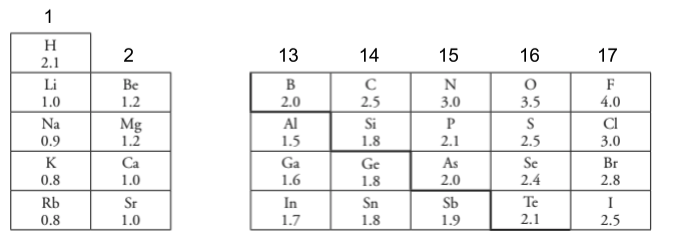
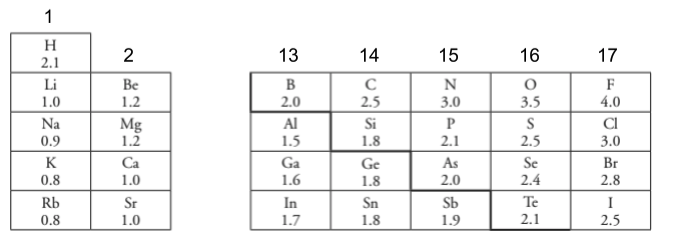
Linus Pauling used scientific data to devise a numbering system, which quantifies an atom’s ability to attract an electron that is shared with another atom. This property is called electronegativity (EN). The values shown in the table below are electronegativity values. You can think of these electronegativities as the ranking of members in a prizefighting competition, with the highest electronegativity given a value of 4.0. All contestants are fighting to get the ultimate prize—an electron to fill their shell.
Model 1
1 point
1
Question 1
1.
Which diagram accurately illustrates electronegativity?
1 point
1
Question 2
2.
Some elements only need to gain one or two electrons to completely fill their outermost energy level. Which columns in Model 1 contain these elements? Select all that apply.
Hint: Remember atoms (besides H and He) need 8 valence electrons to have a filled outer shell.
1 point
1
Question 3
3.
Do these elements have a low or high electronegativity?
1 point
1
Question 4
4.
Explain why fluorine has the highest electronegativty. Your answer should discuss atomic structure and Coulombic attraction.
1 point
1
Question 5
5.
Some of the elements in Model 1 have atoms with only one or two electrons in their valence shells. They can achieve a full valence shell by losing these electrons. Which columns in Model 1 contain these elements? Select all that apply.
1 point
1
Question 6
6.
Do these elements have a low or high electronegativity?
1 point
1
Question 7
7.
Rubidium (Rb) has one of the lowest electronegativity values, 0.8. Explain why this is. Your answer should discuss atomic structure and Coulombic attraction.
1 point
1
Question 8
8.
Suppose that a single electron was placed between two atoms. Predict what would happen to the electron by matching each set of atoms and their description with the correct image.
Draggable item
arrow_right_alt
Corresponding Item
F with F
arrow_right_alt
Both atoms attract the electron strongly. The electron stays between the atom.
Li with O
arrow_right_alt
One atom attracts the electron strongly and pulls the electron towards itself.
Li with K
arrow_right_alt
Neither atom attracts the electron strongly. The electron is free to move about.
Confused? Need an explanation? Watch the video below!
Directions: Use Model 2 to answer questions 9 - 12.
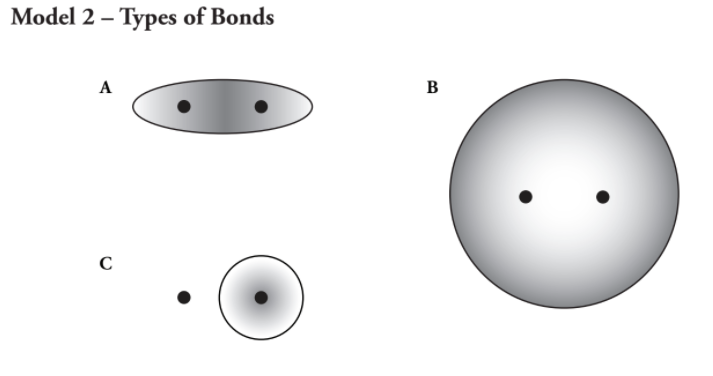
The figures in Model 2 depict the valence electron distribution around bonded atoms. The black dots represent the nuclei of the two atoms that are bonded. The circles and ellipses represent the area where the bonded valence electrons could be. Darker shading indicates a higher probability of finding the electrons in that space.
1 point
1
Question 9
9.
Which figure(s) in Model 2 show atoms sharing electrons?
1 point
1
Question 10
10.
Which figure(s) in Model 2 show atoms transferring electrons?
1 point
1
Question 11
11.
Compare figures A and B in Model 2. In which case are the electrons more tightly held by the two nuclei of the bonded atoms?
1 point
1
Question 12
12.
The three situations in Model 2 were described in Question 8. Match the three figures in Model 2 with the compounds from Question 8.
Hint: Use Model 1 or question 8 to help you answer this question.
Use Model 1 or question to help you answer this question.
Model 1
Draggable item
arrow_right_alt
Corresponding Item
Li with O
arrow_right_alt
Li with K
arrow_right_alt
F with F
arrow_right_alt
Read This!
Ionic bonds are formed when one atom takes an electron from another atom. Ions are the result (one positive, one negative). They stick together because of opposite charges.
Covalent bonds are formed when both atoms have a strong attraction to the electron, so they share the electron. Neither atom has a charge.
Metallic bonding occurs when neither atom has a strong attraction to the electrons.
1 point
1
Question 13
13.
Label the three figures in Model 2 with the three types of bonding described in the Read This! box
Draggable item
arrow_right_alt
Corresponding Item
Covalent
arrow_right_alt
Metallic
arrow_right_alt
Ionic
arrow_right_alt
1 point
1
Question 14
14.
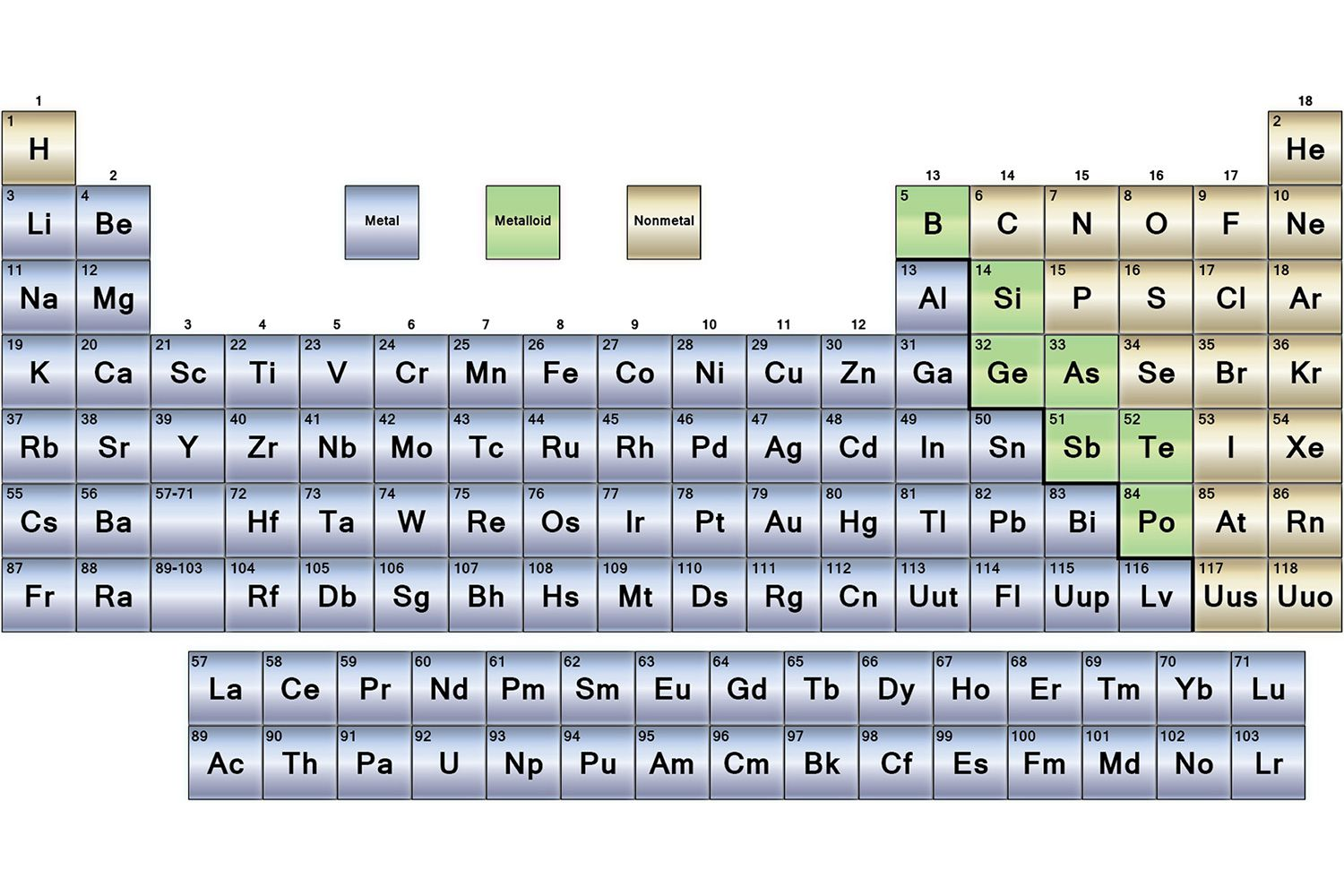
Bonds can be formed between atoms that come from the same region of the periodic table or between atoms that come from two different regions of the periodic table. For each of the bond types below, shade in one or two regions of the periodic table where atoms might come from to form that type of bond.
Confused? Need an explanation? Watch the video below!
Use the image below to answer questions 15 - 17.
1 point
1
Question 15
15.
Take a look at the compounds that formed covalent bonds. What type of elements most often formed this type of bond.
1 point
1
Question 16
16.
Take a look at the compounds that formed ionic bonds. What type of elements most often formed this type of bond.
1 point
1
Question 17
17.
Take a look at the compounds that formed metallic bonds. What type of elements most often formed this type of bond.