Lesson 6: Formulas and Names of Covalent Compounds
star
star
star
star
star
Last updated about 3 years ago
20 Nsɛmmisa
1
1
1
1
1
1
1
1
1
1
1
1
1
1
1
1
1
1
1
1
How are the chemical formula and name of a molecular compound related?
Objectives:
Students will...
write the formula of a molecular compound when given the compound name.
write the name of a molecular compound when given the chemical formula.
Why?
When you began chemistry class this year, you probably already knew that the chemical formula for carbon dioxide was CO2. Today you will find out why CO2 is named that way. Naming chemical compounds correctly is of very important. The slight difference between the names carbon monoxide (CO, a poisonous, deadly gas) and carbon dioxide (CO2, a greenhouse gas that we exhale when we breathe out) can be the difference between life and death! In this activity you will learn the naming system for molecular compounds.
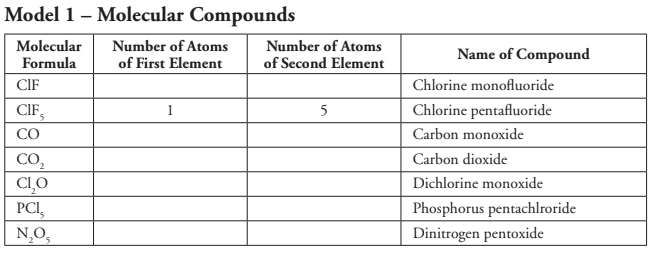
Fill in the table to indicate the number of atoms of each type in the molecular formula.
Look at the molecular formulas given in Model 1 for various molecular compounds. How many different elements are present in each compound shown?
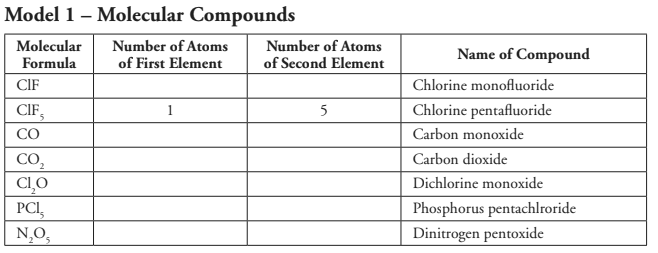
What types of elements combine to form the molecular compounds shown in the table?
Based on your answer to question 3, what type of bonding must be involved in molecular compounds?
Find all of the compounds in Model 1 that have chlorine and fluorine in them. Explain why the name "chlorine fluoride" is not sufficient to identify a specific compound.
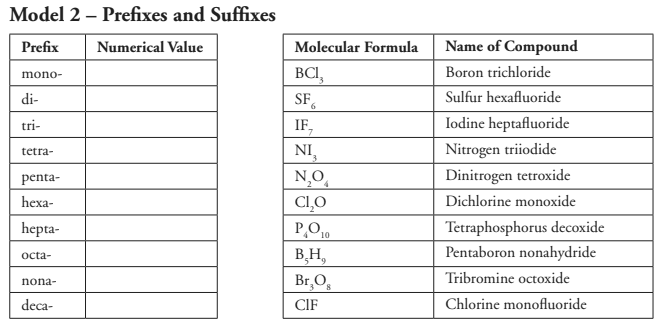
Assuming that the name of the compound gives a clue to its molecular formula, predict how many atoms each of these prefixes indicates.
| Draggable item | arrow_right_alt | Corresponding Item |
|---|---|---|
di- | arrow_right_alt | 1 |
penta- | arrow_right_alt | 2 |
mono- | arrow_right_alt | 5 |
Examine the prefixes in Model 2. Match the prefix to the corresponding numerical value.
| Draggable item | arrow_right_alt | Corresponding Item |
|---|---|---|
tri- | arrow_right_alt | 1 |
hexa- | arrow_right_alt | 2 |
octa- | arrow_right_alt | 3 |
nona- | arrow_right_alt | 4 |
deca- | arrow_right_alt | 5 |
hepta- | arrow_right_alt | 6 |
mono- | arrow_right_alt | 7 |
tetra- | arrow_right_alt | 8 |
penta- | arrow_right_alt | 9 |
di- | arrow_right_alt | 10 |
What suffix (ending) do all the compound names in Model 2 have in common?
When is a prefix NOT used in front of the name of an element?
Consider the compound NO. Which element, nitrogen or oxygen, would require a prefix in the molecule name?
What is the name of the NO molecule?
All of the compounds listed in Model 2 are binary molecular compounds. Compounds such as CH3OH or PF2Cl2 are not binary compounds. What does the term "binary molecular compound" mean?
What is the name of OF2?
What is the name of P4O10?
What is the name of P2O7?
Match the molecular formula to the molecule name.
| Draggable item | arrow_right_alt | Corresponding Item |
|---|---|---|
SO3 | arrow_right_alt | phosphorus tribromide |
BrF | arrow_right_alt | sulfur tetrachloride |
SCl4 | arrow_right_alt | dinitrogen difluoride |
N2F2 | arrow_right_alt | sulfur trioxide |
PBr3 | arrow_right_alt | bromine monofluoride |
DIRECTIONS! For questions 17-19, write the chemical formula for each compound. You won't be able to write subscripts, so your answers should look like the example below with no spaces in between letters and numbers.
carbon dioxide CO2
Do not use Google! This is a skill that you HAVE to know how to do in order to be successful in AP Chemistry.
disulfur decafluoride.
carbon tetrachloride
dinitrogen trioxide
Match the molecule name with the correct molecular formula.
| Draggable item | arrow_right_alt | Corresponding Item |
|---|---|---|
dinitrogen tetroxide | arrow_right_alt | Cl2O |
dichlorine heptoxide | arrow_right_alt | CO |
dichlorine monoxide | arrow_right_alt | S4O10 |
carbon monoxide | arrow_right_alt | N2O4 |
tetrasulfur pentoxide | arrow_right_alt | Cl2O7 |