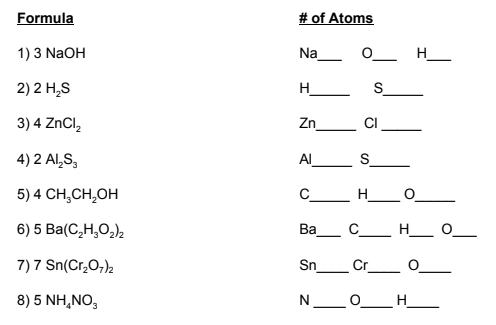
DIRECTIONS: For questions 20 - 27, determine the number of atoms in each of the formulas. See the example below:

Answer: 4, 2
Chemical equations are balanced using coefficients. You cannot change a subscript to balance a chemical equation.
Determine the number of atoms of each type of element present in five of the following molecules: Ba(NO3)2
Following along with your teacher, click on the 'show your work' box below and balance the equation.
Enter the coefficients in the following format:
a, b, c, d
where a is the first coefficient, b is the second, c is the third, and d is the fourth.
Following along with your teacher, click on the 'show your work' box below and balance the equation.
Enter the coefficients in the following format:
a, b, c, d
where a is the first coefficient, b is the second, c is the third, and d is the fourth.
Following along with your teacher, click on the 'show your work' box below and balance the equation.
Enter the coefficients in the following format:
a, b, c, d
where a is the first coefficient, b is the second, c is the third, and d is the fourth.
DIRECTIONS: For questions 20 - 27, determine the number of atoms in each of the formulas. See the example below:
Answer: 4, 2
Now that you've been introduced to balancing equations, it's time to do some practice. The key thing to remember about balancing chemical equations is that it is a trial and error process. Don't be afraid to try something, erase it, try something else, erase that, try another thing - you get the picture.
A few reminders and hints as you work through these...
You may only change the coefficients - never change the subscripts!
If polyatomic ions are on both sides of the equation, treat them as a unit and balance them first.
Balance the metals, then the nonmetals.
If the equation has O2 or H2, balance those last.
For combustion reactions, balance carbon first, hydrogen second, and oxygen last (C-H-O)
Make sure that the coefficients are in the most reduced ratio.
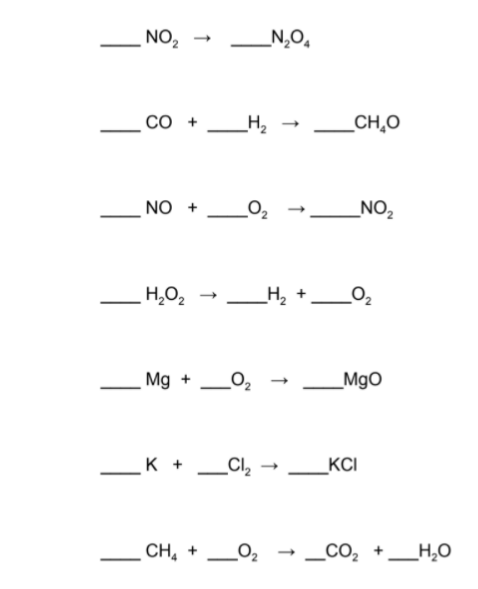
DIRECTIONS: Answer at least six questions between 35 - 42. You may use the 'show your work' box if you like.
Type the coefficients in order with commas and spaces between, like this:
a, b, c, d

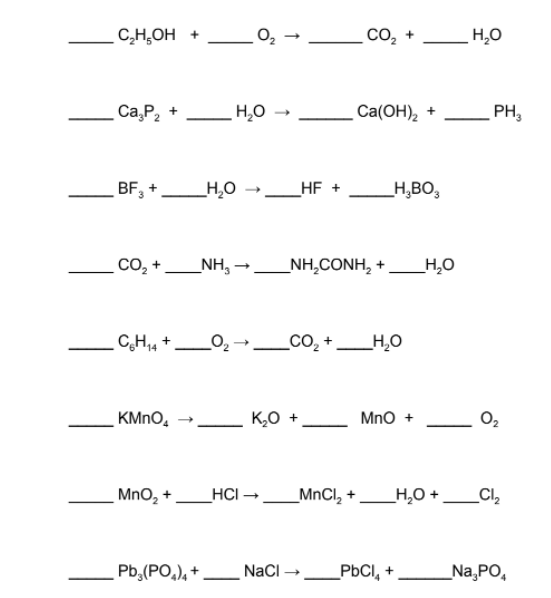
DIRECTIONS: Answer at least five questions between 43 - 50. You may use the 'show your work' box if you like.
Type the coefficients in order with commas and spaces between, like this:
a, b, c, d
Na:___ O:___ H:___
H:___ S:____
Zn:___ Cl:___
Al:___ S:___
C:___ H:___ O:___
Ba:___ C:___ H:___ O:___
Sn:___ Cr:___ O:___
N:___ O:___ H:___
What are the coefficients?
What are the coefficients?
What are the coefficients?
What are the coefficients?
What are the coefficients?
What are the coefficients?
What are the coefficients?
What are the coefficients?
What are the coefficients?
What are the coefficients?
What are the coefficients?
What are the coefficients?
What are the coefficients?
What are the coefficients?
What are the coefficients?
What are the coefficients?
What are the coefficients?
What are the coefficients?
What are the coefficients?
What are the coefficients?
What are the coefficients?
What are the coefficients?
What are the coefficients?