Lesson 7: Introduction to Balancing Chemical Equations

Last updated over 2 years ago
12 questions

Balancing Chemical Equations

Objectives: Students will...
  • explain what chemists mean when they say an equation is balanced.
  • balance chemical equations.

Part 1: PhET Simulation

To start investigating how to balance chemical equations, spend a few minutes playing with the 'Introduction' screen in the simulation below. Make sure to check out the tools and figure out what they do.

DIRECTIONS: Once you're done exploring the 'Introduction' screen, use the simulation to answer questions 1-5 .

1

Balance the 'Make Ammonia' reaction. How many total molecules are on the reactants and products side?

1

Balance the 'Make Ammonia' reaction. How many total atoms are on the reactants and products side?

1

Balance the 'Separate Water' reaction. How many total molecules and how many total atoms are on each side of the balanced equation?

  • 2 molecule
  • 3 molecules
  • 6 molecules
  • 1 atom
  • 2 atoms
  • 3 atoms
  • 6 atoms
  • 9 atoms
  • Reactant side
  • Product side
1

Balance the 'Combustion of Methane' reaction. How many total molecules and how many total atoms are on each side of the balanced equation?

  • 1 molecule
  • 2 molecules
  • 3 molecules
  • 1 atom
  • 2 atoms
  • 4 atoms
  • 6 atoms
  • 9 atoms
  • Reactant side
  • Product side
1

Which of the following statements about balanced chemical equations is correct?

1

Consider the equation from the 'Making Ammonia' example:


What are the numbers in green and blue called, and what do they represent?

  • Coefficients
  • Subscripts
  • The number of molecules involved in the reaction
  • The number of a specific type of atom.
  • Green Numbers
  • Blue Numbers
1

Which of the following coefficients could you use in a balanced chemical equation?

1

If you were balancing an equation containing an O2 molecule, which of the following would be correct representations of O2 and its coefficient?

1

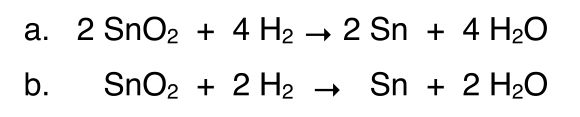
Examine equation a and equation b below. Both are balanced, but equation b is the correct way to write a balanced equation:


Answer the following questions:
  1. What is the relationship between the coefficients in equations a and b?
  2. Why is equation b considered the correct way to write the balanced chemical equation?

1

Play Level 1 of the Balancing Equation game.
  1. Take a screenshot of your score and put it in the 'Show Your Work' box below. (Don't know how to take a screenshot? Click here to find out how!)
  2. Write down two strategies that you used to balance chemical equations.

1

Play Level 2 of the Balancing Equation game.
  1. Take a screenshot of your score and put it in the 'Show Your Work' box below. (Don't know how to take a screenshot? Click here to find out how!)
  2. What do you find most difficult about balancing chemical equations so far?

1

Play Level 3 of the Balancing Equation game.
  1. Take a screenshot of your score and put it in the 'Show Your Work' box below. (Don't know how to take a screenshot? Click here to find out how!)
  2. Are there any other strategies you found for balancing?