Suppose your friend suffers from Asthma. People with respiratory problems such as asthma are usually more sensitive to air pollution. Sensitive is a term used on the Air Quality Index (AQI). Use the AQI in the table below to answer the following questions.
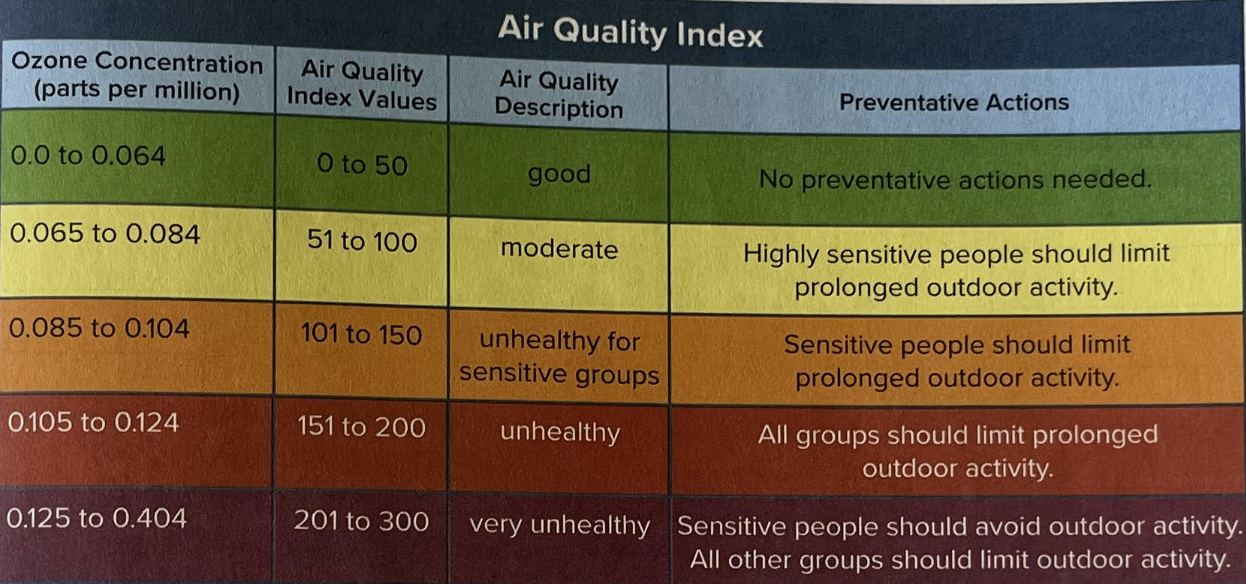
Today's AQI value is 130. What is the concentration of ozone in the air? Is today a good day for you and your friend to go to the park to play basketball for a few hours?
1 point
1
Question 2
2.
Research: Why might smog be worse on a sunny weekday than on a sunny weekend?
1 point
1
Question 3
3.
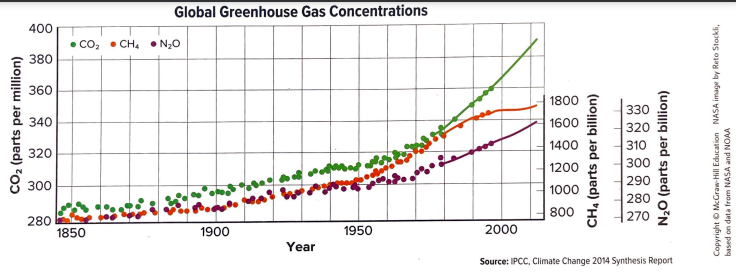
What has happened to the levels of CO2, CH4, and N2O in the atmosphere over the last century?
Sentence Starter: One observation that I see is that... Another observation that I see is...
1 point
1
3 points
3
Question 5
5.
Your answer must be inone complete paragraph
Research: What is the Greenhouse effect? How does it work?
A change in climate can present serious problems for the environment and its organisms. Global warming has already had observable effects on Earth's natural systems. Let's take a look closer.
Melting Ice
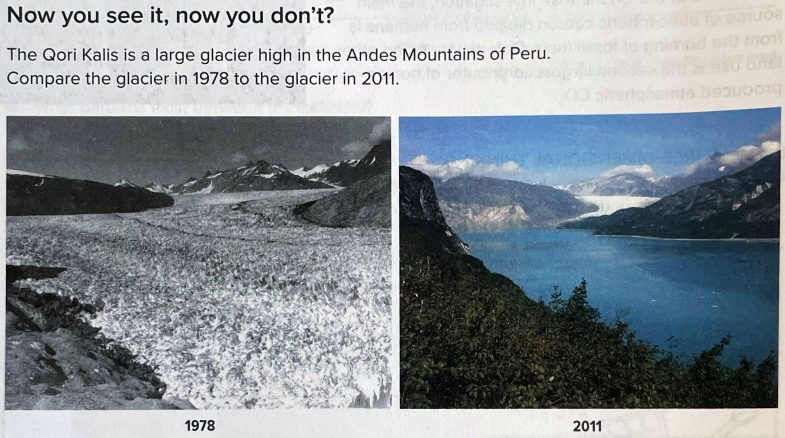
One of the most recent signs if climate change is the retreat of glaciers around the world. Since 1980, glaciers with the longest, most reliable records decreased by an amount equivalent to 15.1m (50 ft) of water. Glacier National Park, which had 150 glaciers in 1910, now has fewer than 30 glaciers left.
1 point
1
1 point
1
Question 7
7.
What has happened to the glacier over time?
1 point
1
Question 8
8.
Why do you think this has occurred?
1 point
1
Question 9
9.
What consequences might arise because of phenomena such as this?
1 point
1
Question 10
10.
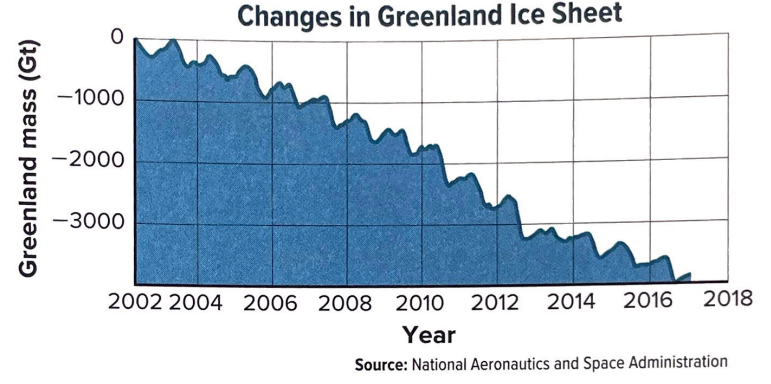
What is this a graph of?
* What are the variables
1 point
1
Question 11
11.
What patterns do you see in the data?
1 point
1
Question 12
12.
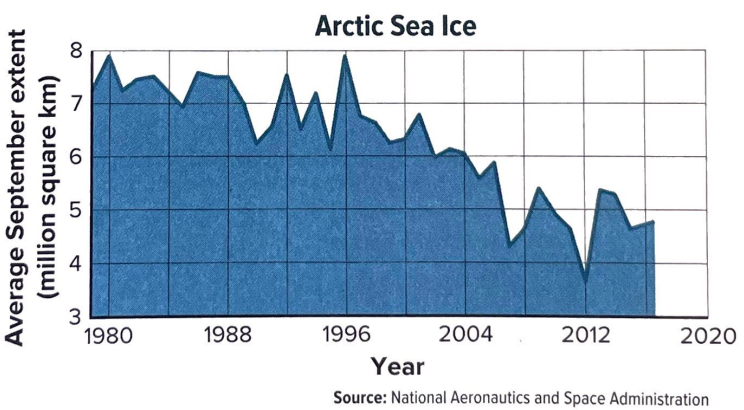
What is this a graph of?
* What are the variables
1 point
1
Question 13
13.
What patterns do you see in the data?
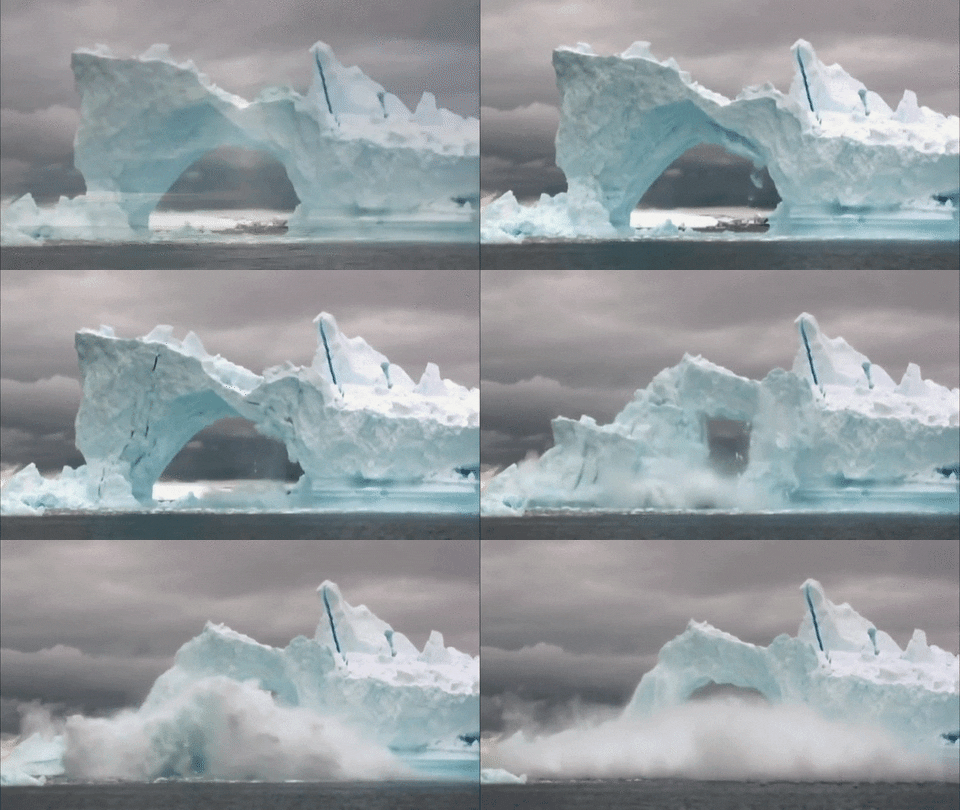
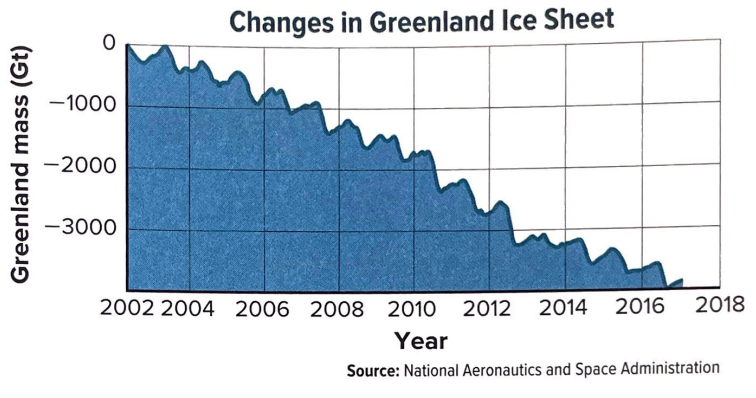
A glacier that spreads over land in all directions is called an ice sheet. Increased temperatures can also cause ice sheets to melt. For example, data form NASA's GRACE satellites show that the Greenland ice sheet has been losing an estimated 286 billion metric tons per year. Land ice sheets in both Greenland and Antarctica have seen an acceleration of ice land loss since 2009.
1 point
1
1 point
1
Question 15
15.
Find an attach a picture of an ice sheet.
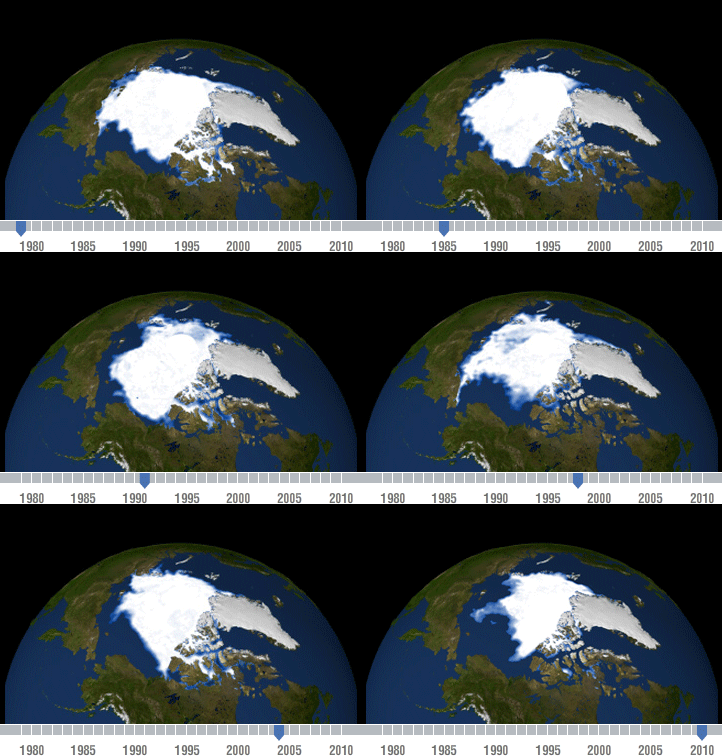
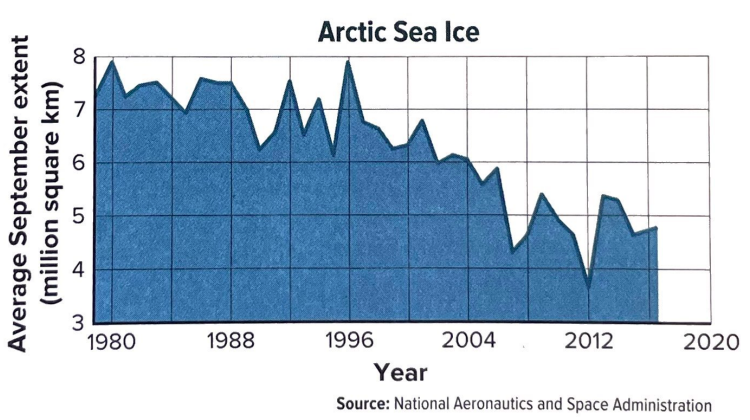
Sea ice in the Arctic Ocean is also shrinking, as shown in the images below. The white surface of the sea ice reflects up to 80% of incoming sunlight. With less sea ice present, the dark surface of the ocean absorbs much more of the Sun's energy, leading to further warming of the atmosphere. This leads to more melting of ice, which leads to further warming.
1 point
1
1 point
1
Question 17
17.
How do you think warming temperatures and melting ice impacts Earth's oceans?
1 point
1
Question 18
18.
Describe: two ways you can personally help minimize human impact on the atmosphere.