5.24.23 Death Penalty for Mentally Disabled persons
star
star
star
star
star
Last updated about 3 years ago
4 Nsɛmmisa
Hyɛ no nsow a efi ɔkyerɛwfo no hɔ:
read the problem and answer the questions
read the problem and answer the questions
25
25
25
25
read the problem and answer the questions
read the problem and answer the questions
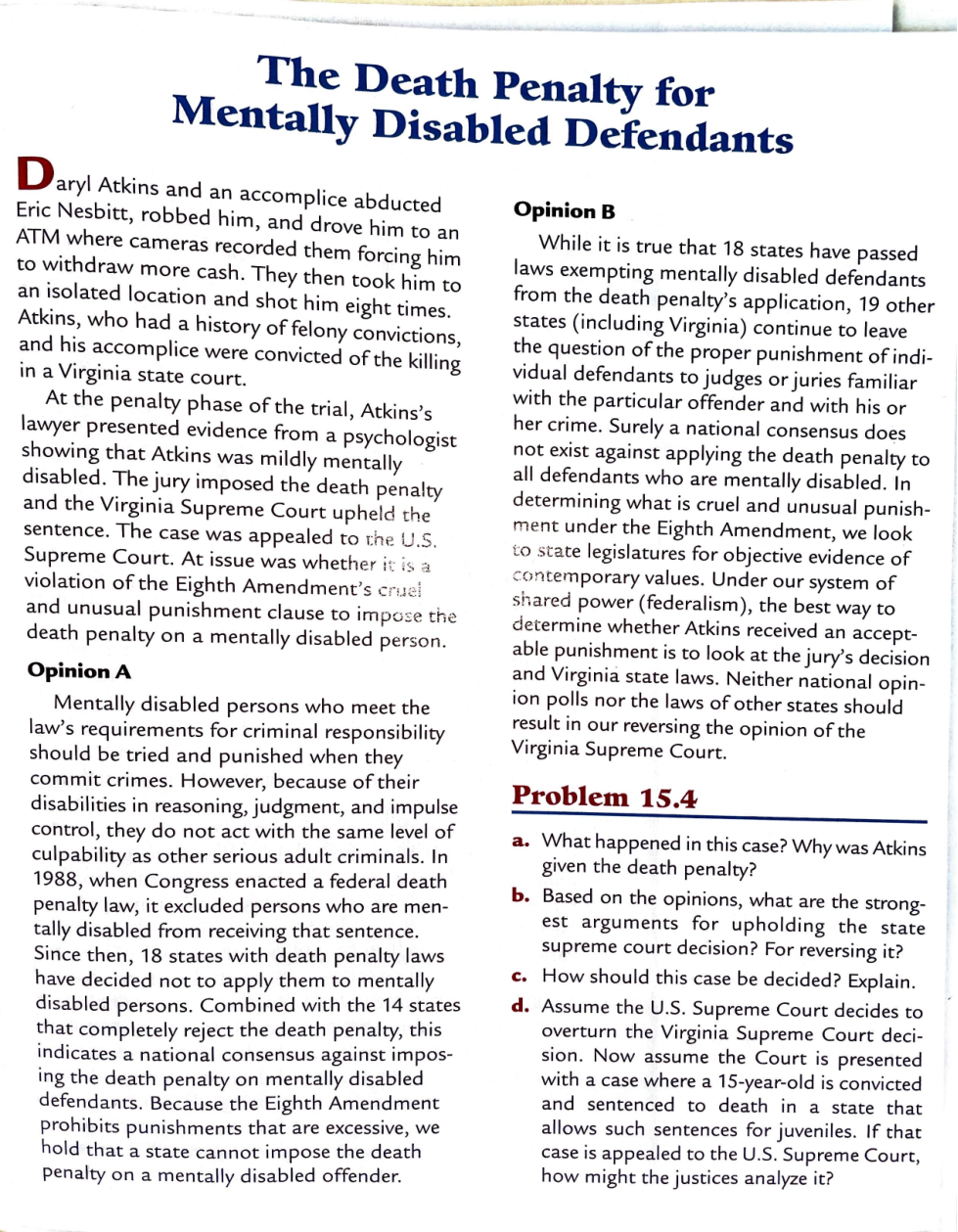
What happened in this case? Why was Adkins given the death penalty
Based on the opinions, what are the strongest arguments for upholding the state supreme court decision? For reversing it?
How should the case be decided? Explain
Assume the SCOTUS decides to overturn the Virginia Supreme Court decision. Now assume the Court is presented with a case where a 15-year old is convicted and sentenced to death in a state that allows the death penalty for juveniles. If that case is appealed to the Supreme Court, how would the justices analyze it?
Around midnight on August 16, 1996, following a day spent together by drinking alcohol and smoking marijuana, the 18-year-old Daryl Renard Atkins (born November 6, 1977) and his accomplice, William Jones, walked to a nearby convenience store, where they abducted Eric Nesbitt, an airman from nearby Langley Air Force Base. Unsatisfied with the $60 they found in his wallet, Atkins drove Nesbitt in his own vehicle to a nearby ATM and forced him to withdraw a further $200. In spite of Nesbitt's pleas, the two abductors then drove him to an isolated location, where he was shot eight times and killed.
Footage of Atkins and Jones in the vehicle with Nesbitt was captured on the ATM's CCTV camera, which showed Nesbitt in the middle between the two men and leaning across Jones to withdraw money. Further forensic evidence implicating the two men were found in Nesbitt's abandoned vehicle. The two suspects were quickly tracked down and arrested. In custody, each man claimed that the other had pulled the trigger. Atkins's version of the events, however, was found to contain a number of inconsistencies. Doubts concerning Atkins's testimony were strengthened when a cellmate claimed that Atkins had confessed to him that he had shot Nesbitt. A deal of life imprisonment was negotiated with Jones in return for his full testimony against Atkins. The jury decided that Jones's version of events was more coherent and credible, and it convicted Atkins of capital murder.
During the penalty phase of the trial, the defense presented Atkins's school records and the results of an IQ test carried out by the clinical psychologist Dr. Evan Nelson confirmed that he had an IQ of 59. On that basis, it proposed that he was "mildly mentally retarded." He was, nevertheless, sentenced to death.