Physics Final Honors
star
star
star
star
star
Last updated about 2 years ago
38 Nsɛmmisa

1
1
1
1
1
1
1
1
1
1
1
1
1
1
1
1
1
1
1
1
1
1
1
1
1
1
1
1
1
1
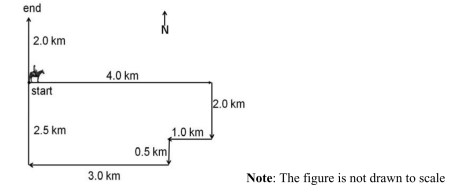
A rancher surveyed his property to make sure there were no breaks in his fence. He rode his horse around his entire property and then ended at home, as shown in the figure to the left. It took him 5 hours to complete this job from start to end.
What was the rancher's average velocity?
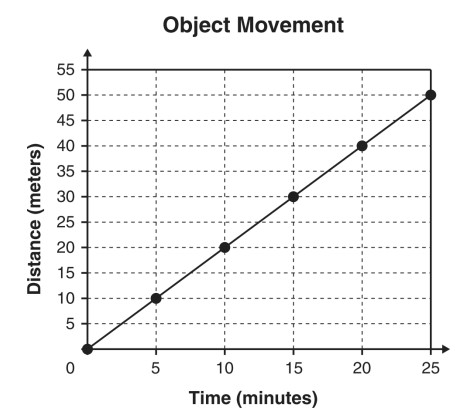
The graph to the left shows the movement of an object at several points in time.
What is the average speed of the object?

The figure shows a block that is being pulled along the floor. According to the figure, what is the acceleration of the block?
A projectile was launched horizontally with a velocity of 468 m/s, 1.86 m above the ground. How long did it take the projectile to hit the ground?

A small stone is shot straight up in the air. The figure shows a plot of the stone's position vs. time (air resistance is ignored). When is the stone moving the fastest?
Two workers use a ramp to help lift a box onto a dock as shown below. Use the diagram, to answer the following question.

Despite the advantage gained by the ramp there is loss of energy mainly due to
Noah carried a skateboard up a hill and then rode the skateboard down the hill. When Noah reached the bottom of the hill he rolled to a stop. When did Noah have the most potential energy?
The figure below shows a wagon that moves from point X to point Y.

Which of the following best describes the wagon's change in energy as it coasts from point X to point Y?
A 2.0 kg mass is moving with a speed of 3.0 m/s. What is the kinetic energy of the mass?
Starting from rest a 2 kg block of wood slides a distance of two meters down a frictionless slope, as shown.

What is the approximate kinetic energy of the wooden block at the bottom of the slope
A man applies a force of 100 N to a rock foe 60 seconds, but the rock does not move. What is the amount of work done on the rock?
A steel ball is dropped from a height (h) of 90 m as shown in the diagram below.

What is the potential energy (PE) and kinetic energy (KE) of the ball at h=36?0 m
A student exerts a force of 500 N pushing a box 10 m across a floor in 10 seconds. How much work does the student perform?
Windmills are used to convert wind energy into a more useful form. In most cases, there are three steps in this process. The energy is in a different form at each step. Which of the following flowcharts shows the most likely order of the energy changes?
Which statement best explains how iron can become a magnet?
As the distance between two point charges is tripled, the electrostatic force between the charges
What is the relationship between I1 and I2?

The diagram represents a DC circuit.

What is the total resistance of the circuit?
The diagram below shows a bar magnet within a coil of conducting wire. The magnet is moved back and forth. The magnet never has contact with the wire.

As the magnet is moved, the wire will
The primary coil of a transformer has 400 turns; the secondary coil has 1,000 turns. An alternating current is sent through the primary coil. The voltage in the primary coil has an amplitude of 17 V. Which statement best describes the voltage amplitude in the secondary coil?
The diagram represents two charges q1 and q2, separated by distance d. Which change would produce the greatest increase in the electrical force between the two charges?

A simple circuit has a current of 3.0 A and a resistance of 5.0 ohm . What is the voltage supplied by the battery of this circuit?
Two metal spheres, A and B, possess charges of 1.0 microcoulomb and 2.0 microcoulombs, respectively. In the diagram below, arrow F represents the electrostatic force exerted on sphere B by sphere A.

Which arrow represents the magnitude and direction of the electrostatic force exerted on sphere A by sphere B?
The force of gravity on the surface of the moon is about one-sixth the force of gravity on the surface of Earth. Which describes the relationship of mass and weight of an object on the moon compared to that on Earth?
At a certain distance from the center of Earth, a satellite experiences a gravitational force, F. If the mass of the satellite was doubled and placed into the same orbit, what gravitational force would the satellite have acting on it?
Two spheres, 1.00 kg each, whose centers are 2.00 m apart, would have what gravitational force between them?
Which diagram shows a planet with the least eccentric orbit?

The accompanying chart gives the mass and orbital period (time it takes to go around the Earth) of each of four satellites, A, B, C, and D, orbiting Earth in circular paths. Which satellite is closest to the Earth?
The table below shows gravitational data for a planet traveling in an elliptical orbit around a star. The table shows the relative gravitational force between the star and this planet at eight positions in the orbit (letters A through H). Higher numbers indicate stronger gravitational attraction.

Which diagram best represents the positions of the planet in its orbit that would produce the gravitational forces shown in the data table?
Which statement describes the motion of Earth around the sun?
A student swings a bat horizontally, making contact with a ball thrown to her. The ball leaves the bat, and the bat continues moving through the rest of the swing.
Which of the following statements best describes the change in energy necessary to do work on the ball?

The graph shows the distance an object traveled over time. Which line segment represents the time interval during which the object was moving at a positive constant speed?
A student attempts to measure the mass of a brick by measuring the force required to accelerate it at 1 m s 2 on a level surface. The force required is 2 N, and the student concludes that the brick has a mass of 2 kg. A balance shows that the mass of the brick is really 1.5 kg. The experimental error is most likely due to
The data table shown gives the mean radius of orbit R and the period T of some planets orbiting the Sun. Which ratio is constant for these planets?

Automobiles, baseballs, skateboards and bicycles --the world is full of things that are in motion. Centuries ago the British physicist Sir Isaac Newton stated three laws that describe the ways in which things move. These are Newton's three laws of motion:
The first law: Unless acted upon by an outside force, a body at rest tends to stay at rest, and a body in motion tends to stay in motion.
The second law: Acceleration is equal to the net force acting on a body divided by its mass.
The third law: For every action force there is an equal and opposite reaction force.
A driver starts her car and steps on the gas pedal. The car gradually accelerates to 50 km/hr. A few minutes later, the driver suddenly slams on the brakes to avoid hitting a box in the road. As the car comes to a stop, the driver's body appears to lurch forward in the seat until it is restrained by the seatbelt.
What law best explains why the driver's body appears to lurch forward when the brakes are suddenly applied?
A hot air balloon exerts a force of 1200 N while lifting a load of 800 N. Which free-body force diagram depicts the forces involved?
A student pushes a book across a classroom table. Which of the following statements best explains the difference between the amount of force needed to start the book moving and the amount of force needed to keep it moving?

Consider this distance vs. time graph of an object. During which intervals is the object being acted on by a force?