Identify different types of data, including categorical, numerical, discrete, and continuous.
Summarize categorical data using two-way tables
Interpret data in relative frequency tables in context, including identifying associations.
Common Core Math Standards
Link to all CCSS Math
CCSS.PRACTICE.MP2
CCSS.PRACTICE.MP4
CCSS.HSS.ID.B.5
CCSS.HSS.ID.C.9
Personal Finance Objectives
Analyze real-world data about education and employment
National Standards for Personal Financial Education
Earning Income
3a: Evaluate the costs and benefits of investing in additional education or training
3c: Compare earnings and unemployment rates by level of education and training
DISTRIBUTION & PLANNING
Distribute to students
Student Activity Packet
Application Problems
OBJECTIVES & STANDARDS
Math Objectives
Identify different types of data, including categorical, numerical, discrete, and continuous.
Summarize categorical data using two-way tables
Interpret data in relative frequency tables in context, including identifying associations.
Common Core Math Standards
Link to all CCSS Math
CCSS.PRACTICE.MP2
CCSS.PRACTICE.MP4
CCSS.HSS.ID.B.5
CCSS.HSS.ID.C.9
Personal Finance Objectives
Analyze real-world data about education and employment
National Standards for Personal Financial Education
Earning Income
3a: Evaluate the costs and benefits of investing in additional education or training
3c: Compare earnings and unemployment rates by level of education and training
DISTRIBUTION & PLANNING
Distribute to students
Student Activity Packet
Application Problems
Intro
ANALYZE: Prom Decisions
The senior class at Evergreen High School is planning their prom! The prom planning committee decides to survey the class on their top options. They ask each senior whether they would prefer to hold prom at Sunset Lodge or the Aquarium and whether they prefer a Under the Sea or Starry Night theme.
Some of the survey results are:
The survey included 92 different students.
20 students said they’d prefer Starry Night at the Aquarium.
43 students said they’d prefer Sunset Lodge over the Aquarium.
47 students said they’d prefer Under the Sea over Starry Night.
18 students said they’d prefer Under the Sea at Sunset Lodge.
Use the above information to answer the following questions. Show all reasoning.
3 points
3
Question 1
1.
How many students prefer the Aquarium over Sunset Lodge?_______
How many students said they prefer both Under the Sea and the Aquarium?_______
How many students said they prefer both Starry Night and Sunset Lodge?_______
Learn It 1
VIDEO: Types of Data: Categorical vs Numerical Data
In the INTRO, you looked at a survey that gathered categorical data about prom options. Watch the video to learn about the different types of data. Then, answer the questions
1 point
1
Question 2
2.
Annotate the diagram with a definition or example for each type of data: categorical, numerical, discrete, and continuous.
4 points
4
Question 3
3.
Read each survey question below and determine what type of data would be collected in response. For each question, circle categorical, discrete, or continuous.
categorical
discrete
continuous
How tall are you?
What is your favorite color?
How many pets do you have?
Rate your experience on a scale of 1 to 10.
2 points
2
Question 4
4.
Think back to the survey from the INTRO. What two categories did the prom committee collect data on? These are called the categorical variables._______ &_______
VIDEO: Two-Way Tables
We can organize data on two categorical variables by using a two-way table. A two-way table uses rows to represent one categorical variable and columns to represent the second categorical variable. Each cell of the table tells us how many data points fall into that particular intersection and totals are often included at the end of each row and column. Watch the video walkthrough and answer the questions.
Complete the two-way table using the data from the Intro.
Some of the survey results are:
The survey included 92 different students.
20 students said they’d prefer Starry Night at the Aquarium.
43 students said they’d prefer Sunset Lodge over the Aquarium.
47 students said they’d prefer Under the Sea over Starry Night.
18 students said they’d prefer Under the Sea at Sunset Lodge.
1 point
1
Question 5
5.
Complete the two-way table using the data from the Intro.
Some of the survey results are:
The survey included 92 different students.
20 students said they’d prefer Starry Night at the Aquarium.
43 students said they’d prefer Sunset Lodge over the Aquarium.
47 students said they’d prefer Under the Sea over Starry Night.
18 students said they’d prefer Under the Sea at Sunset Lodge.
1 point
1
Question 6
6.
Which options do you think the prom committee should choose? Explain your reasoning.
Practice It
High School Graduates: 6 Months Later
You’ve finally made it - you’ve graduated from high school! But what comes next? Let’s look at some data to see what recent high school graduates are doing
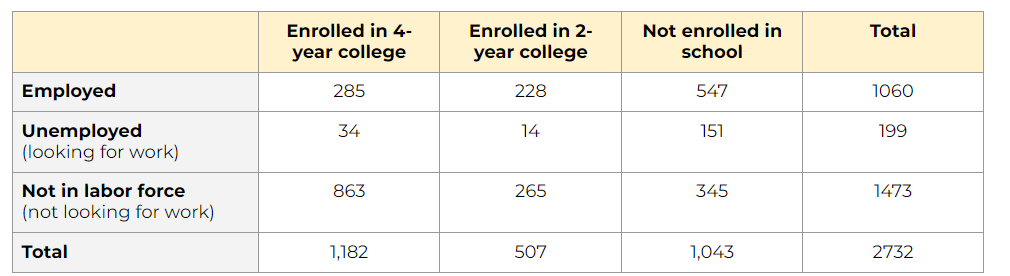
The table below shows observational data about the education and employment of recent high school graduates. It is based on the nationally representative sample from the Current Population Survey. Study the table and answer the questions.
7 points
7
Question 7
7.
What was the population for this table?_______
How many people were included in the sample studied?_______
What are the two categorical variables being studied in this table?_______ &_______
How many people surveyed are enrolled at a 4-year college?_______
If you wanted to know the total number of high school graduates who were in the labor force, which boxes would you add together?
Note: the labor force includes both people who are employed and people who are unemployed and looking for work._______ &_______
1 point
1
Question 8
8.
Write one question that you could answer using the information in this table.
Explore It
Relative Frequency Table
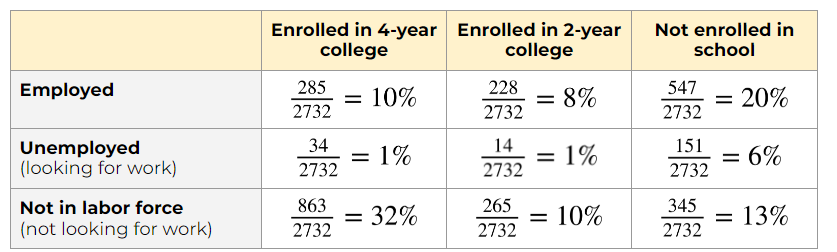
The table below shows the same data about recent high school graduates. However, it is organized differently to show the percentage of people who gave each response, instead of the number.
This is called a relative frequency table. It is a type of two-way table that shows percentages rather than counts. It is helpful for seeing if there is an association between two variables.
5 points
5
Question 9
9.
The denominator used to calculate each percentage is 2732. What does that represent?_______
Out of all recent high school graduates, what percentage are enrolled in a 4-year college and employed?_______
Find the cell with the value 6%. What is that cell telling you?_______
What percentage of recent high school graduates are enrolled in a 4-year college?_______
If 3 million students graduate from high school in 2025 and these trends stay the same, how many graduates would you expect to attend 2-year college after graduation?_______
Playing with Percentages
The table above tells you the percentage of ALL the recent high school graduates who gave each answer. But what if you want to focus on only high school graduates who are enrolled in 2-year colleges? Or only high school graduates who are employed?
Using the same data set, let’s calculate a couple of percentages that will tell us more about those graduates.
1 point
1
Question 10
10.
1060 recent graduates said they were currently employed. 228 recent graduates said they were both currently employed AND enrolled in 2-year college. Out of recent graduates who are employed, what percentage were enrolled in 2-year college?_______
1 point
1
Question 11
11.
507 recent graduates said they were currently enrolled in 2-year college. 228 recent graduates said they were both currently employed AND enrolled in 2-year college. Out of recent graduates who are enrolled in 2-year college, what percentage were employed?_______
1 point
1
Question 12
12.
In the relative frequency table above, you saw another percentage describing the same group of 228 graduates: 8% of all recent graduates said they were both currently employed AND enrolled in 2-year college. Why are these three percentages different?
Represented Another Way
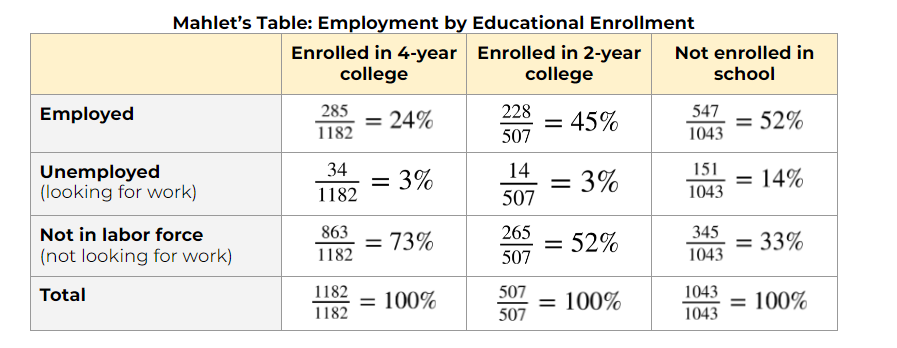
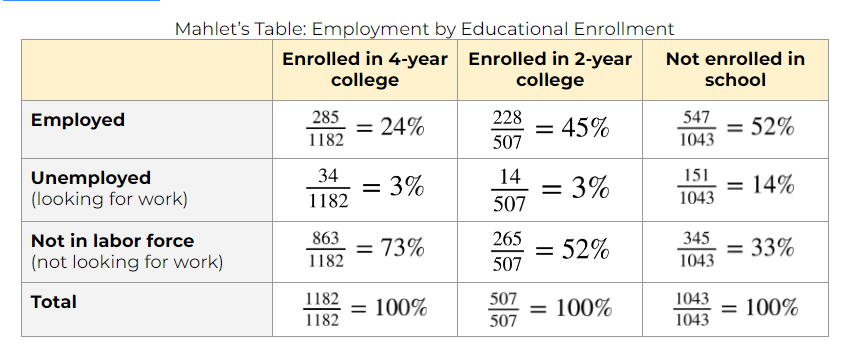
Mahlet wanted to find out if educational enrollment was associated with employment. Using the same data set about recent high school graduates, she built a different relative frequency table to compare the percentage of people who were employed, unemployed, or not in the labor force across each educational group.
1 point
1
Question 13
13.
How is Mahlet’s table different than the other tables we’ve seen for this data set?
1 point
1
Question 14
14.
Out of all recent high school graduates enrolled in a 4-year college, 73% are not in the labor force. Make an inference - why do you think that percentage is so high?
1 point
1
Question 15
15.
Out of recent high school graduates who are not enrolled in school, what percentage are employed?_______
Learn It 2
Associations Between Variables
You’ve learned about correlation in previous lessons; when we talk about two-way tables, we use the term association to mean something similar.
Association refers to a relationship between two variables: when one variable changes, so does the other one. Correlation is a type of association that tells us more about the shape and strength of the relationship.
We can use relative frequency tables to determine whether two variables have an association. One of the easiest ways to know if there is an association is to work backwards: check if the variables have NO association. If there’s no association, the relative frequency values should be very similar across each column or row.
Part 1: No Association
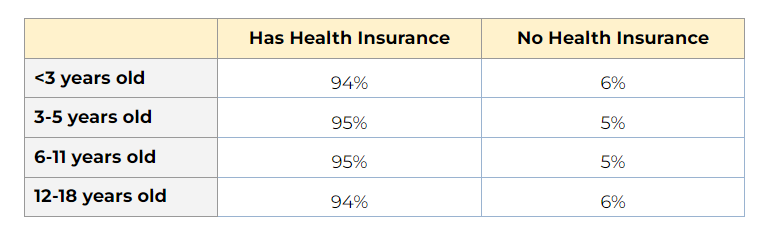
The table below is an example of two variables with no association; it shows the percentage of American children with health insurance by age. You can see that the percentage of children with health insurance stays approximately the same in each age group.
1 point
1
Question 16
16.
Hypothesize: why is there no association between age and having health insurance for children?
1 point
1
Question 17
17.
How might the table be different if there was an association - if children were less likely to have health insurance as they got older?
Part 2: Association
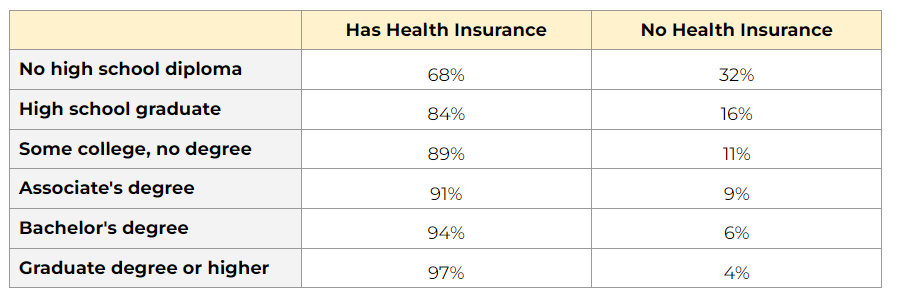
The table below shows the percentage of American adults with health insurance by education level. Study the table and answer the questions.
1 point
1
Question 18
18.
Find the cell in the table with the value 91%. What is this cell telling you?
1 point
1
Question 19
19.
Based on this observational data, Owen concludes that there is an association between education level and having health insurance. What evidence from the table supports that conclusion?
1 point
1
Question 20
20.
Imagine a law passed tomorrow that required everyone to complete at least an associate’s degree. Do you think that would that cause more Americans to have health insurance? Why or why not?
1 point
1
Question 21
21.
Make an inference: What is one other variable that you think could be related to either education and/or health insurance?
1 point
1
Question 22
22.
Review Mahlet’s relative frequency table from the previous activity. Is there an association between educational enrollment and employment for recent high school graduates? Explain your reasoning. *Hint: “Out of all ____________, ___% are/have ________. This means ________ are more/less likely to ___________.”
Application
Level 1
Part 1: Graduation Rates and College Type
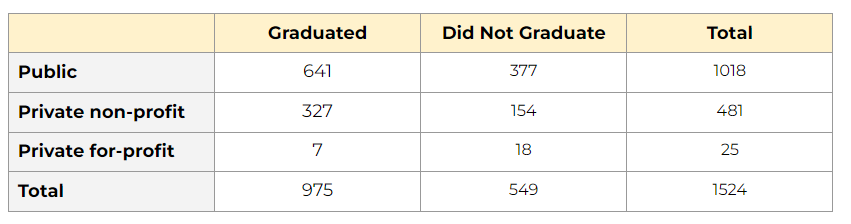
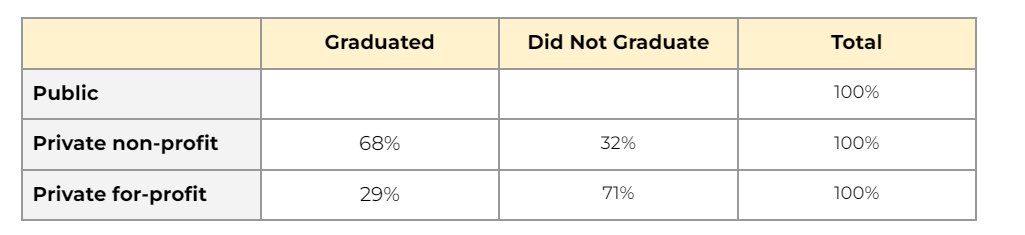
Of students who enroll at 4-year colleges, how many graduate? Let’s explore some data about the graduation rates at different types of 4-year colleges: public, private non-profit, and private for-profit.
The table below based on a nationally representative sample of full-time students at 4-year colleges[1].
1 point
1
Question 23
23.
What does the cell with the value 1524 tell you?_______
How many people surveyed attended public colleges?_______
1 point
1
Question 24
24.
Complete the first row of the relative frequency table below to show the percentage of students at public colleges who graduated _______and did not graduate._______
1 point
1
Question 25
25.
Is there an association between the type of college and graduation rate? Explain your reasoning.
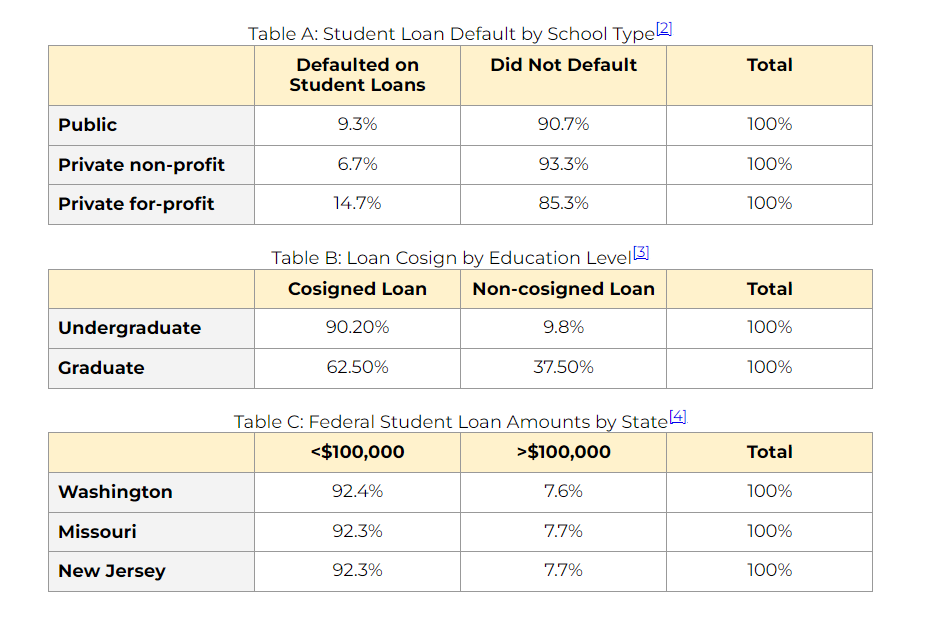
Part 2: Student Loan Associations
1 point
1
Question 26
26.
Which of the data sets shows no association between the two variables? Explain your reasoning.
Level 2
Part 1: Education and Employment
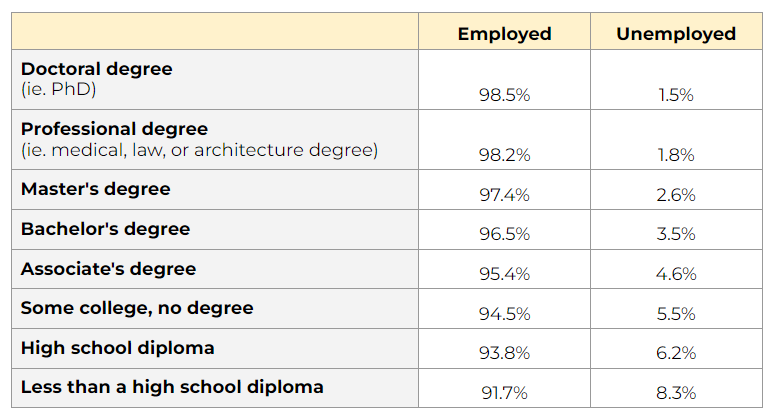
How does education level relate to unemployment rates? Explore the data below to find out.
The relative frequency table shows the percentage of adults who are employed by level of education. The data focuses on adults over 25 years old who are in the labor force (looking for work).
1 point
1
Question 27
27.
Find the cell with the value 3.5%. What is that cell telling you?
1 point
1
Question 28
28.
What percentage of adults with a high school diploma are employed?
1 point
1
Question 29
29.
There are approximately 15,318,000 adults in the labor force with an associate’s degree. Based on this data, how many of those adults would you expect to be unemployed?
1 point
1
Question 30
30.
Is there an association between education and employment? Explain your reasoning.
1 point
1
Question 31
31.
Make an inference: why are unemployment rates similar for adults with doctoral degrees and professional degrees?
Part 2: Comparing Occupations
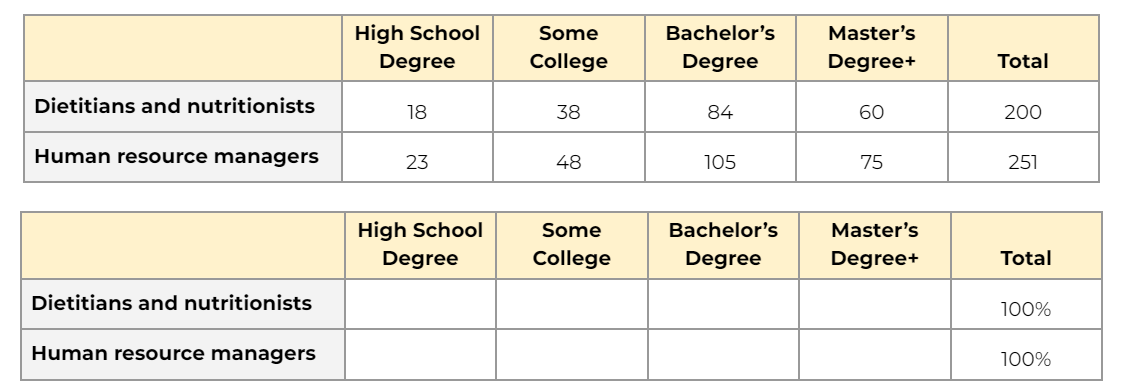
Different jobs have different educational requirements. Some careers require a specific degree, while others have more flexible requirements. Let’s explore 5 careers where workers have similar levels of education.
1 point
1
Question 32
32.
Use the first two-way table to complete the relative frequency table below.
1 point
1
Question 33
33.
Which of the following statements is true about the variables in the table above?
A There IS an association because more dietitians have a bachelor’s degree than any other education level
B There IS an association because there are more human resource managers than dietitians with a Master’s Degree
C There IS NO association because the same percentage of dietitians and human resource managers have each level of education
D There IS NO association because there are more human resource managers than dietitians