Use an interest formula to calculate student loan debt after 4 years of college
Common Core Math Standards
Link to all CCSS Math
CCSS.PRACTICE.MP7
Personal Finance Objectives
Understand how grants and scholarships are awarded and why they are superior forms of student aid
Search for grants or scholarships they might personally be eligible for
Describe why federal direct loans to undergraduates are superior to private student loans and parent PLUS loans
National Standards for Personal Financial Education
Managing Credit
4a: Describe the different sources of funding for postsecondary education
5a: Compare federal and private student loans based on interest rates, repayment rules, and other characteristics
5c: Estimate total interest on various student loans based on interest rates and repayment plans
DISTRIBUTION & PLANNING
Distribute to students
Student Activity Packet
OBJECTIVES & STANDARDS
Math Objectives
Use an interest formula to calculate student loan debt after 4 years of college
Common Core Math Standards
Link to all CCSS Math
CCSS.PRACTICE.MP7
Personal Finance Objectives
Understand how grants and scholarships are awarded and why they are superior forms of student aid
Search for grants or scholarships they might personally be eligible for
Describe why federal direct loans to undergraduates are superior to private student loans and parent PLUS loans
National Standards for Personal Financial Education
Managing Credit
4a: Describe the different sources of funding for postsecondary education
5a: Compare federal and private student loans based on interest rates, repayment rules, and other characteristics
5c: Estimate total interest on various student loans based on interest rates and repayment plans
DISTRIBUTION & PLANNING
Distribute to students
Student Activity Packet
Intro
QUESTION OF THE DAY: What percent of students receive scholarships or grants for college?
Write your answer to the question below. Then, compare your answer to the answer on the second slide. Finally, follow your teacher’s directions on how to answer the follow-up questions below. You may assume there are 30 days in a month for this saving example.
1 point
1
Question 1
1.
What percent of students receive scholarships or grants for college?
1 point
1
Question 2
2.
Would you choose a college just based on how many scholarships or how much grant aid you receive from them? Why or why not?
Untitled Section
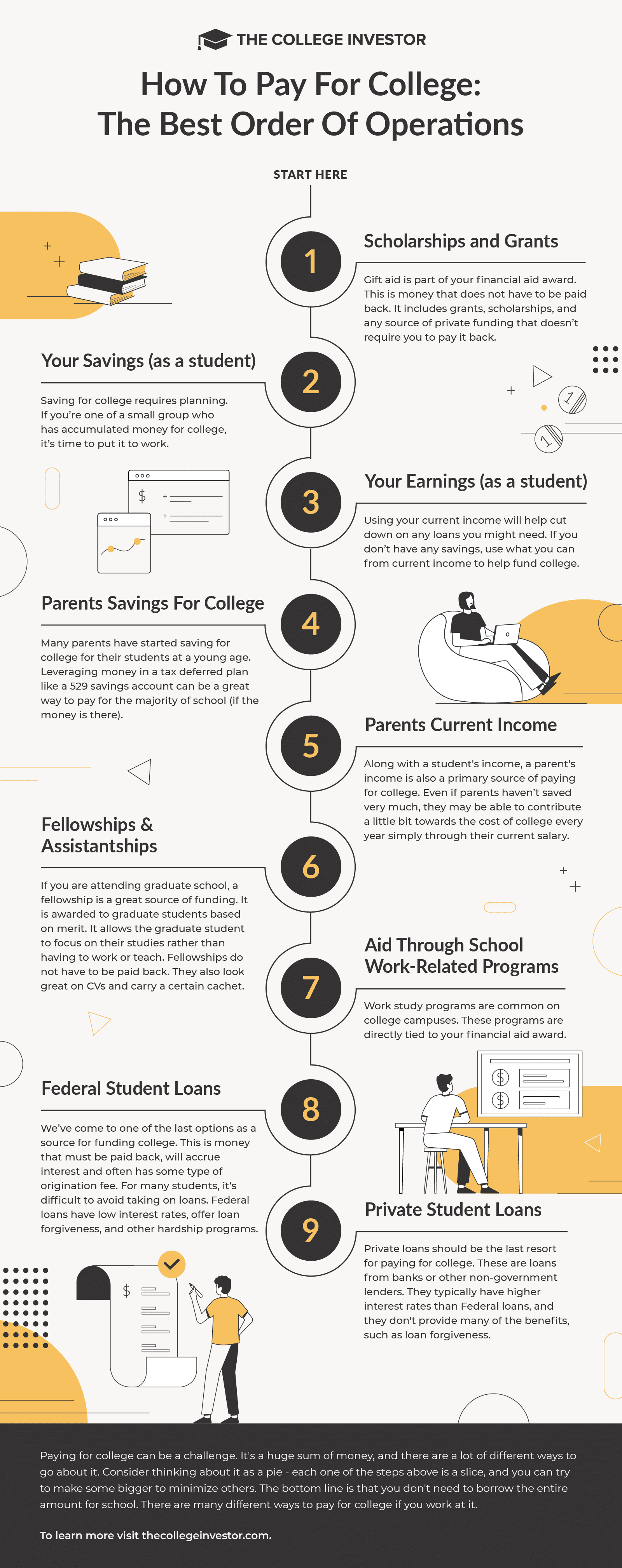
INFOGRAPHIC: Order of Operations to Pay for College
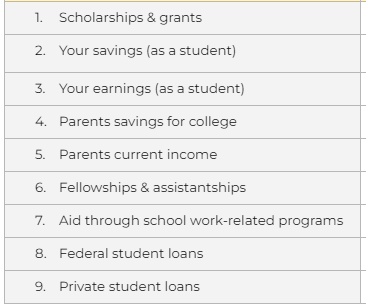
As you’ve previously learned, a necessary step in the paying for college process is completing the FAFSA, which will determine your eligibility for need-based aid. Once that application is completed, you’ll want to understand the many ways to pay for college, which ones are accessible to you, and in which order you should use them.
9 points
9
Question 3
3.
Yes, I'll have access
Not Sure
No, I will not have access
1. Scholarships & grants
2. Your savings (as a student)
3. Your earnings (as a student)
4. Parents savings for college
5. Parents current income
6. Fellowships & assistantships
7. Aid through school work-related programs
8. Federal student loans
9. Private student loans
1 point
1
Question 4
4.
Which of these ways to pay are reliant on FAFSA completion?
Suggestions 3, 6, and 7 revolve around you spending some of your time as a college student also working. Paying costs as they occur, rather than paying them later in the form of interest-bearing loans, seems like a win.
4 points
4
Question 5
5.
a. Name at least 2 other potential benefits of working while you're enrolled in college.
b. But what might be the drawbacks of working while also a college student?
ARTICLE: College Grants vs. Scholarships vs. Loans
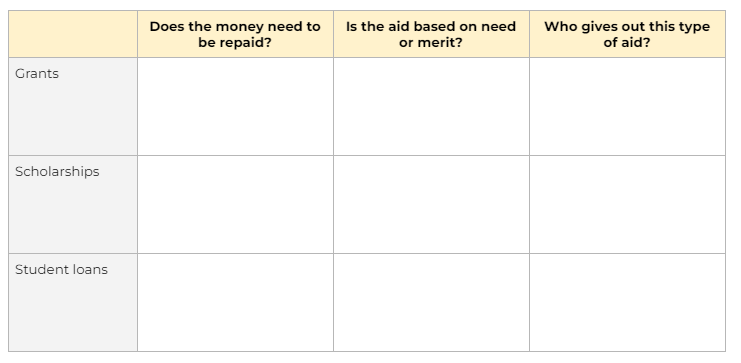
Before we dive in deeper with a podcast, let’s do some categorizing of three of the main types of aid – grants, scholarships, and loans. Read this article, but you can stop when you get to the section on How to Apply. Use what you learn to complete the chart.
3 points
3
Question 6
6.
Does the Money need to be repaid?
Grants
Scholarships
Loans
Yes
No
3 points
3
Question 7
7.
Is the money based on need or merrit?
Grants
Scholarships
Loans
Need
Merrit
6 points
6
Question 8
8.
Who Gives out this type of aid?
Grants _______
Scholarships_______
Loans_______
PODCAST: Paying for College: What to Know Before You Go
In the next three resources, we’ll listen to portions of a much longer podcast. In this first section, please listen from 14:54 - 18:07, where you’ll hear a bit more about grants and scholarships.
📷
TEACHER TIP: A transcript of this podcast is available from NPR.
1 point
1
Question 9
9.
Regarding Pell Grants, the podcast says “you can essentially put it in a backpack and carry it to whatever school you want to.” What do they mean by this?
1 point
1
Question 10
10.
Explain how it’s possible that an expensive, private college can end up being a cheaper option than a public school.
Answer true or false for each of the following:
1 point
1
Question 11
11.
It’s possible for a student to have both grants and scholarships
1 point
1
Question 12
12.
It’s possible to use multiple grants to pay for college
1 point
1
Question 13
13.
It’s possible to use multiple scholarships to pay for college
1 point
1
Question 14
14.
The best strategy for scholarships is to focus on the large, high dollar national awards
PODCAST: Paying for College: What to Know Before You Go
Next, we’ll resume the podcast and listen from 18:07 - 20:25, which discusses both federal and private loans. You may want to preview the questions before pushing play so that you know what details to listen for.
1 point
1
Question 15
15.
If subsidized loans mean the government doesn’t charge you interest until you graduate, what do you think it means if a loan is unsubsidized?
1 point
1
Question 16
16.
Multiple “experts” on the podcast agree that $31,000 is a good upward limit for the amount of undergrad loans to take out. Explain why they chose that number.
1 point
1
Question 17
17.
Marti hears that she can either get loans from the federal government or loans from a private bank, and she’s thinking private banks are a better option because banks lend people money all the time – they’re experts! Explain why you agree or disagree with Marti.
Math Connection: Desmos
20 points
20
Question 18
18.
Complete the Desmos and tell me something you learned from this activity.
1 point
1
Question 19
19.
Why are grants and scholarships the first type of college funding an undergraduate should use?
Grants and scholarships are typically worth the largest dollar amounts
Grants and scholarships all come from the federal government
Grants and scholarships are “free money” that won’t need to be repaid
Grants and scholarships are awarded equally to all high school graduates
1 point
1
Question 20
20.
Which statement best describes the difference between merit-based and need-based awards?
Merit-based awards come from the individual college, while need-based awards come from the state government
Merit-based awards require the FAFSA, while need-based awards do not
Merit-based awards are much easier to get than need-based awards
Merit-based awards are given for achievements, while need-based awards are given based on income
1 point
1
Question 21
21.
How much student loan debt you graduate with is dependent on each of these factors EXCEPT…
Whether loans are subsidized or unsubsidized
How much you borrow each year of college
What interest rate your loans have
The starting salary of your first job
20 points
20
Question 22
22.
ACTIVITY: Find Some Aid for You **Bonus Points +20**
It’s time to head out onto the internet and try to find a financial aid option for you. First, choose one of these assignment options:
Do a web search for an as-local-as-possible scholarship you could apply to
Choose the college you’d most love to attend and read on their website about their scholarship and/or grant programs
Research great options available at the state level
As you research and learn more, record answers to as many of the following questions as possible:
How much money is available?
How many of the awards are available?
Who is eligible, and do you meet those requirements?
What is the application process, and when is the deadline?
Record answers to those questions and other pertinent details here: