1-1 (Intro): Lincoln and Kennedy Coincidence
Last updated almost 2 years ago
2 questions
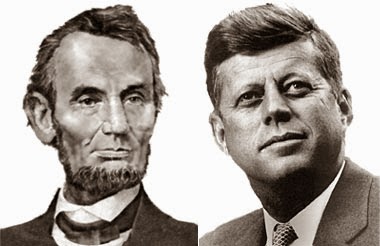
Abraham Lincoln was elected to Congress in 1846.  John F. Kennedy was elected to Congress in 1946.  Abraham Lincoln was elected President in 1860.  John F. Kennedy was elected President in 1960.  The names Lincoln and Kennedy each contain seven letters.  Both were particularly concerned with civil rights.  Both wives lost their children while living in the White House.  Both Presidents were shot on a Friday.  Both were shot in the head.  Kennedy had a secretary named Lincoln. (contrary to popular belief, Lincoln did not have a secretary named Kennedy) Both were assassinated by Southerners.  Both were succeeded by Southerners.  Both successors were named Johnson.  Andrew Johnson, who succeeded Lincoln, was born in 1808.  Lyndon Johnson, who succeeded Kennedy, was born in 1908.  Both assassins were known by their three names.  Both names are comprised of fifteen letters  Booth ran from the theater and was caught in a warehouse. (well, more like a shed, but that's a little detail we have forgotten..) Oswald ran from a warehouse and was caught in a theater.  Booth and Oswald were assassinated before their trials.
We are predisposed to encounter coincidences because their detection, it might be said, reflects the basic modus operandi of our cognitive and perceptual systems. The brain seeks patterns in the flow of sensory data it receives from the world. It infuses the patterns it detects with meaning and sometimes agency (often misplaced) and, as a part of this process, it forms beliefs and expectations that serve to shape future perceptions and behaviour. Coincidence, in the simple sense of co-occurrence, informs pattern-detection, especially in terms of identifying causal relationships, and so enhances predictability. The “world” does not simply present itself through the windowpanes of the eyes and channels of the other senses. The brain’s perceptual systems are proactive. They construct a model of the world by continually attempting to match incoming, “bottom-up” sensory data with “top-down” anticipations and predictions. Raw sensory data serve to refine the brain’s best guesses as to what’s happening, rather than building the world afresh with each passing moment. The brain, simply put, is constantly on the lookout for coincidence...

...Primed by deeply ingrained cognitive biases, and ill-equipped to make accurate estimates of chance and probability, we are innately inclined to see (and feel) patterns and connections where they simply don’t exist. “Innately inclined” because, in evolutionary terms, the tendency to over-detect coincidences is adaptive. Failure to detect contingencies between related events – for example, rustling in the undergrowth/proximity of a predator – is generally more costly than an erroneous inference of a relationship between unrelated events.

Source: Are Coincidences Real?
1

Check off all of the statements that are true about the way the brain perceives coincidences.

Required
1

Look at the "coincidences" that exist between the assassinations of Abraham Lincoln and JFK. Categorize these coincidences based on whether or not you believe they are really strange or whether there's probably a decent explanation as to why that happened. THERE ARE NO RIGHT OR WRONG ANSWERS!

  • Both presidents were shot on a Friday.
  • Both of their successors were named Johnson.
  • Both assassins were known by three names.
  • Both names are comprised of 15 letters.
  • Both presidents were shot in the head.
  • Both were assassinated by Southerners.
  • Lincoln was elected in 1860 and JFK was elected in 1960.
  • That's a really strange coincidence!
  • There's actually decent odds of that happening.