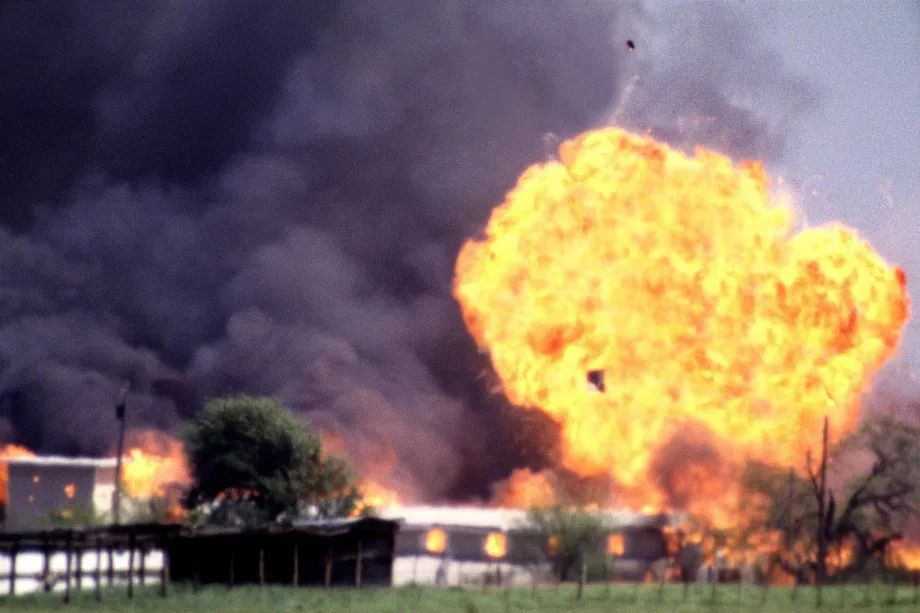
A new Netflix documentary premiered this week [March 2023], recounting one of the strangest and most tragic incidents in American religious history just before its 30th anniversary next month: the bloody ending of the siege between FBI agents and members of the Branch Davidian religious group in Waco, Texas.
For many people, Waco is a lurid story about a cult — a story that has lent itself to decades of sensationalist media coverage (and, recently, a television miniseries). It’s the story of a maniacal and apocalypse-minded cult leader, David Koresh, whose delusional stubbornness led to the deaths of 76 people.
Media coverage almost uniformly referred to the Branch Davidians as a “cult” and was unsympathetic not just to Koresh but to his followers as well.
The prevailing narrative, in other words, presumed that all inhabitants of the Branch Davidian community were crazy, and that therefore, any violent means used against them would be justified.
The 1993 siege at Waco was between the Branch Davidians and the
The leader of the Branch Davidians, David Koresh, was seen as a maniacal, stubborn, and apocalypse-minded man.
The Siege at Waco ultimately led to the deaths of
The Branch Davidians are a religious organization that was founded in the 1930s. According to this article, how did calling the Davidians a "cult" impact the way that they were treated by the government and the American public?
The story of Waco is, without question, a tragedy. But it’s also much more complicated than a story about a cult. Indeed, some of the few survivors of the siege have expressed anger with the way they feel that official accounts of the siege removed Branch Davidians’ agency, portraying them as victims rather than believers. In his book Waco: a Survivor’s Story, David Thibodeau writes: “So many of the Davidians have been demonized by the media ... I felt it my duty to tell the true story of a group of people who were trying to live according to their religious beliefs and the teachings of a man they all considered divinely inspired.”
The story of Waco is also the story of disagreements over religious freedom, the rights and boundaries of the federal government, and what it means to be a legitimate religion.
The traditional story of Waco portrays the Branch Davidians as
List the three main disagreements that were also highlighted by the tragedy at Waco.
While David Koresh is the figure most commonly associated with the Branch Davidians, the story of the group begins several decades before his ascent to leadership.
The group began as the “Davidians” (also known as “Shepherd’s Rod”), an offshoot of the Seventh-Day Adventists, a Christian religious movement that flourished in the late 19th century in America and that boasts 21 million members worldwide...
The Davidian movement was spearheaded in 1930...[the founders] believed that the Messiah prophesied in the biblical book of Isaiah was not Jesus, but was yet to come. They argued that they would help bring about the future “Davidic kingdom” — mirroring the empire of the biblical King David — during the apocalypse. That apocalypse, he taught, was imminent.
It was [the original leader] who first purchased the compound in Waco, Texas, that he called Mount Carmel, after the biblical mountain of the same name. There, he led a small Christian religious community that believed Mount Carmel would be the center of a new divine kingdom following the apocalypse...
Only in 1981 did Vernon Howell — the man who would soon change his name to David Koresh — join the Branch Davidian community. A troubled child from an unstable family background, Howell had become a born-again Christian in the 1980s. He joined the Southern Baptist Church, then switched to a Seventh-Day Adventist Church, from which he was expelled after aggressively pursuing a pastor’s daughter.
Claiming the gift of prophecy, Howell gained increasing power within the Branch Davidian community...While Koresh did, ultimately, possess an extraordinary amount of power within the Branch Davidian community, he was not its only representative. A number of Branch Davidians exist today, many of whom see Koresh as a splinter leader from their own legitimate tradition. And many of the Branch Davidians who ultimately died at Waco had been longstanding members of the community, practicing their faith long before Koresh was even born.
The Branch Davidians began as an offshoot of another Christian religion, the Seventh Day Adventists.
Seventh Day Adventism was extremely popular in the late 19th century but no longer exists.
Check off all of the following that are TRUE of the Branch Davidians
David Koresh taught that he was a messiah and that, furthermore, any children born of the messiah would be sacred. Because of this, he engaged in multiple “marriages” with women in the Branch Davidian community, some of whom were underage, fathering at least 13 children...
...at the time of the Waco siege, the evidence to support any sexual allegations against Koresh was inconclusive. Multiple probes into alleged sexual abuse at the Mount Carmel site went nowhere.
The government’s primary interest in the Branch Davidians, according to later documents, was the alleged possession of a potential illegal arms cache on the site.
Federal agents attempted their raid on Mount Carmel in Waco because they believed that David Koresh was having sexual relations with minors.
The federal government's primary interest in the Branch Davidians at Mount Carmel was their possession of weapons.
On February 28, 1993, the Bureau of Alcohol, Tobacco, Firearms and Explosives (ATF) attempted to raid the Branch Davidian site in order to execute a search warrant. What happened next remains unclear — both surviving Branch Davidians and surviving agents claimed the other side fired first — but the raid resulted in a bitter gun battle that killed five ATF agents and five Branch Davidians, and injured an additional 16 agents.
What followed was all but unprecedented in American history: a 51-day standoff between the Branch Davidians and the FBI (which had taken over from the ATF). The FBI used a variety of tactics to breach the compound — including the playing of agonizingly loud music on speakers 24/7 in order to induce sleep deprivation in members — and participated in a full 60 hours of negotiation with Koresh in an attempt to negotiate access to the site. Malcolm Gladwell, writing on the siege for the New Yorker, captures the sheer scale of the operation:
"Outside the Mount Carmel complex, the F.B.I. assembled what has been called probably the largest military force ever gathered against a civilian suspect in American history: ten Bradley tanks, two Abrams tanks, four combat-engineering vehicles, six hundred and sixty-eight agents in addition to six U.S. Customs officers, fifteen U.S. Army personnel, thirteen members of the Texas National Guard, thirty-one Texas Rangers, a hundred and thirty-one officers from the Texas Department of Public Safety, seventeen from the McLennan County sheriff’s office, and eighteen Waco police, for a total of eight hundred and ninety-nine people."
Finally, on April 19, the FBI raided the compound, using military-grade weaponry such as armored tanks, as well as tear gas. A fire broke out — the source of which remains disputed — and 76 of the 85 Branch Davidians, including Koresh and a number of children, were killed.
Check off all of the following that are TRUE about the ATF raid on the Branch Davidians in Waco.
According to author Malcolm Gladwell, the Waco Siege may have been the largest military force ever gathered against a civilian suspect.
By and large, the public treated the ending of the siege of Waco as the story of a crazy cult that had gotten the end it deserved...
Just a day after the raid, then-President Bill Clinton argued that the FBI bore no responsibility for the deaths at Waco, saying: “I do not think the United States government is responsible for the fact that a bunch of religious fanatics decided to kill themselves.”
But for some, the Waco tragedy was the foundation of a different narrative: a story of unlawful government overreach, and of the consequences of federal aggression. On the political far right in particular, Waco became something of a rallying cry for those who saw the federal government as a threat. Right-wing anti-government bomber Timothy McVeigh, for example, carried out his 1995 Oklahoma City bombings in part as a direct response to Waco, where he had been an eyewitness at the siege.
As a 2015 New York Times story looking at Waco’s influence on today’s far right put it:
"For right-wing militias and so-called Patriot groups, Waco amounts to evidence of a tyrannical, illegitimate government unblinkingly prepared to kill its own people ... the specter of Waco has not faded. Right-wing extremists regularly invoke it as a defining moment, proof of Washington’s perfidy. “Waco can happen at any given time,” Mike Vanderboegh, a prominent figure in the Patriot movement, told Retro Report. He added ominously: “But the outcome will be different this time. Of that I can assure you.”
Why were many Americans uncomfortable with what happened at Waco?
What is the connection between what happened at Waco and what happened two years later in the Oklahoma City Bombing?
Explain how the events at Waco inspired the people on the far right. How did it impact American militia and Patriot movements?
The media tended to legitimized the FBI’s raid on Mount Carmel — despite its disastrous outcome for many innocent members of the Branch Davidians, including children — because Waco was a “cult.”
But all too often, notes Dr. Megan Goodwin, a scholar specializing in American minority religions, the term “cult” is used to delegitimize and diminish religious practices that don’t fit neatly into the American (Christian, often Protestant) mainstream, and justify violence that would not be used against more established religious groups.
“When journalists and law enforcement agents use the term ‘cult’ to describe a religious group,” Wessinger writes, “it’s problematic. In fact, studies have shown that once the ‘cult’ label is applied, the group is more likely to be deemed illegitimate and dangerous. It’s then easier for law enforcement agents to target the group with excessive, militarized actions, and it’s easier for the public to place all blame on the supposed cult leader for any deaths.”
The fact that it was so easy to diminish Koresh and his followers as “unworthy victims,” she adds, made it that much easier for the public to accept their deaths. “Religion is a constitutionally protected category. ... And the identification of Waco’s Branch Davidians as a cult places them outside the protections of the state.”
List three reasons why designating the Branch Davidians as a "cult" ultimately made people more willing to accept what happened to them.
Pause the video as you watch and answer the following questions:
A - Why do the images of the Siege at Waco still hold so much power today?
B - Why was the government so concerned about the Branch Davidians who were living at Mount Carmel?
C - How did the Davidians' religious beliefs, especially in terms of life and death, impact the actions they took during the siege?
D - List some of the actions that the ATF, FBI, and other law enforcement agencies took to try to execute their search warrant (throughout the entire siege)?
E - How did the federal government's actions during the siege impact the actions of the Davidians?
F - People around the world saw the footage of the final day of the siege (the government raid and the massive fire). How did this impact people's views of the government? Why was this such a defining moment in our history?
G - Explain the connection between the Siege at Waco and the American militia movement.
H - Explain the connection between the Siege at Waco and the situation with Cliven Bundy in 2014. What do these two events have in common? What is different?
I - In the end, what are some lessons Americans can learn by examining the situation at Waco? How should future Americans think about this situation?