This Week 4: Heat Transfer lesson has a short video, a couple of short readings, and about 16 questions. There is an optional experiment at the end you can do with an adult's permission and supervision.
Be sure to attempt all the questions and submit when you are finished. Please contact me through the comment feature or send an email to rshaw@fergflor if you have any questions.
Question 1
1.
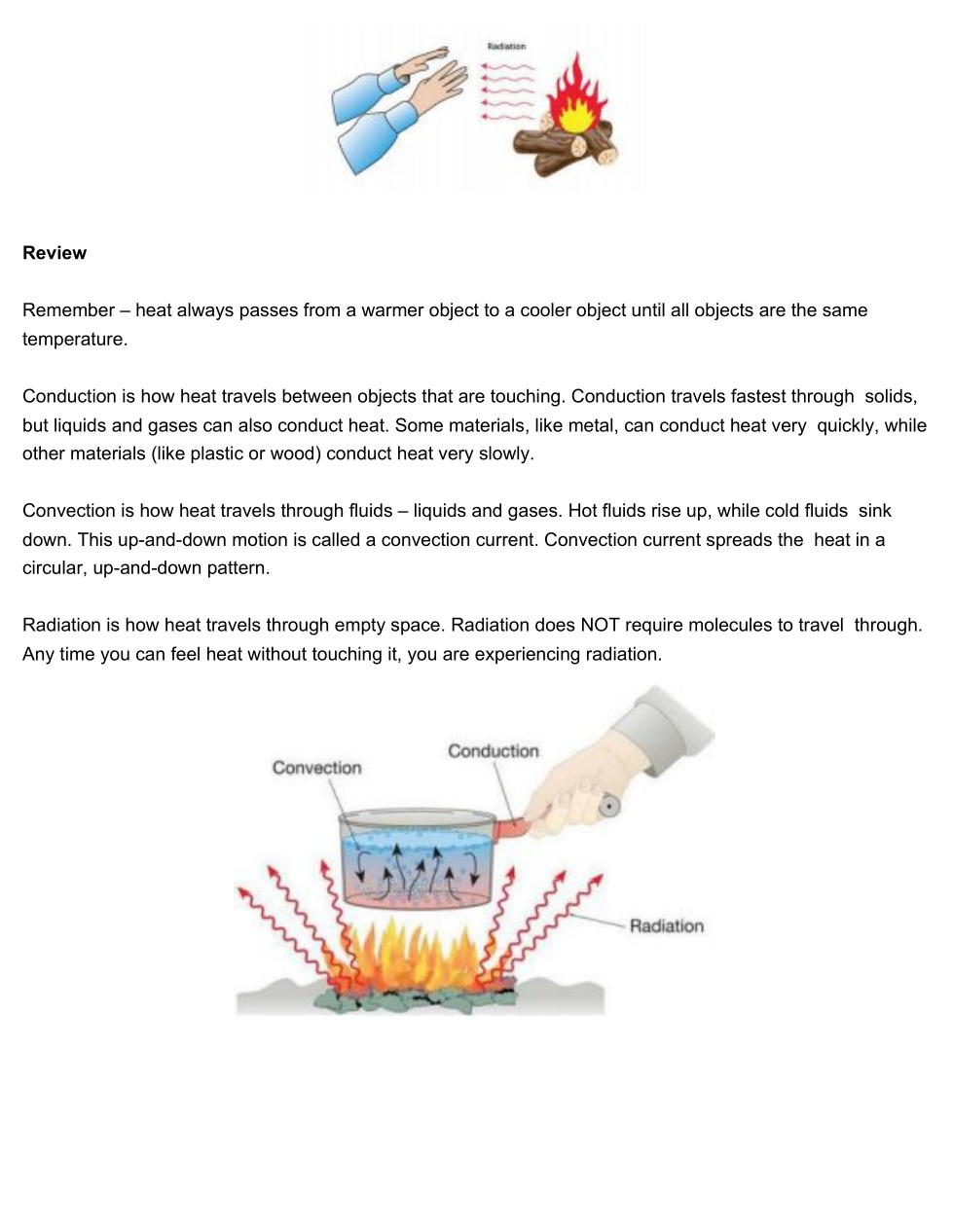
Take a photo or draw an example of each type of heat transfer: convection, conduction, and radiation.
Question 2
2.
Explain the difference between each of the three types of heat transfer.
Question 3
3.
Find something to touch that is cooler than you and something else that is warmer than you.
Why do things feel cool and other things feel warm when you touch them?
Thermodynamics
As you know, energy cannot be created or destroyed. So what happens to energy when an object is heated or cooled? Let’s think about what happens when you place your hands around a mug of hot chocolate. Is heat energy released to the surroundings (your hands), or is it absorbed by the hot chocolate? Your hands start to warm up from holding the hot chocolate, therefore the heat energy must be released by the hot chocolate and absorbed by your hands. This physical reaction is called exothermic.
Thermodynamics is the science that deals with the relationship between heat, pressure, density, and temperature in a substance. Thermodynamics specifically focuses largely on how the transfer of heat is related to various energy changes within a physical system. Those changes in heat usually result in work being done by the system. The changes are guided by the laws of thermodynamics.
An exothermic reaction can be a chemical or a physical object that releases heat energy to its surroundings. The opposite of this reaction is endothermic. An endothermic reaction absorbs heat from its surroundings. Figure 1 shows an example of exothermic and endothermic phenomena you are probably familiar with.
Heat and temperature are not the same thing. Heat is a form of energy; it is measured in calories or joules. Temperature is a measure of the average kinetic energy of the particles in a substance; it is measured in kelvins or degrees.
📷
Question 4
4.
Question 5
5.
Question 6
6.
Question 7
7.
Question 8
8.
Question 9
9.
Question 10
10.
Question 11
11.
Required
1
Required
1
Required
1
Required
1
Required
1
Required
0
Question 18
18.
Optional Acivity to Try at Home! (with adult supervision): Make SUN TEA!
Use the sun's energy to brew tea.
1. Put 4 to 8 tea bags into a santitized 2 quart or gallon glass container (use fewer teabags for a smaller container: 4 teabags for a 2 quart container, 8 tea bags for a gallon container).
Always use a glass container or BPA-free container. Do not use single use plastic water bottle.
2. Fill with water and cap.
3. Place outside where the sunlight can strike the container for about 3 to 4 hours. Move the container if necessary to keep it in the sun. Leaving tea out for too long, brewing in plastic, or not cleaning your sun tea container can cause bacteria to grow into ropey strands or white spots, or make it thick or syrupy consistency; if it does, discard it.
4. When the tea has reached its desired strength, remove from sun and put it in the refrigerator. You may or may not want to remove the tea bags at this point. I usually don't. The tea will probably taste more mellow than what you are used to from using boiling water. The slow steeping has a way of bringing out a slightly different flavor from the tea. Also, because you didn't use boiling water, you should refrigerate the tea and drink it up pretty quickly - a day or two. It will not keep as well as iced tea made from boiling water. I usually make sun tea with various kids of tea, but black tea and green tea are my favorites.
5. Pour the tea into a clear glass. Take a close look to make sure the tea does not have any bacteria as explained above. Add ice and sometimes sweetener or sprigs of mint and enjoy.
Question 19
19.
How are the lessons going for your so far this summer?
Question 20
20.
How long did this lesson take you to complete today?
When a cold stick of butter is left out on the kitchen counter ___________.
there is no flow of heat.
heat is transferred to the stick of butter from the surroundings.
heat from the stick of butter is transferred to the surroundings.
What happens if a metal object heated to 130° Celsius is placed in a container of water that is 24° Celsius?
The object will transfer energy to the water until the water and spoon are the same temperature
The object will maintain its temperature.
The water will transfer energy to the spoon until the water and spoon are the same temperature
The water will begin to boil since the object is hotter than 100° Celsius.
A cup of hot coffee is placed on the counter in a room that is about 22° Celsius. How would you describe the energy of the cup of coffee after two hours?
The energy has increased.
The energy decreased and then increased.
There is no change in energy.
The energy has decreased.
Insulator
The internal energy present in a system due to the kinetic and potential energy of the molecules found within that system
The quantity of heat required to raise the temperature of a substance by one degree Celsius, measured in either calories or joules
A material that does not conduct heat or electrical curren
A measure related to the average kinetic energy of the particles contained in a system
What does thermodynamics say about the flow of energy between two objects of different temperatures?
Thermal energy will always flow from the higher-temperature object to the lower-temperature object.
Thermal energy will not flow until heat is removed from both objects.
Thermal energy will always flow from the lower-temperature object to the higher-temperature object.
There will not be any flow of thermal energy unless more energy is put into the system.
What kind of heat (energy) transfer is making the sun tea brew? (check all that apply)
radiation (from the sun)
conduction (glass jar touching the water)
convection (warm water moving around the jar)
all of the above
If a person places one end of a solid metal bar into a fire, the end that is not in the fire also gets hot. Which of the following methods of energy transfer does this describe?
A. Conduction
B. Convection
C. Radiation
D. Induction
Which of the following is an example of convection?
A. Heating an iron pipe by placing it into a fire
B. Warming one's hands by rubbing them together
C. Melting an ice cube in a microwave
D. Heating water to a rolling boil
Question 12
12.
Question 13
13.
Question 14
14.
Heat will continue to move between objects until ________ is reached? (hint, see page 1 of the reading)
Question 15
15.
Question 16
16.
Question 17
17.
Are there any concepts in this reading that are still unclear or that you need help with?
What method of energy transfer is primarily responsible for moving energy from the Sun to Earth?
A. Conduction
B. Convection
C. Vaporization
D. Radiation
If you sit in a cold metal chair on your back porch when it's 36°F outside the heat will move...
from the chair to your body
from your body to the chair
the heat will not move
What are the 3 ways heat moves (check all that apply)
Concurrent
Convection
Radiation
Reflection
Conduction
Congruent
Conduction can move heat through (check all that apply)
solids
liquids
gases
Convection can move heat through (check all that apply)