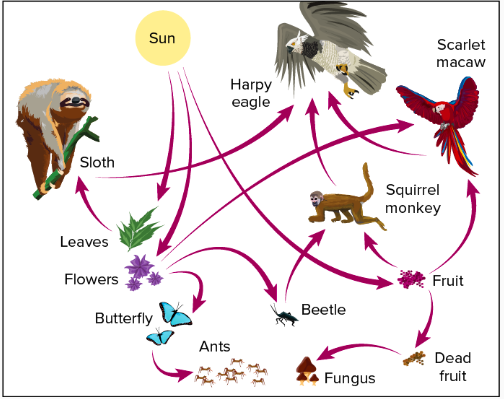
Analyze the food web above. Which statement is true?
Analyze the food web above. Which statement is true?
Greetings!
I will grade submissions at least twice per week, so you will know your score in a day or two after you submit. Also, I may add a comment to your answer in Formative. You can also ask me questions through the comment feature in Formative or email me directly at rshaw@fergflor.org.
As lessons are released, they will stay open, so if you miss a week because of a trip, you can catch up. You can also redo any questions or lessons as many times as you wish.
Let's get started!
Sincerely,
Dr. Shaw
Analyze the food web above. Which statement is true?
Match the term with the definition.
| Draggable item | arrow_right_alt | Corresponding Item |
|---|---|---|
herbivore | arrow_right_alt | an animal that eats other animals |
omnivore | arrow_right_alt | an animal that feeds on dead or decaying matter |
decomposer | arrow_right_alt | an animal that only eats plants |
carnivore | arrow_right_alt | an animal that eats plants and other animals |
Draw arrows to show the transfer of energy among the sun and forest organisms.
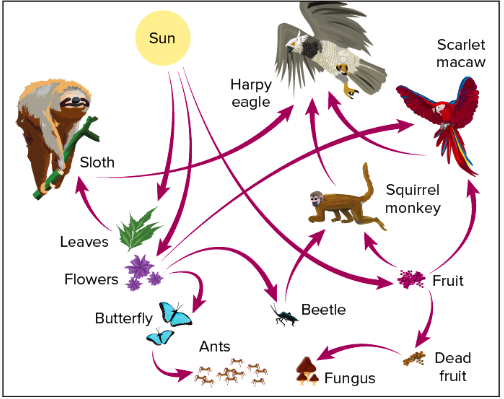
Analyze the food web above. Which of the following are consumers? Select all that apply.
Analyze the food web above. Which of the following are producers? Select all that apply.
In an energy pyramid, approximately 10 percent of the energy available in one trophic level is transferred to the next level. Which statement helps explain why this occurs?
Predict the effect is all great white sharks were removed from an ocean ecosystem. (Hint: How would that affect the organisms they eat and the organisms that the sharks prey eat?)
Watch the video and match the items.
| Draggable item | arrow_right_alt | Corresponding Item |
|---|---|---|
stomata | arrow_right_alt | green substance that absorbs sunlight |
substances plants need to do photosynthesis | arrow_right_alt | process by which plants make their own food |
chlorophyll | arrow_right_alt | sunlight, carbon dioxide, and water |
xylem and phloem | arrow_right_alt | tiny pores in leaves that absorb carbon dioxide |
photosynthesis | arrow_right_alt | absorb water from the soil |
roots | arrow_right_alt | provide animals with oxygen and food and also fight contamination |
plants | arrow_right_alt | tubes within a plant that transports materials used in photosynthesis |
The process in which plants make energy from the sun is known as
A gas released during photosynthesis is
The main source of energy for plants is water.
In the space below, draw and label a diagram of photosynthesis. Be sure to include the terms energy, oxygen, carbon dioxide, water, and glucose.
Read the paragraph below, and then select ALL of the following statements that are correct.
"Most plants grow in soil. They take in sunlight and carbon dioxide through their leaves and nutrients through their roots. Hydroponics is a method of growing plants without soil. Plants are placed in water instead of soil. Even without soil, they still grow."
Upload a photo of a plant (inside or outside). Explain where the plant gets water, sunlight, and CO2.
How long did it take you to complete this lesson?
What model shows the relationship between multiple food chains?
The arrow in a food web points to the consumer (the one that gets the energy).