How would you describe the correlation on this graph?
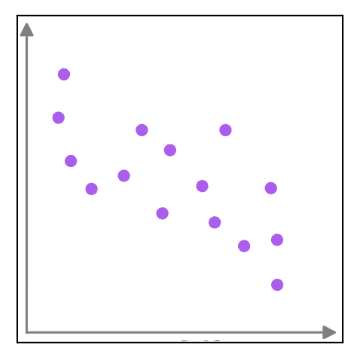
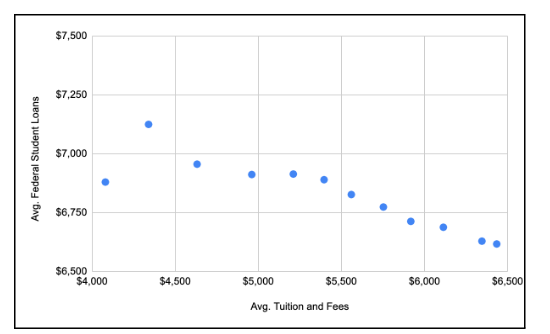
How would you describe the correlation on this graph?
Do you Best! Last Graded Assignment for the School Year!
Do you Best! Last Graded Assignment for the School Year!
The FAFSA is used to determine your eligibility for…
All of the following are potential benefits of attending college EXCEPT…
College graduates are more likely to get a higher paying job
Your employer is required to help you pay back your student loans
A majority of jobs require some college education
College graduates are more likely to work for an employer that offers health insurance
What is the difference between a federal subsidized loan and a federal unsubsidized loan?
Subsidized loans are given to parents, while unsubsidized loans are given to undergraduates
Subsidized loans are charged interest daily, while unsubsidized loans are charged interest monthly
Subsidized loans need to be repaid, while unsubsidized loans do not need to be repaid
Subsidized loans are interest-free until graduation, while unsubsidized loans are charged interest throughout the whole term of the loan
Scout has each of the following options available to her for paying for her first year of college. Which should she choose first?
A work-study job worth $500
A $1,500 scholarship from her father’s employer
A $2,000 subsidized federal loan
A $14,000 private student loan
Which of the following equations is true about college costs?
Sticker Price = Net Price - Scholarships - Loans - Grants
Sticker Price = Net Price - Scholarships - Grants
Net Price = Sticker Price - Grants - Scholarships
Net Price = Sticker Price - Loans - Grants
Horace is going to college and wants to be sure he has enough aid to cover the total cost of attending. All of the following are additional expenses that you should make him aware of EXCEPT…
Fees associated with filling out the FAFSA
Costs of a living in a dorm room or renting off campus
An on-campus meal plan
Textbooks and supplies
How is a Student Aid Report (SAR) different from a financial aid offer?
Student aid report is for public colleges, while financial aid offer is for private colleges
Student aid report comes from the state government, while financial aid offer comes from the federal government
Student aid report is based solely on FAFSA responses, while financial aid offer is customized by each college
Student aid report includes all types of financial support, while financial aid offer is federal loans only
What does it mean for student aid to be merit-based?
The aid is coming from the US military
The aid is based on household income
The aid is based on academic success or other accomplishments
The aid is available for multiple years, rather than just one
Which of the following is true about how frequently you should file the FAFSA?
You need to file the FAFSA once, before you start college
You need to file the FAFSA if you receive a tax refund
You need to file the FAFSA once, after graduation from college
You need to file the FAFSA every year that you attend college
Pipo receives a financial aid package from Bigtown University. What does she need to do next?
Accept the entire offer or risk losing her acceptance at Bigtown University
Register for classes so she will know the exact cost of her tuition, books, and supplies
Complete the FAFSA for next year
Decide which parts of the offer to formally accept and sign any promissory notes
Why are you advised to file your FAFSA as early as possible?
After a certain deadline, you are required to pay a fee to file your FAFSA
Financial aid is awarded on a first come, first served basis so you are more likely to get grants and scholarships by filing early
You have to file your FAFSA before you can complete your federal income tax return
Colleges are more likely to accept you because you took the initiative to file early
All of the following are included on your Student Aid Report (SAR), EXCEPT…
Your Expected Family Contribution
A summary of your FAFSA answers
Offers for grants and scholarships
Directions on how to resolve issues with your FAFSA
A financial aid package could contain each of the following, EXCEPT…
Schedule of first semester classes
Estimated total cost of attendance
Grants and scholarships provided directly from the college
Unsubsidized student loans being offered
Why should a high school senior who has already completed the FAFSA still apply for scholarships as well?
Scholarships almost always have a higher dollar amount than grants or loans do
Scholarships are much easier to qualify for than federal student loans
Scholarships are “free money” that won’t need to be repaid
Scholarships are only offered by prestigious colleges and will help guarantee admission
Which two terms referring to the college financial aid process mean basically the same thing?
Sticker price // Cost of attendance
Sticker price // Net price
Promissory note // Financial aid offer
FAFSA // Financial aid offer
How would you describe the correlation on this graph?
Which statement accurately describes the key features of an observational study?
An observational study influences the members and can NOT demonstrate causation.
An observational study influences the members and can demonstrate causation.
An observational study does NOT influence the members and can demonstrate causation.
An observational study does NOT influence the members and can NOT demonstrate causation.
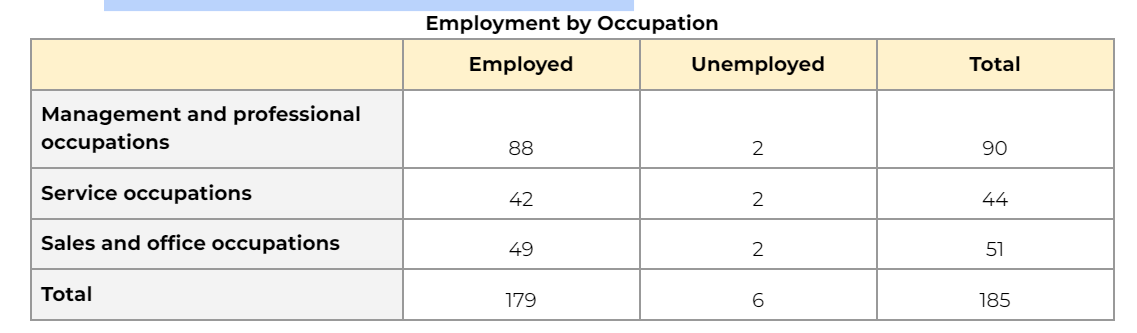
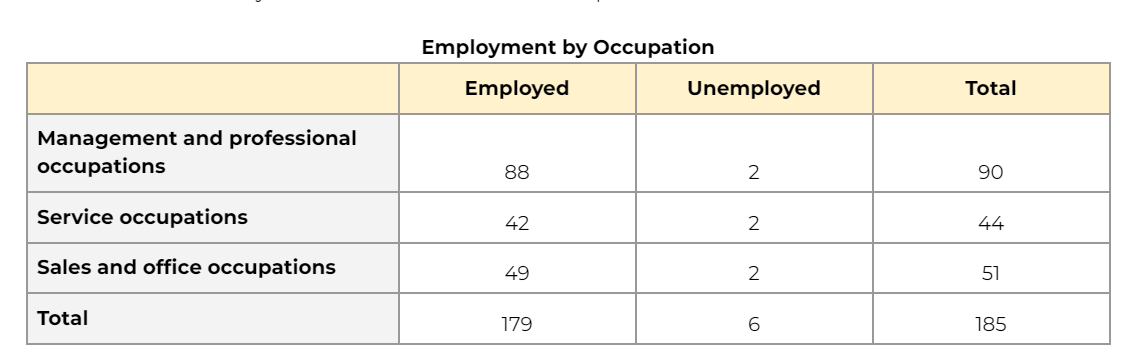
The table below shows survey data about occupation and employment from the Bureau of Labor Statistics. What does the 90 in this table represent?
Which of the following statements is true for a line of best fit with a high r^2 value?
The line has a positive slope
The graphed variables have a causal relationship
The data points fall close to the line
The sum of the squared residuals has been maximized
Which statement below is a correct interpretation from running a hypothesis test at the 95% confidence level and getting a resulting p-value of p = 0.01?
Your p-value is too large to reject the null hypothesis based on this data set
Your p-value is large enough to reject the null hypothesis based on this data set
Your p-value is too small to reject the null hypothesis based on this data set
Your p-value is small enough to reject the null hypothesis based on this data set
The graph below plots the relationship between U.S. university costs and student aid. Using the graph and data provided:
Sketch a line of best fit for this data
Estimate the value of the correlation coefficient, r, for this relationship. Explain your answer about the correlation between the variables using vocabulary from the unit.
Terry looks at the graph and says: “Well, according to this graph, I better not go to an expensive university, because then I won’t get any federal student loans!” What mistake is Terry making, and how could you correct him?
The data comes from full-time, undergraduate students at public universities.
Give an example of a population that this would be a GOOD representative sample for.
Give an example of a population that this would be a POOR representative sample for.
Use the two-way table below to answer each subquestion.
Complete the relative frequency table to find the employment and unemployment rate by occupation. Round to the nearest tenth of a percent
Is there an association between the unemployment rate and occupation? Explain your reasoning.
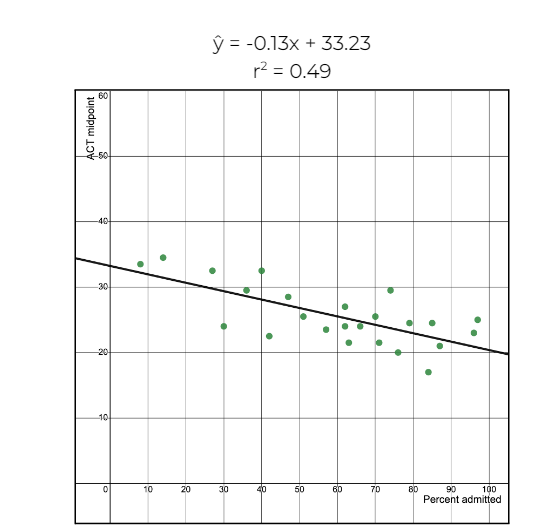
Henry collected data on the percent of applicants admitted and the median ACT score for 24 colleges. Here are the results from his linear regression:
Describe the relationship between the percent of applicants admitted and the ACT midpoint.
Do you think Henry’s line is a good model for the data set? Why or why not?
You are testing the hypothesis that public and private university graduates will make the same starting salary after graduating with a Bachelor’s degree. You believe that public school graduates will make less, on average, than private school graduates given similar skills and experiences. You decide you are going to survey 5000 recent graduates in order to ensure a significant sample size.
You decide to use a stratified sampling method and divide into groups based on similar majors. Explain why this might be a better choice than simple random sampling for a test such as this."
Write your null
After completing your calculations, you find that the mean salary for graduates of private universities is indeed higher than for public universities by approximately $8,200. You are testing at the typical 95% confidence level and your p-value for the test was p = 0.053.
Which of these is the appropriate conclusion to draw from your test? Explain your choice based on the rules for hypothesis testing we discussed.
The p-value indicates that the null hypothesis has been proven false in 5.3% of cases
The p-value tells us there is a 5.3% chance the null hypothesis is wrong
The p-value has determined that the null hypothesis is true 94.7% of the time
The p-value has failed to reject the null hypothesis at the 95% confidence level