Determine the amino acids that were produced in parts 2 and 3 by using either codon chart below.
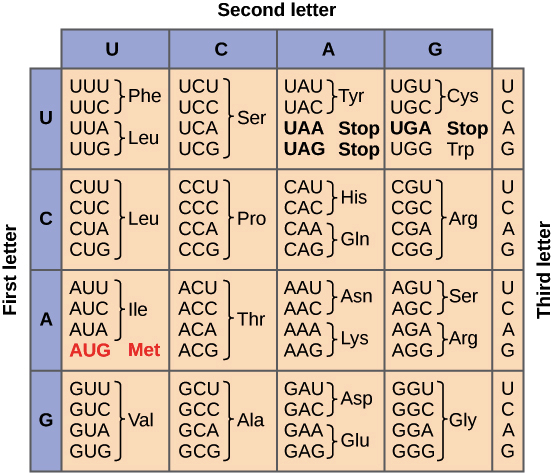
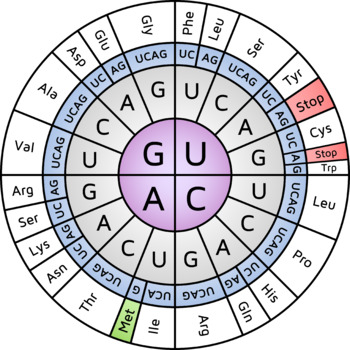
What amino acids do the following codons code for?
AUG:
CUG:
ACC:
UAG:
Before you can complete this assignment, you need to click here log in to Gizmos.
Gizmos switched to their new log in system. Follow the directions in this document to join:
Before you can complete this assignment, you need to click here log in to Gizmos.
Gizmos switched to their new log in system. Follow the directions in this document to join:
Click here to open the Building DNA Gizmo.
Step 1: Build one side of the DNA molecule with the base pairs TCATGAGC
Step 2: Build the other side of the DNA using the base pairing rules.
Once you are done, use the camera in the upper right hand corner to take a screen shot.
Right click on the image and choose "Copy image to clipboard."
Paste the screen shot by click in the free response box and using the keyboard keys Control + V (Command + V on Macs)
Observe: An enzyme is a protein that facilitates certain cell processes.
Drag the blue DNA helicase enzyme onto the DNA strand.
What does this enzyme do to the DNA molecule?
Observe: Drag the yellow DNA polymerase molecule onto the DNA strand.
DNA polymerase adds complementary nucleotides to create new double-stranded DNA molecules.
Step 1: Help the DNA polymerase complete the right DNA strand by adding nucleotides according to base pairing rules.
Step 2: Help the DNA polymerase complete the left DNA strand by adding nucleotides according to base pairing rules.
Once you are done, use the camera in the upper right hand corner to take a screen shot.
Right click on the image and choose "Copy image to clipboard."
Paste the screen shot by click in the free response box and using the keyboard keys Control + V (Command + V on Macs)
Compare the right and left DNA molecules.
Click here to open the RNA and Protein Synthesis Gizmo
Drag the RNA polymerase onto the DNA molecule.
Use the complementary nucleotides to create a strand of mRNA.
Once you are done, use the camera in the upper right hand corner to take a screen shot.
Right click on the image and choose "Copy image to clipboard."
Paste the screen shot by click in the free response box and using the keyboard keys Control + V (Command + V on Macs)
After a strand of mRNA has been built, the strand exits the cell’s nucleus. The second stage of protein synthesis, called translation, occurs next. During translation, the strand of mRNA is used to build a chain of amino acids.
Examine the strand of mRNA. Each group of three bases of mRNA is called a codon.
Match the complementary tRNA anticodon to the corresponding codon on the mRNA strand.
Once you are done, use the camera in the upper right hand corner to take a screen shot.
Right click on the image and choose "Copy image to clipboard."
Paste the screen shot by click in the free response box and using the keyboard keys Control + V (Command + V on Macs)
Determine the amino acids that were produced in parts 2 and 3 by using either codon chart below.
What amino acids do the following codons code for?
AUG:
CUG:
ACC:
UAG: