Log in
Sign up for FREE
arrow_back
Library

5/16 FA 8.1

star
star
star
star
star
Last updated over 2 years ago
55 questions
Note from the author:

OBJECTIVES & STANDARDS

Math Objectives
  • Calculate the interest accrued with different debt payoff methods
Common Core Math Standards
  • Link to all CCSS Math
  • CCSS.HSS.IC.A.1
  • CCSS.HSS.IC.B.6
Personal Finance Objectives
  • Identify dangers of compounding debt
  • Compare different debt repayment options available to debtors
  • Learn about different types of predatory lending and how to avoid it
  • Examine statistics on the prevalence and rates of debt in the U.S.
National Standards for Personal Financial Education
Managing Credit
  • 8b: Explain how a borrower’s credit score can impact their cost of credit and their ability to get credit
  • 10a: Describe how failing to repay a loan can negatively impact a person’s finances and life
  • 10b: Identify sources of assistance with debt management
  • 10c: Create a plan for a person who is having difficulty repaying debt

OBJECTIVES & STANDARDS

Math Objectives
  • Calculate the interest accrued with different debt payoff methods
Common Core Math Standards
  • Link to all CCSS Math
  • CCSS.HSS.IC.A.1
  • CCSS.HSS.IC.B.6
Personal Finance Objectives
  • Identify dangers of compounding debt
  • Compare different debt repayment options available to debtors
  • Learn about different types of predatory lending and how to avoid it
  • Examine statistics on the prevalence and rates of debt in the U.S.
National Standards for Personal Financial Education
Managing Credit
  • 8b: Explain how a borrower’s credit score can impact their cost of credit and their ability to get credit
  • 10a: Describe how failing to repay a loan can negatively impact a person’s finances and life
  • 10b: Identify sources of assistance with debt management
  • 10c: Create a plan for a person who is having difficulty repaying debt
Intro
Learn It
CALCULATE: Debt Avalanche v. Debt Snowball
Learn It
Exit Ticket
1
1
1
The End!

QUESTION OF THE DAY: What percent of Americans who have credit card debt won't be able to pay it off within a year?

Debt is not a common subject of conversation, so it can easily feel overwhelming. It can be helpful to know how common debt problems are when faced with debt to know you are not alone.  Answer the question on the first slide in the box. Then, compare your answer to the answer on the second slide. Finally, follow your teacher’s directions on how to answer the follow-up questions on the last slide.
Required
1
Question 1
1.
What percent of Americans who have credit card debt won't be able to pay it off within a year?_______

INFOGRAPHIC: Experian 2021 Consumer Credit Review

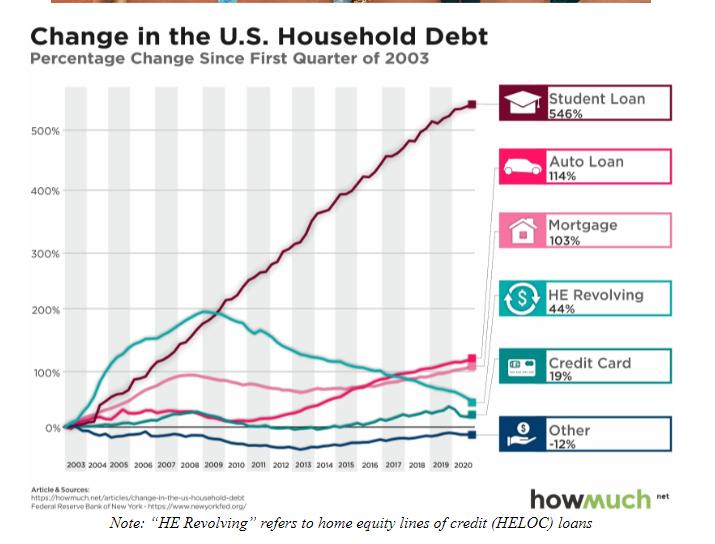
GRAPH: Charting 17 Years of American Household Debt

The “normal” amount of debt for an average person can be a tough question to answer, but can be a useful benchmark when considering your own decisions around loans. Take a look at this infographic and this graph depicting different aspects of debt in the U.S. Then, answer the questions.


Required
1
Required
1
Required
1
Required
1
Required
1

INFOGRAPHIC: The Consequences of Unpaid Debt

Just as you saw in the game, unpaid debt has consequences in real life too, often serious ones. NerdWallet has compiled this list of potential consequences of missing payments.. Use the chart to answer:
Required
1
Question 7
7.

Foreclosure and repossession are when you lose the rights of your property and the lender takes ownership of it. What types of loans could result in the seizure of your property?

Required
5
Question 8
8.

Wage garnishment is when payments are deducted from your wages before you are paid. In general, which type of loans can lead to wage garnishment if not paid on time?

Required
1

VIDEO: Debt Snowball vs Avalanche Method: Best Way to Pay Off Debt?

Let’s say you’re ready to start paying off your debt, but you aren’t sure how to allocate your funds, and there are a variety of ways you can approach it. Watch the video to learn about two of the most popular payoff structures, and then answer the questions.
Briefly describe the two methods in your own words.
Required
1
Required
1
Required
1
Required
1
Required
1
Let’s assume you’re the “average American” holding debt. What’s the best method to repay your loans - the Debt Avalanche Method or the Debt Snowball Method?
According to Debt Avalanche vs. Debt Snowball: What's the Difference?
  • Debt Avalanche: make minimum payments on all debt accounts. Contribute any additional money towards the highest interest rate debt.
  • Debt Snowball: make minimum payments on all debt accounts. Contribute any additional money towards the lowest balance account.
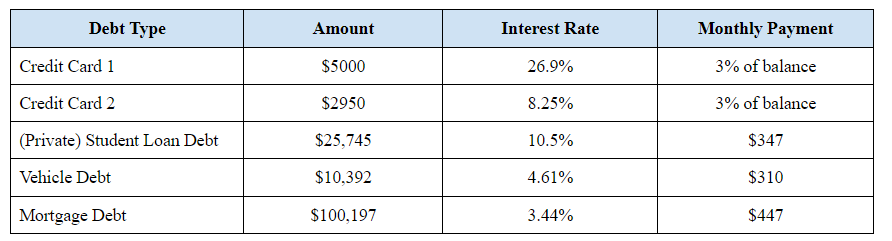
Assume you’ve got $1400 each month to contribute toward your debts. Assume you’re living a cash lifestyle from now on and not adding to any of these balances.
Here’s a snapshot of your monthly debt obligations:

Required
1
Question 15
15.

For each method, predict the order that the debts will be paid off.

Required
1
Required
1
Make a copy of Vertex42.com’s Debt Reduction Calculator. Enter your 5 debts (Note: To enter 3% of balance, type =.03*The location of your balance.  Example  =.03*C8), set your Monthly Payment to $1400 and set the Strategy dropdown menu to Avalanche (Highest Interest First).  Use the results to answer the following questions:
1
1
1
1
1
1
1
1
1
1
1
1
1
1
1
1
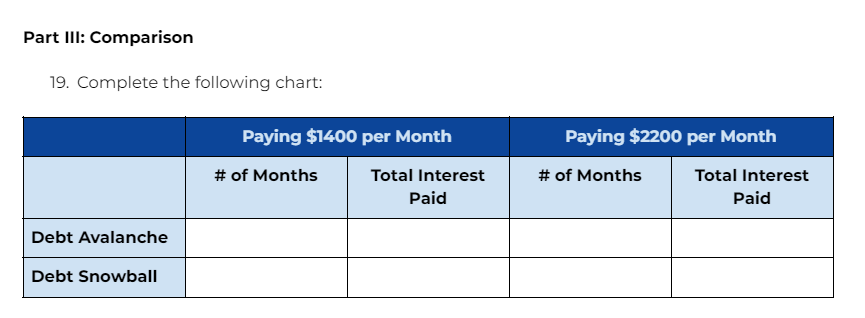
As a class Complete the following Chart and Answer the Questions independently:

1
Question 34
34.

What is an advantage to using the Debt Avalanche method?

1
Question 35
35.

What is an advantage to using the Debt Snowball method?

1
Question 36
36.

A friend says, “The most important thing you can do, to minimize your debt quickly, is to use the Debt Avalanche Method.” Do you agree or disagree? Explain your answer.

VIDEO: Payday Loans Explained

VIDEO: Payday Loans Can Trap Consumers With Interest Rates, Hidden Fees

Watch these videos to get a better understanding of what payday loans actually are, who uses them, and how they can lead to a cycle of debt! Then, answer the questions.
1
Question 37
37.

How are payday loans different from other loan types you’ve learned about?

3
Question 38
38.
Let's consider the example in the video. Sally takes out a $375 loan and can't afford to repay it after two weeks. She pays a $55 renewal fee every two weeks. Assuming she has to renew that loan as stated in the video:
a. After 6 months (26 weeks), how much would she have paid in fees?_______
b. How much would she pay in fees over 1 year of renewing the loan?_______
c. To compare the cost of loans, we can calculate the APR, which is the total cost of the loan, including fees and interest, divided by the principal. Since this type of loan just has fees, use the formula APR = fees/principal *100 to calculate the APR for this loan after one year expressed as a percentage._______
1
1

ARTICLE: Predatory Lending

Debt can sometimes stack up due to our own choices, but other times we are taken advantage of by unfair lenders. Payday loans are just one practice that can trap borrowers into a cycle of debt. Skim the section titled “Predatory Lending Tactics to Watch Out For” to learn about other predatory practices, and then answer the questions.
1
Question 41
41.

Choose ONE of these practices that you think poses a significant risk to borrowers. Give a brief definition of that tactic in your own words.

1
Question 42
42.

Why did this tactic stand out to you?

1
Question 43
43.

Explain how this tactic could contribute to a cycle of debt.

ARTICLE: How to Manage Debt of Any Size

If you are unable to manage a program on your own or extenuating circumstances apply, there are organizations explicitly to help you get back on track. These debt relief services are often free or low-cost and the biggest barrier to obtaining them is knowing they’re there in the first place.
1
Question 44
44.

What is always the first step in beginning to tackle your debt? Why do you think this step is important?

1
Question 45
45.

The article recommends making at least the minimum payments and always paying on time. What can you avoid by following these two rules?

1
1
1

VIDEO: 4 Ways to Deal with Debt Shame

Debt can be a stressful thing, but there are some steps you can take if you find yourself in debt to help you work your way out. Watch this video on understanding debt shame and some keys to working through it, and then answer the questions.
1
Question 49
49.

What are some potential non-financial costs to living with debt?

1
Question 50
50.

How might the emotional impacts described make it more difficult to manage your debt?

1
Question 51
51.

Why do you think it is common for people to feel shame about being in debt?

1
Question 53
53.

  1. Which accurately compares the interest and payback term of the debt avalanche vs. snowball?
  2. The avalanche pays more interest and has a longer term than the snowball
  3. The avalanche pays more interest and has a shorter term than the snowball
  4. The avalanche pays less interest and has a longer term than the snowball
  5. The avalanche pays less interest and has a shorter term than the snowball

Question 54
54.

Which of these is a common predatory lending tactic to watch out for?
  1. Balloon payments
  2. Subscription services
  3. Origination fees
  4. Loan skimming

Question 55
55.

Which of these students has an accurate statement on debt in America?
  1. Gerardo: “There is no excuse for anyone to have debt. If you work hard enough, you should always be able to avoid debt.”
  2. José: “High debt balances are relatively uncommon in America and usually only the result of an emergency or surprise expense.”
  3. Manu: “Many people have many different types of debt, and it is relatively common for Americans to carry some debt.”
  4. Blaise: “Credit card debt makes up the largest portion of household debt for most Americans today.”

Question 2
2.
Aside from mortgages, what is the largest source of debt for most Americans on average?_______
Question 3
3.
What debt has grown by the largest percentage since 2003?_______ has grown by _______ %.
Question 4
4.

Over the same time period, the bottom 90% of workers' income rose just over 10%. How does that growth compare the growth of household debt? How might that impact workers?

Question 5
5.

What factors do you think may have contributed to the increase of these debts over time?

Question 6
6.

These graphics are examples of inferential statistics because they took a smaller sample and from those answers made inferences about the larger U.S. population.  What other interesting or surprising inferences can you draw from any of these graphics?

Question 9
9.

What do you think might be some other consequences of carrying unpaid debts, besides what is listed in the chart?

Question 10
10.

Avalanche Method:

Question 11
11.

Snowball Method:

What are the benefits of each method?
Question 12
12.

Avalanche Method:

Question 13
13.

Snowball Method:

Question 14
14.

Which method do you think would work best for you, if you were trying to pay off debts? Explain why.

Question 16
16.

Which method do you think will cost the least amount of total interest when all debts have been repaid?

Question 17
17.

Which method do you think will pay off all debts in the least amount of time?

Question 18
18.
How long does it take to pay off all of your debt?_______
Question 19
19.
How much total interest do you pay on your debts?_______
Question 20
20.

List the debts in which order they are paid off:

Question 21
21.

At the end of 4 years, how many of the original 5 debts do you have remaining?

Question 22
22.

A standard repayment term for a student loan is typically 10 years or 120 months. How long does it take you to repay your student loan using this method?

Question 23
23.

A standard repayment term for a home loan is 30 years, or 360 months. How long does it take you to repay your mortgage using this method?

Question 24
24.

Why are your student loan and home loan paid more quickly using this method than if you had followed their standard repayment plan?

Following advice on how to pay down debt more quickly, you cut out unnecessary spending in your budget, and you pick up a side job that generates an extra $200 per week or $800 per month. Now, instead of paying $1400 toward your debts per month, you’re paying $2200.
Question 25
25.

How long does it take to repay your debt now?

Question 26
26.

How much total interest do you pay on your debts?

Part II: Debt Snowball
On the Debt Reduction Calculator Spreadsheet, change the Strategy dropdown menu to Snowball (Lowest Balance First) and your Monthly Balance back to $1400.
Question 27
27.
How long does it take to pay off this debt?_______
Question 28
28.
How much total interest do you pay on your debts?_______
Question 29
29.

List the debts in which order they are paid off:

Question 30
30.
How long does it take to pay off the lowest balance credit card, with a balance of $2950?_______
Question 31
31.

If the whole point of Debt Snowball is to pay off your smallest debt first, why not devote the full $1400 each month toward that credit card, and pay it off in 3 months?

Question 32
32.

At the end of 4 years, how many of the original 5 debts do you have remaining?

Question 33
33.
Just like before, you make changes to your lifestyle and now, instead of paying $1400 toward your debts per month, you’re paying $2200.
a. How long does it take to repay your debt now?_______
b. How much total interest do you pay on your debts?_______
Question 39
39.

Why do you think so many people still use payday loans despite the financial dangers?

Question 40
40.

Your friend says: “Payday loans are a perfect short term fix in an emergency!” What would you say in response to your friend’s statement?

Question 46
46.

What do you think is the benefit of building up an emergency fund, even when you are working on paying off debts?

Question 47
47.

What are two options you could explore further if you find yourself overwhelmed with debt and unable to make all your payments?

Question 48
48.

The tip at the end of the article emphasizes the importance of distinguishing between “needs” and “wants.” While this might be the problem for some, others might face different difficulties in overcoming debt. Looking at the larger debt amounts from the graphic resources at the beginning of the lesson, what category (needs or wants) do you think those fall under, and how would those rising costs impact a person struggling with debt?

Question 52
52.

Summarize the 4 keys this video recommends for dealing with debt shame.