Genetics, DNA, RNA, Protein Synthesis Test Summer School 2023
star
star
star
star
star
Last updated over 1 year ago
28 questions
Note from the author:
Don't forget you can use your notes!
Required
1 point
1
Question 1
1.
The Punnett square shown below describes a cross between two pea plants. The letter T represents the dominant allele for tall plant height, and the letter t represents the recessive allele for short plant height.
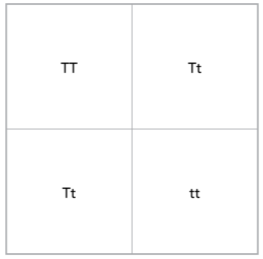
What were the genotypes of the parents that produced the offspring in the Punnett square?
Required
1 point
1
Question 2
2.
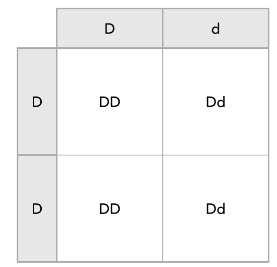
Study the Punnett square shown here. It describes the potential offspring of a cross between two parents.
What phenotypes will be shown by the offspring?
Required
1 point
1
Question 3
3.
What did Gregor Mendel study in his pea plant experiments?
Required
1 point
1
Question 4
4.
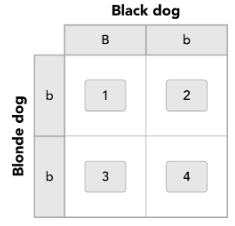
One dog is heterozygous for black fur (Bb), and its mate is homozygous for blonde fur (bb). The Punnett square describes a cross between the two dogs.
What is the expected outcome of the cross?
Required
1 point
1
Question 5
5.
Meiosis creates 4 identical daughter cells, leading to identical parents and offspring.
Required
1 point
1
Question 6
6.
Alvin is studying a model of the chemical structure of a common nucleic acid. He observes that the nucleic acid consists of four nitrogenous bases: adenine (A), cytosine (C), guanine (G), and uracil (U).
Alvin’s observation most strongly supports which of these conclusions?
Required
1 point
1
Question 7
7.
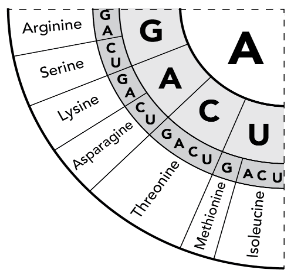
The diagram shows a portion of the genetic code. The diagram is read from the center of the circle outwards. So, the codon AGU is translated as serine, which is an amino acid.
Which conclusion about the genetic code is most strongly supported by the evidence presented in the diagram?
Required
1 point
1
Question 8
8.
A sequence of mRNA contains the following bases, which are translated as three codons.
ACUACGACA
Which amino acids are produced by this sequence? Select all of the amino acids that apply.
Required
1 point
1
Question 9
9.
If 15% of an organism’s DNA is thymine, what is the percentage of guanine?
Required
1 point
1
Question 10
10.
A scientist uses radioactive isotopes to label a double-stranded molecule of DNA. Then the DNA undergoes replication in a non-radioactive medium. Where are the two original radioactive strands of DNA?
Required
1 point
1
Question 11
11.
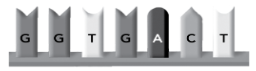
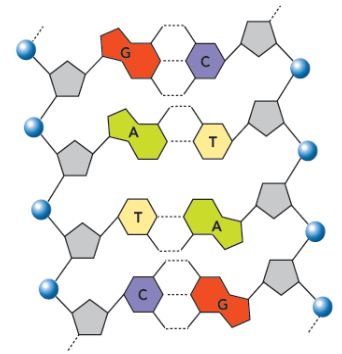
The sequence of nitrogenous bases on a portion of a strand of DNA is shown in the diagram. From left to right, what is the corresponding sequence of the complementary strand?
Required
1 point
1
Question 12
12.
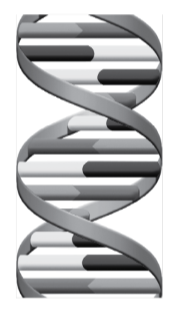
The model of the double-helix model of the DNA molecule resembles a twisted ladder.
What makes up the rungs of the twisted ladder?
Required
1 point
1
Question 13
13.
This figure shows a section of a double-stranded DNA molecule.
What aspects of the structure of DNA are explained by this model? Select three
answer choices.
Required
1 point
1
Question 14
14.
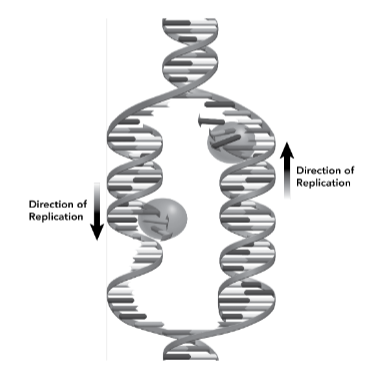
The diagram shows a model of DNA replication.
Which of the following labels should NOT be added to the model?
Required
1 point
1
Question 15
15.
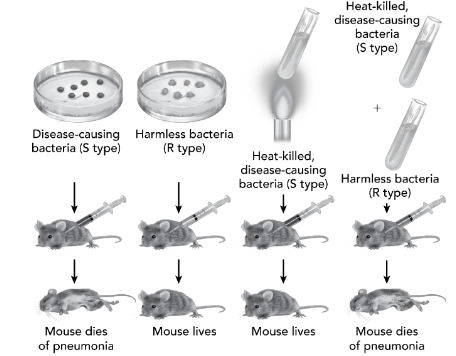
Griffith investigated how certain types of bacteria produce pneumonia in mice. The diagram outlines his experiments. What did Griffith conclude from these experiments?
Required
1 point
1
Question 16
16.
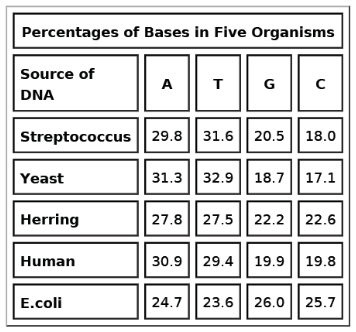
The table shows data that Chargaff collected on nitrogenous bases in the DNA in five organisms.
Which statement did Chargaff conclude based on these data? (Note: A letter in brackets, such as [A] or [C], refers to the concentration of one of the nitrogenous bases.)
Required
1 point
1
Question 17
17.
What is the process of creating an RNA molecule from a DNA sequence?
Required
1 point
1
Question 18
18.
Which molecule serves as the template for protein synthesis?
Required
1 point
1
Question 19
19.
What is a DNA nucleotide made up of?
Required
1 point
1
Question 20
20.
Which molecule helps transfer amino acids to the ribosome during protein synthesis?
Required
1 point
1
Question 21
21.
What is the primary function of DNA helicase?
Required
1 point
1
Question 22
22.
What is the enzyme responsible for adding new nucleotides and proofreading during DNA replication?
Required
1 point
1
Question 23
23.
Which molecule is single-stranded and contains uracil?
Required
1.5 points
1.5
Question 24
24.
What are the three main functions of DNA?
Required
1 point
1
Question 25
25.
What is the DNA base-pair rule?
Required
1 point
1
Question 26
26.
A point mutation changes a codon in an mRNA molecule. Will the mutation affect the protein that forms? Why?
Required
1 point
1
Question 27
27.
There are three main types of RNA: messenger RNA (mRNA), ribosomal RNA (rRNA), and transfer RNA (tRNA).
Which type or types of RNA contain a copy of the instructions that a gene
carries?
Required
1 point
1
Question 28
28.
Robert is studying a long list of letters. The letters represent the order of
nitrogenous bases in a molecule of mRNA. The first several bases in the list are
shown below.
AUGCCACAGGUUCAUCCGAA…
To identify the amino acid sequence encoded by the mRNA, which would be the