You have a few options for this assignment.
Option 1
First read the section from a 1977 article titled "Pinto Madness" and answer the related questions. Then, read the two passages about the article's source, Mother Jones, and answer the related questions.
Option 2
Prefer to watch a video? First, watch this video: Was the Ford Pinto Really That Dangerous?, which provides a lot of important information about the Ford Pinto. You should still be able to answer most of the questions in the Pinto Madness section of this assignment. Then, read the two passages about the article's source, Mother Jones, and answer the related questions.
You have a few options for this assignment.
Option 1
First read the section from a 1977 article titled "Pinto Madness" and answer the related questions. Then, read the two passages about the article's source, Mother Jones, and answer the related questions.
Option 2
Prefer to watch a video? First, watch this video: Was the Ford Pinto Really That Dangerous?, which provides a lot of important information about the Ford Pinto. You should still be able to answer most of the questions in the Pinto Madness section of this assignment. Then, read the two passages about the article's source, Mother Jones, and answer the related questions.
POLITICS - SEPTEMBER/OCTOBER 1977 ISSUE
Pinto Madness
A Mother Jones Classic: For seven years the Ford Motor Company sold cars in which it knew hundreds of people would needlessly burn to death.
One evening in the mid-1960s, Arjay Miller was driving home from his office in Dearborn, Michigan, in the four-door Lincoln Continental that went with his job as president of the Ford Motor Company. On a crowded highway, another car struck his from the rear. The Continental spun around and burst into flames. Because he was wearing a shoulder-strap seat belt, Miller was unharmed by the crash, and because his doors didn’t jam he escaped the gasoline-drenched, flaming wreck. But the accident made a vivid impression on him. Several months later, on July 15, 1965, he recounted it to a U.S. Senate subcommittee that was hearing testimony on auto safety legislation. “I still have burning in my mind the image of that gas tank on fire,” Miller said. He went on to express an almost passionate interest in controlling fuel-fed fires in cars that crash or roll over. He spoke with excitement about the fabric gas tank Ford was testing at that very moment. “If it proves out,” he promised the senators, it will be a feature you will see in our standard cars.”
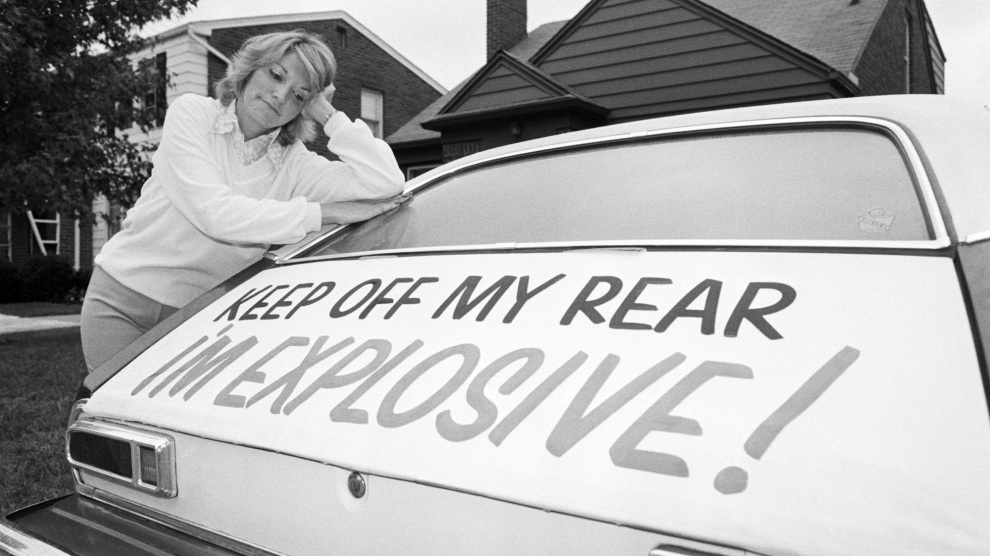
Almost seven years after Miller’s testimony, a woman, whom for legal reasons we will call Sandra Gillespie, pulled onto a Minneapolis highway in her new Ford Pinto. Riding with her was a young boy, whom we’ll call Robbie Carlton. As she entered a merge lane, Sandra Gillespie’s car stalled. Another car rear-ended hers at an impact speed of 28 miles per hour. The Pinto’s gas tank ruptured. Vapors from it mixed quickly with the air in the passenger compartment. A spark ignited the mixture and the car exploded in a ball of fire. Sandra died in agony a few hours later in an emergency hospital. Her passenger, 13-year-old Robbie Carlton, is still alive; he has just come home from another futile operation aimed at grafting a new ear and nose from skin on the few unscarred portions of his badly burned body. (This accident is real; the details are from police reports.)
Why did Sandra Gillespie’s Ford Pinto catch fire so easily, seven years after Ford’s Arjay Miller made his apparently sincere pronouncements—the same seven years that brought more safety improvements to cars than any other period in automotive history? An extensive investigation by Mother Jones over the past six months has found these answers:
Fighting strong competition from Volkswagen for the lucrative small-car market, the Ford Motor Company rushed the Pinto into production in much less than the usual time.
Ford engineers discovered in pre-production crash tests that rear-end collisions would rupture the Pinto’s fuel system extremely easily. Because assembly-line machinery was already tooled when engineers found this defect, top Ford officials decided to manufacture the car anyway—exploding gas tank and all—even though Ford owned the patent on a much safer gas tank.
For more than eight years afterwards, Ford successfully lobbied, with extraordinary vigor and some blatant lies, against a key government safety standard that would have forced the company to change the Pinto’s fire-prone gas tank. By conservative estimates Pinto crashes have caused 500 burn deaths to people who would not have been seriously injured if the car had not burst into flames. The figure could be as high as 900. Burning Pintos have become such an embarrassment to Ford that its advertising agency, J. Walter Thompson, dropped a line from the end of a radio spot that read “Pinto leaves you with that warm feeling.” Ford knows the Pinto is a firetrap, yet it has paid out millions to settle damage suits out of court, and it is prepared to spend millions more lobbying against safety standards. With a half million cars rolling off the assembly lines each year, Pinto is the biggest-selling subcompact in America, and the company’s operating profit on the car is fantastic. Finally, in 1977, new Pinto models have incorporated a few minor alterations necessary to meet that federal standard Ford managed to hold off for eight years. Why did the company delay so long in making these minimal, inexpensive improvements?
Ford waited eight years because its internal “cost-benefit analysis,” which places a dollar value on human life, said it wasn’t profitable to make the changes sooner.Before we get to the question of how much Ford thinks your life is worth, let’s trace the history of the death trap itself. Although this particular story is about the Pinto, the way in which Ford made its decision is typical of the U.S. auto industry generally. There are plenty of similar stories about other cars made by other companies. But this case is the worst of them all.The next time you drive behind a Pinto (with over two million of them on the road, you shouldn’t have much trouble finding one), take a look at the rear end. That long silvery object hanging down under the bumper is the gas tank. The tank begins about six inches forward of the bumper. In late models the bumper is designed to withstand a collision of only about five miles per hour. Earlier bumpers may as well not have been on the car for all the protection they offered the gas tank.
Mother Jones has studied hundreds of reports and documents on rear-end collisions involving Pintos. These reports conclusively reveal that if you ran into that Pinto you were following at over 30 miles per hour, the rear end of the car would buckle like an accordion, right up to the back seat. The tube leading to the gas-tank cap would be ripped away from the tank itself, and gas would immediately begin sloshing onto the road around the car. The buckled gas tank would be jammed up against the differential housing (that big bulge in the middle of your rear axle), which contains four sharp, protruding bolts likely to gash holes in the tank and spill still more gas. Now all you need is a spark from a cigarette, ignition, or scraping metal, and both cars would be engulfed in flames. If you gave that Pinto a really good whack—say, at 40 mph—chances are excellent that its doors would jam and you would have to stand by and watch its trapped passengers burn to death.
This scenario is no news to Ford. Internal company documents in our possession show that Ford has crash-tested the Pinto at a top-secret site more than 40 times and that every test made at over 25 mph without special structural alteration of the car has resulted in a ruptured fuel tank. Despite this, Ford officials denied under oath having crash-tested the Pinto.
Eleven of these tests, averaging a 31-mph impact speed, came before Pintos started rolling out of the factories. Only three cars passed the test with unbroken fuel tanks. In one of them an inexpensive light-weight plastic baffle was placed between the front of the gas tank and the differential housing, so those four bolts would not perforate the tank. (Don’t forget about that little piece of plastic, which costs one dollar and weighs one pound. It plays an important role in our story later on.) In another successful test, a piece of steel was placed between the tank and the bumper. In the third test car the gas tank was lined with a rubber bladder. But none of these protective alterations was used in the mass-produced Pinto.
Mother Jones claimed that they studied hundreds of reports and documents before they published their report on the Ford Pinto.
Whether Ford should manufacture subcompacts at all was the subject of a bitter two-year debate at the company’s Dearborn headquarters. The principals in this corporate struggle were the then-president Semon “Bunky” Knudsen, whom Henry Ford II had hired away from General Motors, and Lee Iacocca, a spunky Young Turk who had risen fast within the company on the enormous success of the Mustang. Iacocca argued forcefully that Volkswagen and the Japanese were going to capture the entire American subcompact market unless Ford put out its own alternative to the VW Beetle. Bunky Knudsen said, in effect: let them have the small-car market; Ford makes good money on medium and large models. But he lost the battle and later resigned. Iacocca became president and almost immediately began a rush program to produce the Pinto.
Like the Mustang, the Pinto became known in the company as “Lee’s car.” Lee Iacocca wanted that little car in the showrooms of America with the 1971 models. So he ordered his engineering vice president, Bob Alexander, to oversee what was probably the shortest production planning period in modern automotive history. The normal time span from conception to production of a new car model is about 43 months. The Pinto schedule was set at just under 25.
[the article continues if you click the Pinto Madness link below, but you are not required to continue reading the article]
Source: Pinto Madness
Every top executive at Ford believed that it was extremely important for Ford to manufacture the Pinto.
List one reason why it might be a bad idea to just jump to the conclusion that Mother Jones wanted us to reach in that excerpt.
The author of this Mother Jones article would be an example of .
Explain why many people would consider Ford's actions regarding the Pinto to be a conspiracy (and NOT a conspiracy theory).
List two similarities between the Big Tobacco conspiracy and the Ford Pinto conspiracy.
The following excerpt is from the "About" page on the Mother Jones website.
What Is Mother Jones?
Mother Jones is a reader-supported investigative news organization honored as Magazine of the Year by our peers in the industry. Our nonprofit newsroom goes deep on the biggest stories of the moment, from politics and criminal and racial justice to education, climate change, and food/agriculture.
We reach 8 million people each month via our website, social media, videos, email newsletters, and print magazine. Our fellowship program is one of the premier training grounds for emerging investigative storytellers.
Founded in 1976, Mother Jones is America’s longest-established investigative news organization. We are based in San Francisco and have bureaus in Washington, DC, and New York.
We are independent (no corporate owners) and are accountable only to you, our readers. Our mission is to deliver hard-hitting reporting that inspires change and combats “alternative facts.”
Mother Jones is often identified as “liberal.” Are you biased?
Our bias is for the truth, for fairness and justice, for a democracy in which facts matter and all can participate. It’s not a partisan position—we believe these values are bigger than party—but it is a point of view, and we believe journalism should be transparent about its values. We also believe in investigating any story worth digging into, and in rigorously following the facts where they lead; our fact-checking and verification protocol is one of the most extensive in the industry.
Source: Mother Jones "About" Page
As shown in this excerpt, which branch of government holds hearings about important issues before new laws get passed?
In these hearings, lawmakers listen to testimony prior to making any decisions. Which of the following would be the best definition of the word testimony?
How was Sandra Gillespie's death connected to the testimony given by Ford Motor Company President Arjay Miller in 1965?
In 1977, Mother Jones released a report explaining the reasons why they believed the Ford Pinto was allowed to be sold despite the dangers. Check off all of the following claims that Mother Jones made in their report.
Read the bolded paragraph that begins with "This scenario is no news to Ford." Find something in this paragraph that demonstrates how the Ford Pinto could meet the criteria for an actual conspiracy (remember the key elements of conspiracy = secret agreement or plan; illegal or harmful actions; for political or financial motives).
Once Ford started manufacturing Pintos, there were no easy or inexpensive ways for them to fix the problems with the fuel tank.
Read the bolded section that begins with "The normal time span..." Which of the following conclusions did Mother Jones want you to draw from this excerpt?
Passage One is from Mother Jones' own website. List one advantage and one disadvantage of going to an organization's own website to learn information about that organization.
Passage Two is from the Wikipedia entry for Mother Jones magazine. List one advantage and one disadvantage of going to Wikipedia to learn information about an organization.
There are differences in the way that Mother Jones describes itself compared to the way that Wikipedia describes Mother Jones.