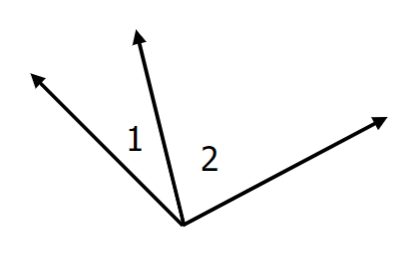
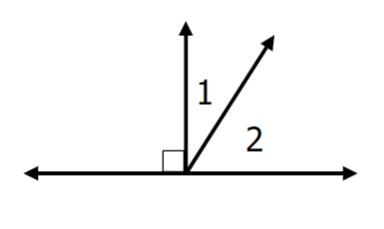
Select all the adjacent angles to ∠1
Select all the adjacent angles to ∠1
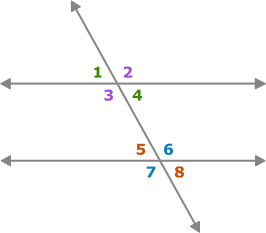
Match the definition of the angle relationship with the angle relationships it describes...
| Draggable item | arrow_right_alt | Corresponding Item |
|---|---|---|
Two angles that are adjacent and supplementary. They form astraight line! | arrow_right_alt | Vertical angles |
Two angles that share a vertex and a common side. They are next to each other | arrow_right_alt | Supplementary angles |
Two angles across from each other on intersecting lines. They share a vertex and they are always congruent! | arrow_right_alt | Complementary angles |
Any two angles whose sum is 180° | arrow_right_alt | Linear pairs |
Any two angles whose sum is 90° | arrow_right_alt | Adjacent Angles |
Select all the adjacent angles to ∠1
Select all the vertical angles to ∠6
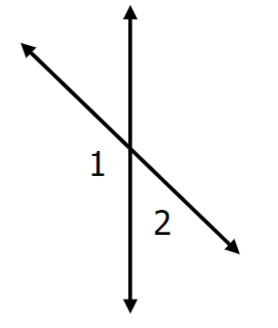
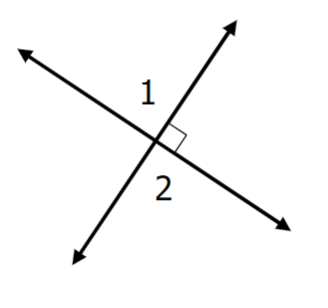
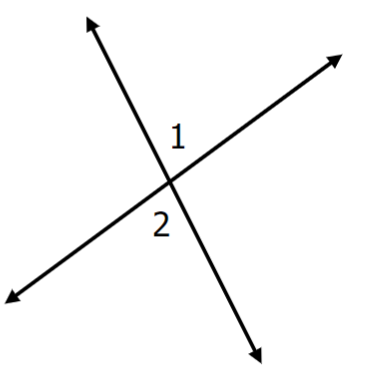
Match the image with the angle relationship that best describes it...
| Draggable item | arrow_right_alt | Corresponding Item |
|---|---|---|
| arrow_right_alt | Vertical angles | |
| arrow_right_alt | Supplementary angles | |
| arrow_right_alt | Complementary angles | |
| arrow_right_alt | Linear pairs | |
| arrow_right_alt | Adjacent Angles |
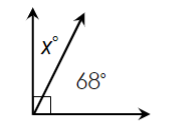
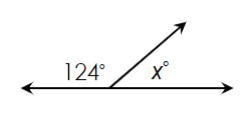
What is the value of x?
What is the value of x?
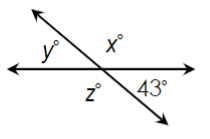
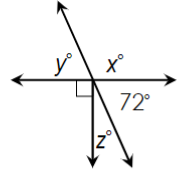
What are the values of x, y, and z?
x°=
y°=
z°=
What is the values of x, y, and z?
x°=
y°=
z°=
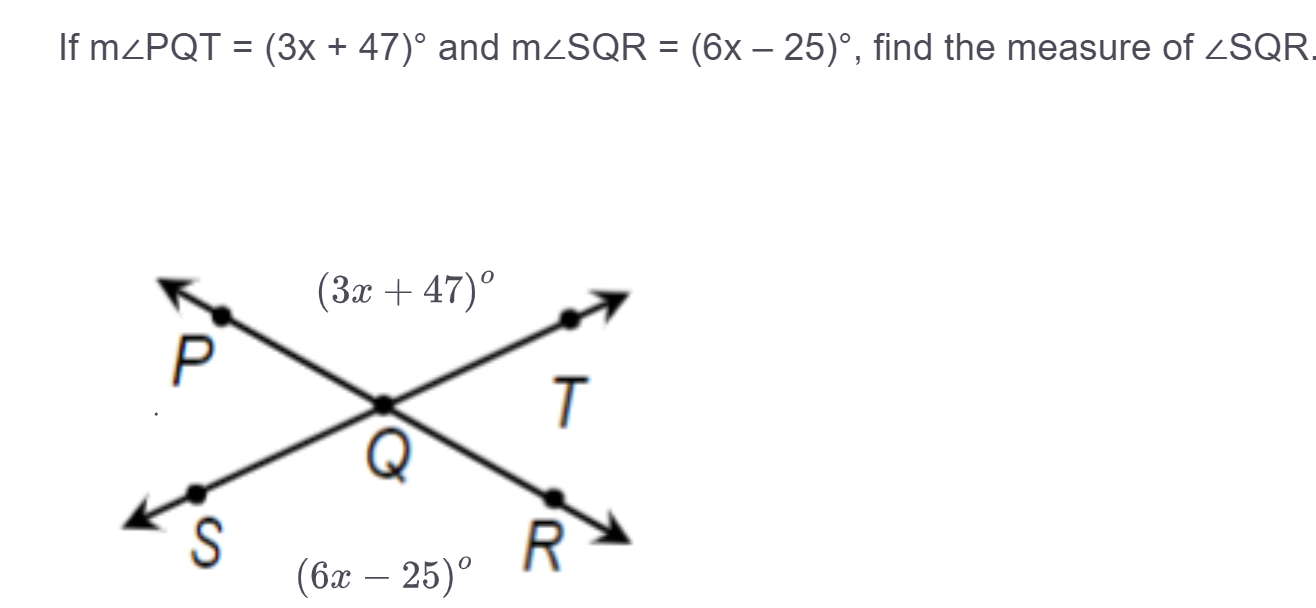
If m∠PQT =109° and m∠SQR = (4x – 15)°, find the value of x.
If m∠PQT =109° what is the measure of m∠TQR?
What is the correct order of steps to solve this problem?
Subtract 3x from both sides of the equation
Substitute 24 for x into 6x-25 to find out what the m∠SQR equals
Make 3x+47 equal to 6x-25; because vertical angles are equal
Divide both sides of the equation by 3
x=24
6(24)-25=119; therefore the m∠SQR=119°
Add 25 to both sides of the equation
What is the m∠SQR=?
If m∠DEG = (5x – 4)°, m∠GEF = (7x – 8)°, m∠DEH = (9y + 5)°, find the value of x.
Use the answer from the previous problem to find the measure of ∠GEF.
If m∠DEG = (5x – 4)°, m∠GEF = (7x – 8)°, m∠DEH = (9y + 5)°, find the value of y.
Each of the examples below are parallel lines cut by a transversal.
Which of these is an example of alternate interior angles?
Each of the examples below are parallel lines cut by a transversal.
Which of these is an example of corresponding angles?
Each of the examples below are parallel lines cut by a transversal.
Which of these is an example of alternate exterior angles?
Each of the examples below are parallel lines cut by a transversal.
Which of these is an example of same-side interior angles?
Match the types of angle pairs with their relationship to each other.
alternate interior angles
same-side exterior
alternate exterior angles
corresponding angles
same-side interior angles
Add up to 180 degrees (supplimentary)
Congruent
Each of the examples below are parallel lines cut by a transversal.
Which of these pairs of angles are congruent?
Each of the examples below are parallel lines cut by a transversal.
Which of these pairs of angles are supplementary?
The example below is parallel lines cut by a transversal.

What kind of angles are these?
Are these angles congruent or supplementary?
The example below is parallel lines cut by a transversal.

What kind of angles are these?
Are these angles congruent or supplementary?
The example below is parallel lines cut by a transversal.

What kind of angles are these?
Are these angles congruent or supplementary?
The example below is parallel lines cut by a transversal.

What kind of angles are these?
Are these angles congruent or supplementary?
The example below is parallel lines cut by a transversal.

What kind of angles are these?
Are these angles congruent or supplementary?
The example below is parallel lines cut by a transversal.
What kind of angles are these?
Are these angles congruent or supplementary?
The example below is parallel lines cut by a transversal.

What kind of angles are these?
Are these angles congruent or supplementary?
The example below is parallel lines cut by a transversal.

What kind of angles are these?
Are these angles congruent or supplementary?
The example below is parallel lines cut by a transversal.

What kind of angles are these?
Are these angles congruent or supplementary?
The example below is parallel lines cut by a transversal.

What kind of angles are these?
Are these angles congruent or supplementary?
The example below is parallel lines cut by a transversal.

What kind of angles are these?
Are these angles congruent or supplementary?
The example below is parallel lines cut by a transversal.

What kind of angles are these?
Are these angles congruent or supplementary?
The example below is parallel lines cut by a transversal.

What kind of angles are these?
Are these angles congruent or supplementary?
The example below is parallel lines cut by a transversal.

What kind of angles are these?
Are these angles congruent or supplementary?
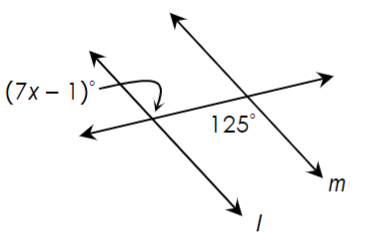
What is the correct order of steps to solve this problem:
If l || m, classify the marked angle pair and give their relationship, then solve for x.
Divide both sides of the equation by 7
Create the equation 7x-1=125
x=18
Determine what the angle relationship is between these angles.
Add 1 to both sides of the equation
Identify these angles as alternate interior angles therefore they are congruent
Directions: If l || m, classify the marked angle pair and give their relationship, then solve for x.
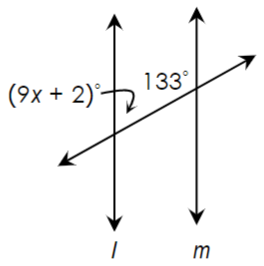
What is the correct order of steps to solve this problem:
If l || m, classify the marked angle pair and give their relationship, then solve for x.
Subtract 135 from both sides of the equation
Identify these angles as same-side interior angles therefore they are supplementary
Create the equation 9x+2+133=180
Divide both sides of the equation by 9
x=5
Determine what the angle relationship is between these angles.
Combined like terms to get 9x+135=180
Directions: If l || m, solve for x.
Directions: If l || m, solve for x.
Directions: If l || m, solve for x and y.
x=
y=
Directions: If l || m, solve for x and y.
x=
y=