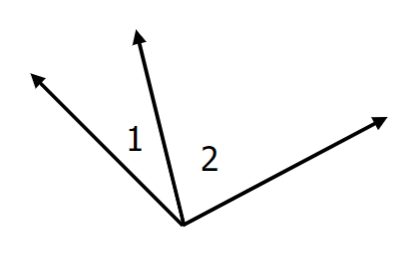
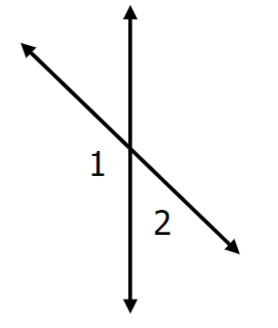
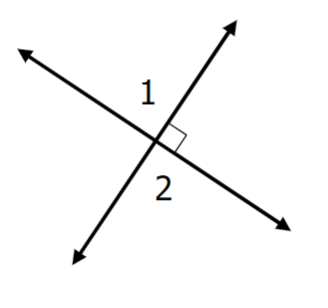
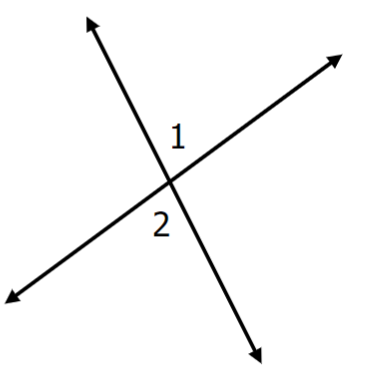
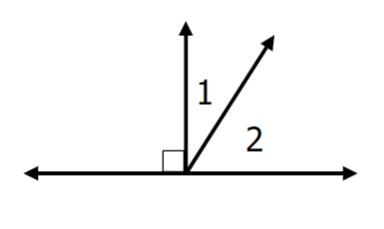
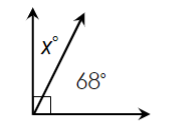
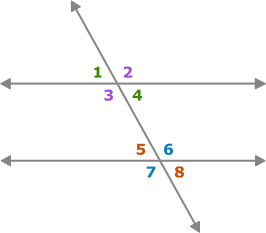
Select all the adjacent angles to ∠1
Select all the adjacent angles to ∠1
Match the definition of the angle relationship with the angle relationships it describes...
| Draggable item | arrow_right_alt | Corresponding Item |
|---|---|---|
Two angles that are adjacent and supplementary. They form astraight line! | arrow_right_alt | Vertical angles |
Two angles that share a vertex and a common side. They are next to each other | arrow_right_alt | Supplementary angles |
Two angles across from each other on intersecting lines. They share a vertex and they are always congruent! | arrow_right_alt | Complementary angles |
Any two angles whose sum is 180° | arrow_right_alt | Linear pairs |
Any two angles whose sum is 90° | arrow_right_alt | Adjacent Angles |
Select all the adjacent angles to ∠1
Select all the vertical angles to ∠6
Match the image with the angle relationship that best describes it...
| Draggable item | arrow_right_alt | Corresponding Item |
|---|---|---|
| arrow_right_alt | Vertical angles | |
| arrow_right_alt | Supplementary angles | |
| arrow_right_alt | Complementary angles | |
| arrow_right_alt | Linear pairs | |
| arrow_right_alt | Adjacent Angles |
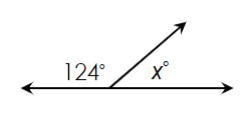
What is the value of x?
What is the value of x?
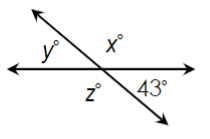
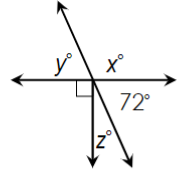
What are the values of x, y, and z?
x°=
y°=
z°=
What is the values of x, y, and z?
x°=
y°=
z°=
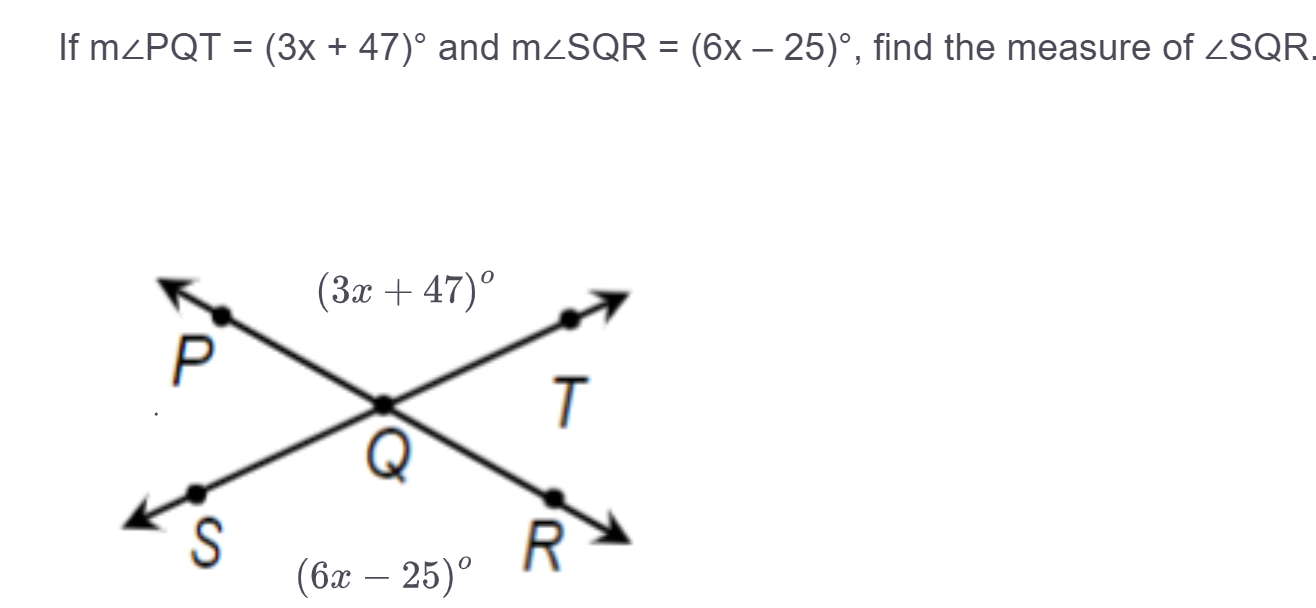
If m∠PQT =109° and m∠SQR = (4x – 15)°, find the value of x.
If m∠PQT =109° what is the measure of m∠TQR?
What is the correct order of steps to solve this problem?
Substitute 24 for x into 6x-25 to find out what the m∠SQR equals
Add 25 to both sides of the equation
x=24
Subtract 3x from both sides of the equation
6(24)-25=119; therefore the m∠SQR=119°
Divide both sides of the equation by 3
Make 3x+47 equal to 6x-25; because vertical angles are equal
What is the m∠SQR=?
If m∠DEG = (5x – 4)°, m∠GEF = (7x – 8)°, m∠DEH = (9y + 5)°, find the value of x.
Use the answer from the previous problem to find the measure of ∠GEF.
If m∠DEG = (5x – 4)°, m∠GEF = (7x – 8)°, m∠DEH = (9y + 5)°, find the value of y.
Each of the examples below are parallel lines cut by a transversal.
Which of these is an example of alternate interior angles?
Each of the examples below are parallel lines cut by a transversal.
Which of these is an example of corresponding angles?
Each of the examples below are parallel lines cut by a transversal.
Which of these is an example of alternate exterior angles?
Each of the examples below are parallel lines cut by a transversal.
Which of these is an example of same-side interior angles?
Match the types of angle pairs with their relationship to each other.
alternate exterior angles
same-side exterior
alternate interior angles
corresponding angles
same-side interior angles
Add up to 180 degrees (supplimentary)
Congruent
Each of the examples below are parallel lines cut by a transversal.
Which of these pairs of angles are congruent?
Each of the examples below are parallel lines cut by a transversal.
Which of these pairs of angles are supplementary?
The example below is parallel lines cut by a transversal.

What kind of angles are these?
Are these angles congruent or supplementary?
The example below is parallel lines cut by a transversal.

What kind of angles are these?
Are these angles congruent or supplementary?
The example below is parallel lines cut by a transversal.

What kind of angles are these?
Are these angles congruent or supplementary?
The example below is parallel lines cut by a transversal.

What kind of angles are these?
Are these angles congruent or supplementary?
The example below is parallel lines cut by a transversal.

What kind of angles are these?
Are these angles congruent or supplementary?
The example below is parallel lines cut by a transversal.
What kind of angles are these?
Are these angles congruent or supplementary?
The example below is parallel lines cut by a transversal.

What kind of angles are these?
Are these angles congruent or supplementary?
The example below is parallel lines cut by a transversal.

What kind of angles are these?
Are these angles congruent or supplementary?
The example below is parallel lines cut by a transversal.

What kind of angles are these?
Are these angles congruent or supplementary?
The example below is parallel lines cut by a transversal.

What kind of angles are these?
Are these angles congruent or supplementary?
The example below is parallel lines cut by a transversal.

What kind of angles are these?
Are these angles congruent or supplementary?
The example below is parallel lines cut by a transversal.

What kind of angles are these?
Are these angles congruent or supplementary?
The example below is parallel lines cut by a transversal.

What kind of angles are these?
Are these angles congruent or supplementary?
The example below is parallel lines cut by a transversal.

What kind of angles are these?
Are these angles congruent or supplementary?
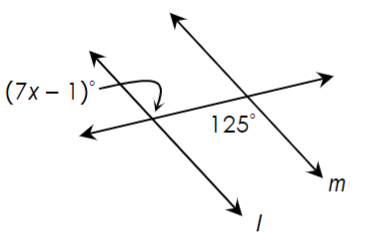
What is the correct order of steps to solve this problem:
If l || m, classify the marked angle pair and give their relationship, then solve for x.
Determine what the angle relationship is between these angles.
Identify these angles as alternate interior angles therefore they are congruent
Create the equation 7x-1=125
Divide both sides of the equation by 7
x=18
Add 1 to both sides of the equation
Directions: If l || m, classify the marked angle pair and give their relationship, then solve for x.
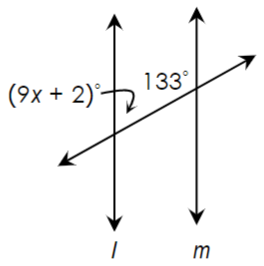
What is the correct order of steps to solve this problem:
If l || m, classify the marked angle pair and give their relationship, then solve for x.
Divide both sides of the equation by 9
x=5
Determine what the angle relationship is between these angles.
Identify these angles as same-side interior angles therefore they are supplementary
Subtract 135 from both sides of the equation
Create the equation 9x+2+133=180
Combined like terms to get 9x+135=180
Directions: If l || m, solve for x.
Directions: If l || m, solve for x.
Directions: If l || m, solve for x and y.
x=
y=
Directions: If l || m, solve for x and y.
x=
y=