Coffee Elasticity Problem Set
star
star
star
star
star
Last updated about 3 years ago
1 Asɛmmisa
1
Coffee is an international crop. The top five coffee-exporting nations are Brazil, Vietnam, Colombia, Indonesia, and Ethiopia. In these nations and others, 20 million families depend on selling coffee beans as their main source of income. These families are exposed to enormous risk, because the world price of coffee bounces up and down. For example, in 1993, the world price of coffee was about 50 cents per pound. In 1995 it was four times as high, at $2 per pound. By 1997 it had fallen by half to $1.00 per pound. In 1998 it leaped back up to $2 per pound. By 2001 it had fallen back to 46 cents a pound. By early 2011 it rose to about $2.31 per pound. By the end of 2012, the price had fallen back to about $1.31 per pound.
The reason for these price fluctuations lies in a combination of inelastic demand and shifts in supply. The elasticity of coffee demand is only about 0.3; that is, a 10% rise in the price of coffee leads to a decline of about 3% in the quantity of coffee consumed. When Vietnam entered the world coffee market as a major producer in the late 1990s, the supply curve shifted out to the right as illustrated below.
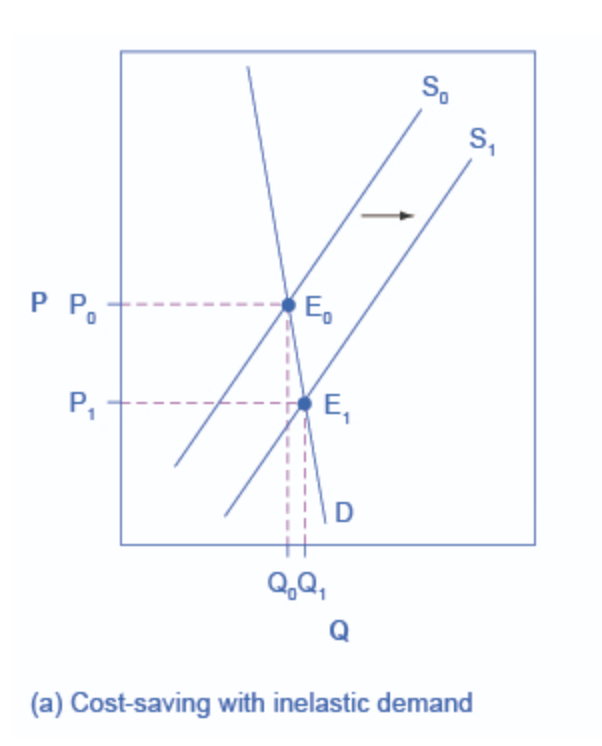
Knowing what you know now about total revenue's relationship to elasticity and supply shifts, what is the change in total revenue?