Which Lewis electron-dot diagram represents an atom of selenium in the ground state?
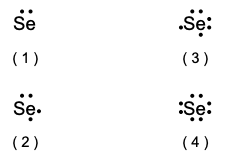
Which Lewis electron-dot diagram represents an atom of selenium in the ground state?
A four-function or scientific calculator and a copy of the 2011 Edition Reference Tables for Physical Setting/Chemistry must be available for you to use while taking this examination.
A four-function or scientific calculator and a copy of the 2011 Edition Reference Tables for Physical Setting/Chemistry must be available for you to use while taking this examination.
Which conclusion resulted directly from the gold foil experiment?
What is the number of electrons in an atom with 37 protons and 49 neutrons?
Which statement describes the mass of an electron?
In the wave-mechanical model of the atom, electrons are located in regions called
At STP, a sample of potassium can be differentiated from a sample of rubidium based on
Which statement describes a chemical property of chlorine?
Oxygen gas,
Which phrase describes two or more elements chemically combined?
Which formula is an empirical formula?
Which terms represent two different categories of compounds?
Which element has molecules that each contain a multiple covalent bond?
Which formula represents an asymmetrical molecule?
Which changes in charge and radius occur when an atom gains one electron?
Given the equation representing a reaction:
What occurs during this reaction?
Which compound has both ionic and covalent bonds?
Which substance can not be broken down by a chemical change?
According to the kinetic molecular theory, the particles of an ideal gas have
In order for a chemical reaction to occur, colliding particles must have proper orientation and proper
At STP, which sample of gas has the same number of atoms as 4.0 liters of Ne gas?
Based on Table I, the dissolving of which compound is an exothermic process at 298 K and 101.3 kPa?
Which expression represents the heat of reaction for a chemical change in terms of potential energy, PE?
Which phrase describes how a catalyst increases the rate of a chemical reaction?
At standard pressure, which 5.0-gram sample of xenon has the greatest entropy?
Systems in nature tend to undergo changes that result in
Which compound is a member of the homologous series represented by the general formula
Which term identifies a reaction that produces an alcohol?
Which statement describes a substance that is an electrolyte?
Which substance is an Arrhenius acid?
A heavy nucleus splits into two lighter nuclei during which process?
The energy released by nuclear fusion in the Sun results from the conversion of
Which electron configuration represents a lithium atom in an excited state?
Which Lewis electron-dot diagram represents an atom of selenium in the ground state?
Which element could be represented by the X in the oxide formula,
What is a chemical name for the compound
Given the balanced equation representing a reaction:
When 12 grams of
What is the gram-formula mass of
In the ground state, ions of which two elements each have the same electron configuration as an atom of neon in the ground state?
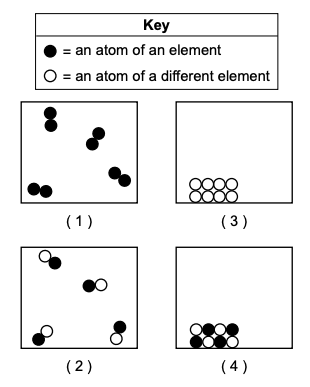
Which particle model diagram represents a sample of fluorine at STP?
Based on Table F, which compound is most soluble in water?
Which solution has the lowest freezing point?
What is the amount of heat energy required to completely vaporize a 12.5-gram sample of
A 2.0-gram sample of solid iron,
Which term describes a system with a sealed 100.-mL flask that contains 50. grams of water at 25°C?
Given the equation and graph representing a reaction:
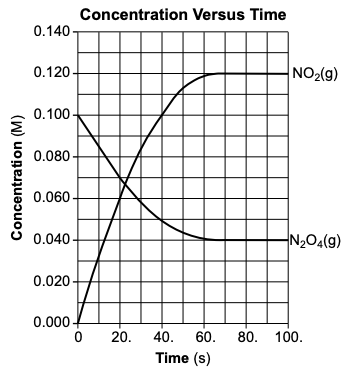
At which time is the system at equilibrium?
Given the equation representing a chemical system at equilibrium in a sealed, rigid container:
When the temperature of the system in the container is increased, the equilibrium shifts to the
Given the formula of a compound:
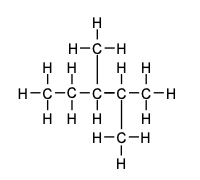
What is a chemical name for this compound?
What is the oxidation state of chlorine in the compound
Given the equation representing a reversible reaction:
According to one acid-base theory, the reactant in the reverse reaction that donates an
When the pH value of a solution is changed from 4.0 to 7.0, what is the change in the concentration of hydronium ions?
The diagram below represents a radioactive emission from a sample of chromium-51 passing through an electric field between two oppositely charged metal plates.
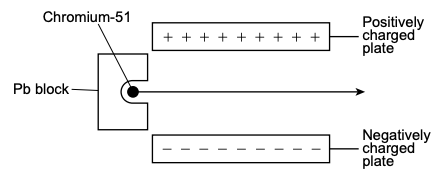
Which type of radioactive emission is represented in the diagram?
Determine the percent composition by mass of Cu in
Base your answers to questions 52 through 54 on the information below and on your knowledge of chemistry.
The three naturally occurring isotopes of potassium are K-39, K-40, and K-41. The atomic mass and percent natural abundance of each of these isotopes are shown in the table below.
Naturally Occurring Isotopes of Potassium
Isotope | Atomic Mass (u) | Natural Abundance (%) |
|---|---|---|
K-39 | 38.964 | 93.26 |
K-40 | 39.964 | 0.01 |
K-41 | 40.962 | 6.73 |
State, in terms of both protons and neutrons, why an atom of K-39 is an isotope of an atom of K-40.
Compare the energy of an electron in the first shell of a potassium atom to the energy of an electron in the fourth shell of the same atom.
Show a numerical setup for calculating the atomic mass of potassium.
Base your answers to questions 55 through 57 on the information below and on your knowledge of chemistry.
Ammonia, NH3 , is used in the production of some fertilizers, textiles, and plastics. Nitrogen gas and hydrogen gas react to produce ammonia as represented by the balanced equation below.
N2 (g) + 3H
State, in terms of the number of each type of atom, why the equation is balanced.
State evidence from the equation that the reaction is exothermic.
Determine the number of moles of hydrogen gas required to react completely with nitrogen gas to produce 10.0 moles of ammonia gas in this reaction.
Base your answers to questions 58 through 61 on the information below and on your knowledge of chemistry.
A 320.-milliliter sample of nitrogen gas, N2 (g), is placed in a sealed, rigid cylinder with a movable piston at 300. K and 100. kilopascals.
State the number of significant figures used to express the original temperature of the sample of nitrogen gas.
Compare the force of collisions of the gas particles at 300. K to the force of collisions at 450. K.
State a change in temperature and a change in pressure of the nitrogen gas that will cause the gas in the cylinder to behave more like an ideal gas.
Temperature:
Pressure:
Determine the volume of the
Base your answers to questions 62 through 65 on the information below and on your knowledge of chemistry.
The organic compound ethyl methanoate is a clear liquid with a pleasant odor. A reaction to produce ethyl methanoate is represented by the equation below.
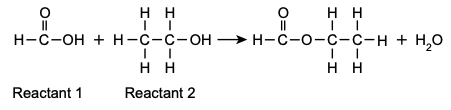
Based on Table R, write the name of the class of compound to which reactant 1 belongs.
Identify the element in reactant 2 that allows it to be classified as an organic compound.
State the number of electrons shared between the carbon atoms in reactant 2.
State, in terms of molecular formulas and structural formulas, why propanoic acid,
Base your answers to questions 66 through 70 on the information below and on your knowledge of chemistry.
Fluorine, chlorine, bromine, and iodine are called halogens. One use for some halogens is as a gas in halogen lightbulbs. These lightbulbs have a tungsten wire filament that glows brightly when electricity flows through the wire. The contents of the halogen lightbulbs reach an operating temperature of 3200 K.
State, in terms of valence electrons, why bromine and iodine have similar chemical properties.
State, in terms of the strength of intermolecular forces, why bromine has a higher boiling point at standard pressure than chlorine at standard pressure.
Based on Table S, state the trend in first ionization energy for these four halogen elements as they are considered in order of increasing atomic number.
Based on Table S, state why the tungsten filament does not melt in the operating halogen lightbulb.
Base your answers to questions 71 through 75 on the information below and on your knowledge of chemistry.
During a laboratory activity appropriate safety equipment was used and safety procedures were followed. In the activity, a student performed a controlled experiment designed to investigate the cooling effect of the evaporation of water. The student used three beakers. A paper towel was held in place over the top of each beaker as shown in the diagram below
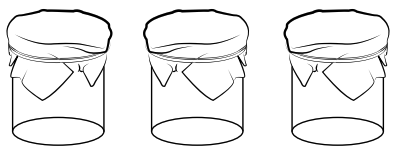 Using a dropper, the student added room temperature water to one of the paper towels, added hot water to another paper towel, and left one paper towel dry. The surface temperature of the dry towel was measured at the start and 8 minutes later. The temperatures of the other two towels were measured when the water was added and 8 minutes later. The data for this activity are shown in the table below.
Temperature Data for the Activity
Towel | Temperature at the Start ( | Temperature after 8 minutes ( |
|---|---|---|
Dry towel | 22.0 | 22.0 |
Towel with room temperature water | 22.0 | 19.0 |
Towel with hot water | 67.0 | 20.0 |
Convert the temperature of the dry towel after 8 minutes to kelvins.
Determine the amount of heat absorbed (in J) when
State the direction of heat flow between the hot water on the towel and the air at room temperature.
From
Base your answers to questions 76 through 78 on the information below and on your knowledge of chemistry.
A voltaic cell is used during a laboratory investigation. The diagram and ionic equation below represent this cell and the reaction that occurs when the switch is closed. During this laboratory activity appropriate safety equipment is used and safety procedures are followed.
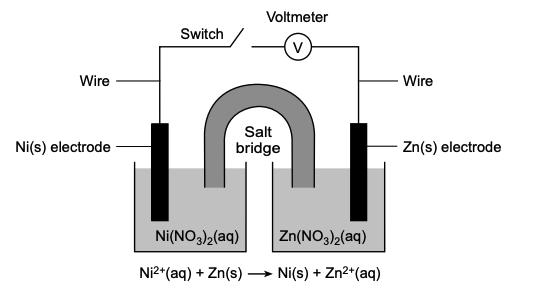
State the form of energy that is converted to electrical energy in the operating cell.
Identify the electrode that is the anode in the operating cell.
Write a balanced equation for the half-reaction that occurs in the nickel half-cell when the cell operates.
Base your answers to questions 79 through 82 on the information below and on your knowledge of chemistry.
A 15.0-milliliter sample of HCl(aq) was exactly neutralized by 25.2 milliliters of 0.50 M NaOH(aq). During this laboratory activity appropriate safety equipment was used and safety procedures were followed.
Identify the negative ion present in the
Complete the equation in the space below for the reaction of
HCl(aq) + NaOH(aq)
State the color of methyl orange indicator if it was added to a sample of the
Determine the concentration of the
Base your answers to questions 83 through 85 on the information below and on your knowledge of chemistry.
Nuclear fusion reactions are being researched as a source of energy to produce electricity. One fusion reaction researched is the reaction of deuterium, H-2, and tritium, H-3. Deuterium can be recovered from seawater. Tritium can be produced by neutron bombardment of lithium as represented by the equation below.
Based on Table N, state the decay mode of tritium, H-3.
Complete the equation in the "Show Your Work" space below for the nuclear fusion of deuterium and tritium by writing a notation for the missing product.
Based on Table N, determine the fraction of an original sample of tritium that remains unchanged after 36.93 years.
State the element classification of the element tungsten.
State what happens to the potential energy of the molecules of water as the water evaporates from the wet towels.
State, in terms of experimental design, why the student left one paper towel dry on a beaker.