Which particle model diagram represents two different compounds?
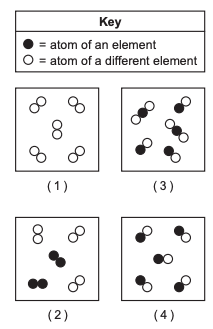
Which particle model diagram represents two different compounds?
Based on the wave-mechanical model of the atom, which statement describes the electrons in an indium atom in the ground state?
Which electron configuration represents a bromine atom in an excited state?
What energy change occurs when light is produced by excited lithium atoms?
Which list contains the symbols of two metals and two metalloids?
Graphite and diamond are solid forms of carbon and have
Which formula represents a nonpolar molecule?
When two iodine atoms become an iodine molecule, energy is
Based on Table H, what is the vapor pressure of ethanol at 50.°C?
Which laboratory process can be used to separate a mixture of two liquids based on the difference in their boiling points?
Which sample of argon gas has atoms with the highest average kinetic energy?
Gas behavior becomes more ideal when a gas has a
Which statement describes the distance between the particles and the attractions between the particles in an ideal gas?
A reaction is most likely to occur if reactant particles collide with proper
What is the pressure of 77 kPa expressed in atmospheres?
At STP, which sample contains the same number of molecules as 20.0 liters of Ne(g) at STP?
What happens to the energy of the molecules in a liquid sample of a substance as it solidifies at its freezing point?
Based on Table I, which compound is formed from its elements at 101.3 kPa and 298 K by an endothermic reaction?
LeChatelier’s principle can be used to predict the
Which mathematical expression represents the heat of reaction for a chemical reaction in terms of potential energy, PE?
Which phrase describes the effect of adding a catalyst to a chemical reaction, causing the reaction rate to increase?
In terms of energy and disorder, chemical systems in nature tend to undergo changes toward
Which element is present in all organic compounds?
Which class of organic compounds has molecules that each contain a nitrogen atom?
Which statement describes the electrodes in an operating electrochemical cell?
Which statement describes the energy conversion that occurs in an operating voltaic cell?
Which compound is an Arrhenius acid?
Which term identifies the change that occurs when the nucleus of an atom is converted from one element to another?
The energy released during a nuclear reaction is produced when
Which reaction releases the most energy per mole of reactants?
What is a risk associated with the long-term storage of waste produced by a nuclear power plant?
Which statement describes the relative energy of the electrons in different electron shells of a krypton atom in the ground state?
The table below lists properties of selected element samples at room temperature.
Properties of Selected Element Samples at Room Temperature
Element Sample | Mass (g) | Reacts with H2O |
|---|---|---|
sodium | 5.00 | yes |
nickel | 5.00 | no |
gold | 2.00 | no |
Based on this table, which statement describes a chemical property that can be used to differentiate two of these element samples from each other?
Which formula represents copper(II) phosphate?
Given the balanced equation representing a reaction:
What is the mass of
Given the balanced equation representing a reaction:
What is the number of moles of
What is the gram-formula mass of
Based on boiling points on Table S, molecules of which element have the strongest intermolecular forces?
Based on Table S, what is the electronegativity difference between the sulfur atom and a hydrogen atom in a bond in a molecule of
Which particle model diagram represents two different compounds?
How many moles of solute are dissolved in
At standard pressure, what is the amount of heat that must be absorbed when a 44.1-gram sample of
Which phrase describes the effect of an increase in temperature on the rate of a chemical reaction?
Given the formula for a compound:
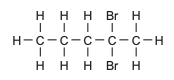 What is a chemical name for this compound?
Which formula represents an organic acid?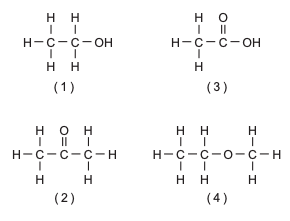
Based on Table J, which element will spontaneously react with a solution of
The diagram below represents an incomplete electrolytic cell that can be used to plate a metal spoon with silver.
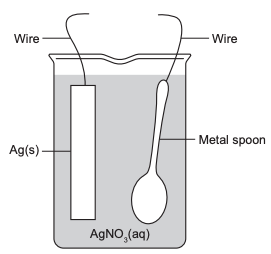
What is missing in the diagram that is required for the cell to operate?
Which statement explains why potassium chloride is classified as an electrolyte?
In a titration, 15.0 mL of a
Given the equation representing a reversible reaction:
According to one acid-base theory, the two
Which equation represents a nuclear fusion reaction?
Base your answers to questions 51 through 53 on the information below and on your knowledge of chemistry.
The elements in Group 2 on the Periodic Table of the Elements have similar chemical properties.
State, in terms of valence electrons, why the chemical properties of the elements in Group 2 are similar.
Based on Table S, state the general trend in electronegativity for these elements as they are considered in order of increasing atomic number.
Determine the number of neurons in an atom of Ba-138.
Base your answers to questions 54 through 57 on the information below and on your knowledge of chemistry.
Selected properties of copper are listed in the table below.
Selected Properties of Copper |
|---|
Conducts heat and electricity. |
Density is 8.96 g/cm3 at room temperature. |
Identify the type of bonding that allows solid copper to conduct electricity.
Compare the amount of thermal energy in a 1.0-kg block of copper at 25°C to the amount of thermal energy in a 3.0-kg block of copper at 25°C.
Show a numerical setup for calculating the volume of a 14.20-gram sample of copper at room temperature.
The density of a sample of copper was calculated to be 9.59 g/cm3 at room temperature. Determine the percent error for this calculated density of the copper.
Base your answer to questions 58 and 59 on the information below and on your knowledge of chemistry.
The elements beryllium and fluorine can react to form the compound beryllium fluoride as represented by the equation below.
Be + F2 → BeF2
Compare the number of electrons lost to the number of electrons gained during this redox reaction.
Write a balanced half-reaction equation for the oxidation of the beryllium.
Base your answers to questions 60 through 62 on the information below and on your knowledge of chemistry.
During a laboratory activity, appropriate safety equipment was used and safety procedures were followed. A student measured the pH values of four samples of household mixtures and distilled water. The pH values measured by the student are listed in the table below.
pH Values of Five Samples
Sample | pH Value |
|---|---|
lemon juice | 2.0 |
black coffee | 5.0 |
distilled water | 7.0 |
milk of magnesia | 10.0 |
household ammonia | 11.0 |
Identify the sample that is the most basic.
State the color of bromcresol green if it is added to a sample of the distilled water.
Compare the hydronium ion concentration in the lemon juice sample to the hydronium ion concentration in the black coffee sample.
Base your answers to questions 63 through 65 on the information below and on your knowledge of chemistry.
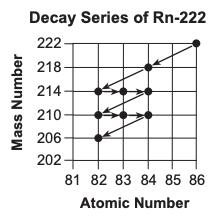
An atom of Rn–222 decays to an atom of Pb–206 through a series of steps, as shown on the graph below. In the graph, each point represents a nuclide and each arrow represents a nuclear decay mode during the decay series.
Based on Table N, determine the time required for an original 20.0-milligram sample of Rn-222 to decay until only 5.0 milligrams of the sample remains unchanged.
Based on the decay series graph and Table O, identify the nuclear decay mode represented by an arrow that goes from atomic number 84 to atomic number 82.
Complete the equation in the Show Your Work space for the decay of Bi-210 by writing a notation for the missing product.
Base your answers to questions 66 through 69 on the information below and on your knowledge of chemistry.
Europium is an element used in lasers and energy-saving light bulbs. The two naturally occurring isotopes of europium are Eu–151 and Eu–153. The table below shows the atomic mass and the percent natural abundance for each of these isotopes.
Naturally Occurring Isotopes of Europium
Isotope | Atomic Mass (u) | Natural Abundance (%) |
|---|---|---|
Eu-151 | 150.92 | 47.81 |
Eu-153 | 152.92 | 52.19 |
State, in terms of both protons and electrons, why an atom of europium is electrically neutral.
Compare the mass of a proton in an atom of europium to the mass of an electron in an atom of europium.
State, in terms of both protons and neutrons, why an atom of Eu–151 and an atom of Eu–153 are isotopes of each other.
Show a numerical setup for calculating the atomic mass of the element europium.
Base your answers to questions 70 through 72 on the information below and on your knowledge of chemistry.
When making baked goods in an oven, baking soda, NaHCO3(s), is often used in recipes as a source of carbon dioxide gas. The carbon dioxide gas produced gives baked goods a less dense composition because the gas takes up space in the structure as items bake in an oven. The unbalanced equation below represents a reaction of baking soda to produce carbon dioxide gas.
NaHCO3(s) + heat → Na2CO3(s) + H2O(g) + CO2(g)
Determine the percent composition by mass of oxygen in baking soda,
Balance the equation for the reaction, using the smallest whole-number coefficients.
State, in terms of substances, why this equation represents a decomposition reaction.
Base your answers to questions 73 through 75 on the information below and on your knowledge of chemistry.
Concrete is an important material used in the construction of buildings and other structures. Concrete is made by mixing powdered cement with sand and gravel. These dry materials are mixed with water to start a series of chemical reactions. A main reaction that allows concrete to become hard and strong includes the hydration of tricalcium silicate, Ca3SiO5, as shown in the balanced equation below.
2Ca3SiO5 + 7H2O → 3CaO•2SiO2•4H2O + 3Ca(OH)2 + heat
State two types of chemical bonding in the calcium hydroxide product.
Compare the radius of a calcium atom to the radius of a
In the Show Your Work space, draw a Lewis electron-dot diagram for a molecule of
Base your answers to questions 76 through 79 on the information below and on your knowledge of chemistry.
The use of solid road salt and enhanced brine are two methods of deicing roads in winter months. The road salt is usually crushed solid sodium chloride. Enhanced brine is an aqueous solution containing sodium chloride, magnesium chloride, and calcium chloride. The percentages of these salts can vary.
Rainfall can wash these salts into bodies of fresh water. This can have a harmful effect on living organisms when the concentration of chloride ions becomes greater than 0.23 gram per liter of fresh water.
A student does a laboratory investigation to determine the concentration of dissolved salts in a sample of water that came from a road treated with road salt. After collecting the sample of water, the student filtered the sample using filter paper. During this laboratory activity appropriate safety equipment was used and safety procedures were followed.
State evidence from the passage that enhanced brine is a mixture.
State, in terms of particle size, why the dissolved salt ions in the student’s sample passed through the filter paper.
State, in terms of ions, why a
Show a numerical setup for calculating the concentration in parts per million of the
Base your answers to questions 80 through 82 on the information below and on your knowledge of chemistry.
An important step in the industrial production of sulfuric acid is the reaction of sulfur dioxide gas and oxygen gas to produce sulfur trioxide gas. This reaction can reach equilibrium in a closed system, as represented by the equation below.
2SO2(g) + O2(g)
Compare the rate of the forward reaction to the rate of the reverse reaction when this system is at equilibrium.
On the labeled axes in the Show Your Work space, draw a potential energy diagram for the forward reaction represented in the equation.
Compare the entropy of a 1.0-mole sample of liquid oxygen,
Base your answers to questions 83 through 85 on the information below and on your knowledge of chemistry.
Natural rubber is made from the sap of the rubber tree, which is grown in tropical regions of the world. Natural rubber is mainly 1,4-polyisoprene. This compound consists of molecules that are long chains of many linked isoprene molecules. In the diagram below, compound 1 represents isoprene. Compound 2 represents an isomer of compound 1.
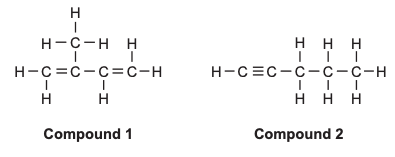
State, in terms of carbon-to-carbon bonds, why compound 1 is an unsaturated hydrocarbon.
Based on Table Q, write the general formula for the homologous series that includes compound 2.
Explain, in terms of both molecular formulas and structural formulas, why compound 2 is an isomer of compound 1.