Twa kɔ nsɛm atitiriw so
Log in
Sign up for FREE
arrow_back
Laabri

2026 (Jun.): NY Regents - Physics

star
star
star
star
star
Last updated 5 days ago
85 Nsɛmmisa
Hyɛ no nsow a efi ɔkyerɛwfo no hɔ:
Akwankyerɛ
Part A
1
1
1
1
1
1
1
1
1
1
1
1
1
1
1
1
1
1
1
1
1
1
1
1
1
1
1
1
1
1
1
1
1
1
1
Part B-1
1
1
1
1
1
1
1
1
1
1
1
1
1
1
1
Part B-2
1
1
1
2
0
Part C

Notice. . . A scientific or graphing calculator, a centimeter ruler, a protractor, and a copy of the 2006 Edition Reference Tables for Physical Setting/Physics, which you may need to answer some questions in this examination, must be available for your use while taking this examination.

Notice. . . A scientific or graphing calculator, a centimeter ruler, a protractor, and a copy of the 2006 Edition Reference Tables for Physical Setting/Physics, which you may need to answer some questions in this examination, must be available for your use while taking this examination.

Asemmisa {{asɛmmisaAhyɛnsode}}
1.

Which quantity is a scalar?

Asemmisa {{asɛmmisaAhyɛnsode}}
2.

Which unit can be used to express the strength of an electric field?

Asemmisa {{asɛmmisaAhyɛnsode}}
3.

The diagram represents a positively charged test particle located between two charged, parallel plates near the surface of Earth.
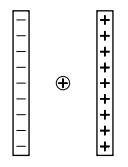
Which force does not exist in this situation?
Asemmisa {{asɛmmisaAhyɛnsode}}
4.

Electrostatic force $F$ exists between two protons separated by a distance of $1 \times 10^{-6}$ meter. If the distance between the protons is tripled, the electrostatic force between them will be

Asemmisa {{asɛmmisaAhyɛnsode}}
5.

A loudspeaker vibrating with frequency $f$ produces a sound wave by vibrating air molecules adjacent to the surface of the speaker. Which statement correctly describes both the direction and frequency of vibration of these air molecules?

Asemmisa {{asɛmmisaAhyɛnsode}}
6.

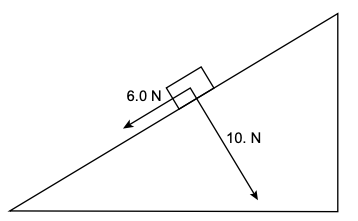
The diagram represents perpendicular components of the weight of a crate resting on an incline. The component of the crate’s weight acting parallel to the incline is 6.0 newtons and the component of the crate's weight acting perpendicular to the incline is 10. newtons.

The magnitude of the normal force acting on the crate is

Asemmisa {{asɛmmisaAhyɛnsode}}
7.

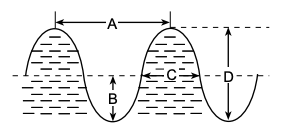
The diagram below represents a wave.

The amplitude of the wave in the diagram is represented by distance
Asemmisa {{asɛmmisaAhyɛnsode}}
8.

Astronauts in a space station orbiting Earth use radio waves to communicate with people on Earth. These radio waves traveling through space are

Asemmisa {{asɛmmisaAhyɛnsode}}
9.

A package is dropped from a helicopter hovering 120 meters above the ground. How far does the package fall during the first 3.0 seconds? [Neglect air resistance.]

Asemmisa {{asɛmmisaAhyɛnsode}}
10.

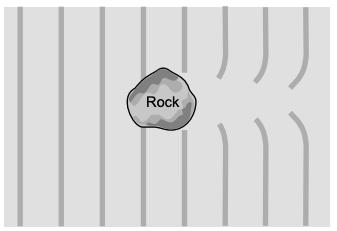
The diagram shows an aerial view of water waves moving to the right in a small pond as they pass a large rock.

The spreading of the waves into the region to the right of the rock is an example of

Asemmisa {{asɛmmisaAhyɛnsode}}
11.

A 1-kilogram object rests on a table at a height of 1 meter from the floor. The work done by the table in supporting the object is

Asemmisa {{asɛmmisaAhyɛnsode}}
12.

A length of nichrome wire of uniform cross-sectional area in a circuit is maintained at a constant temperature of 20°C. As the potential difference across the ends of the wire is increased, the resistance of the wire

Asemmisa {{asɛmmisaAhyɛnsode}}
13.

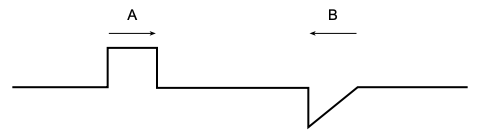
Two pulses, A and B, are traveling in opposite directions in a uniform medium, as shown in the diagram below.

Which diagram best represents the superposition of the two pulses when the two pulses completely overlap?
Asemmisa {{asɛmmisaAhyɛnsode}}
14.

Radar waves transmitted from a weather station are sent toward a storm that is traveling toward the weather station. Compared to the transmitted waves, the reflected waves from the storm that are received by the station will have a

Asemmisa {{asɛmmisaAhyɛnsode}}
15.

A 50.0-kilogram object is attracted to a planet with a gravitational force of 75.0 newtons. A 150.-kilogram object at the same location would be attracted to the planet with a gravitational force of

Asemmisa {{asɛmmisaAhyɛnsode}}
16.

A student walks due north and then due east to arrive at a point 28 meters due northeast of their starting point. The perpendicular components of their displacement are

Asemmisa {{asɛmmisaAhyɛnsode}}
17.

The driver of a car, traveling east at 14 meters per second, accelerates at 6.0 meters per second squared to a velocity of 24 meters per second east. What is the magnitude of the displacement of the car during this time?

Asemmisa {{asɛmmisaAhyɛnsode}}
18.

A constant horizontal net force of 10. newtons acts on a 5.0-kilogram box on a lab table for 15 seconds. The magnitude of the change in momentum of the box is

Asemmisa {{asɛmmisaAhyɛnsode}}
19.

A ball is thrown with the same initial speed at various angles above the horizontal. As the angle above the horizontal decreases, the horizontal component of the initial velocity

Asemmisa {{asɛmmisaAhyɛnsode}}
20.

A projectile is fired from the ground with an initial speed of $1.0 \times 10^2$ meters per second. Which angle above the horizontal will result in the projectile having the greatest time of flight? [Neglect air resistance.]

Asemmisa {{asɛmmisaAhyɛnsode}}
21.

Two identical arrows are fired vertically into the air. The first arrow has twice as much kinetic energy as the second arrow. Neglecting air friction, compared to the maximum height reached by the second arrow, the maximum height reached by the first arrow will be

Asemmisa {{asɛmmisaAhyɛnsode}}
22.

The inertia of a body is most closely related to its

Asemmisa {{asɛmmisaAhyɛnsode}}
23.

When a 1.0-kilogram baseball bat strikes a 0.15-kilogram baseball, the collision causes the ball to accelerate. Compared to the acceleration of the ball during the collision, the acceleration of the bat during the collision has

Asemmisa {{asɛmmisaAhyɛnsode}}
24.

A 1.0-kilogram rock weighs 9.8 newtons on the surface of Earth. What is the mass of this rock on the surface of the Moon, where the magnitude of the gravitational field strength is 1.6 newtons per kilogram?

Asemmisa {{asɛmmisaAhyɛnsode}}
25.

An object is moving at constant speed in a horizontal circle. Which statement describes the centripetal acceleration of the object?

Asemmisa {{asɛmmisaAhyɛnsode}}
26.

Identical rubber tires are sliding on various surfaces. On which surface would the tires experience the least frictional force?

Asemmisa {{asɛmmisaAhyɛnsode}}
27.

The magnitude of the momentum of an electron traveling at $1.00 \times 10^5$ meters per second is

Asemmisa {{asɛmmisaAhyɛnsode}}
28.

A 500.-newton student stands motionless on a level floor. What is the magnitude of the force that the student exerts on the floor?

Asemmisa {{asɛmmisaAhyɛnsode}}
29.

Which statement describes an object that is in equilibrium?

Asemmisa {{asɛmmisaAhyɛnsode}}
30.

Which type of waves can not travel through a vacuum?

Asemmisa {{asɛmmisaAhyɛnsode}}
31.

A 650.-newton student rides an elevator from the first floor to the third floor of a building. How much power is expended to lift the student a vertical distance of 6.00 meters in 13.0 seconds?

Asemmisa {{asɛmmisaAhyɛnsode}}
32.

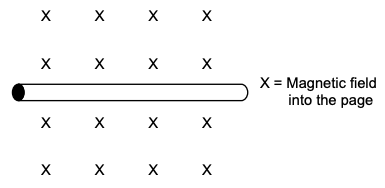
A wire segment is located within a uniform magnetic field directed into the page, as shown in the diagram below.

Which direction could the wire be moved to produce a potential difference across the ends of the wire segment?
Asemmisa {{asɛmmisaAhyɛnsode}}
33.

For a complete description of the nature of electrons and photons, electrons and photons should be treated as

Asemmisa {{asɛmmisaAhyɛnsode}}
34.

When a photon collides with a stationary particle, the photon increases in wavelength and

Asemmisa {{asɛmmisaAhyɛnsode}}
35.

Which statement describes the forces between subatomic particles?

Asemmisa {{asɛmmisaAhyɛnsode}}
36.

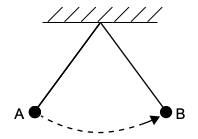
In the diagram below, a pendulum is released from Point A and allowed to swing freely to Point B, where it is stopped.

Which graph best represents the pendulum’s kinetic energy ($KE$) and potential energy ($PE$) as a function of time as the pendulum swings from A to B?

Asemmisa {{asɛmmisaAhyɛnsode}}
37.

As a wooden crate slides down a wooden incline at constant speed, there is an increase in the crate’s

Asemmisa {{asɛmmisaAhyɛnsode}}
38.

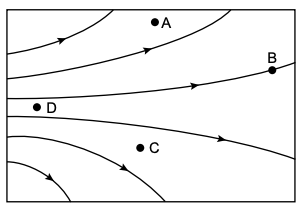
The diagram below represents a magnetic field.

At which point is the magnetic field strength greatest?
Asemmisa {{asɛmmisaAhyɛnsode}}
39.

In $1.5$ minutes, $240$ coulombs of charge pass through a conductor. What is the electric current in the conductor?

Asemmisa {{asɛmmisaAhyɛnsode}}
40.

A potential difference of $5.0$ volts is placed across a $220$-ohm resistor. What is the total amount of energy this resistor dissipates in $30.$ seconds?

Asemmisa {{asɛmmisaAhyɛnsode}}
41.

A potential difference of $9.0 \times 10^3$ volts exists between Points $A$ and $B$ in an electric field. Compared to the total electrical energy gained by a $1.0$-coulomb charge when moved from Point $A$ to Point $B$, the total electrical energy gained by a $2.0$-coulomb charge when moved from Point $A$ to Point $B$ is

Asemmisa {{asɛmmisaAhyɛnsode}}
42.

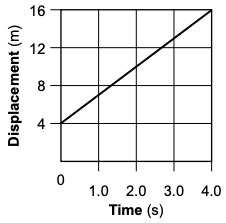
The displacement-time graph below represents the motion of a runner along a straight track. What is the runner’s speed during the 4.0-second interval shown?

Displacement vs Time for a Runner

Asemmisa {{asɛmmisaAhyɛnsode}}
43.

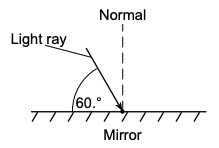
A ray of light strikes a mirror at an angle of 60.° above the surface of a mirror, as shown in the diagram below.

The angle of reflection of the light ray is
Asemmisa {{asɛmmisaAhyɛnsode}}
44.

The thickness of a penny is approximately

Asemmisa {{asɛmmisaAhyɛnsode}}
45.

A 20-newton force and a 10-newton force are the only two forces acting concurrently on a body. As a result of these two forces, the body must be

Asemmisa {{asɛmmisaAhyɛnsode}}
46.

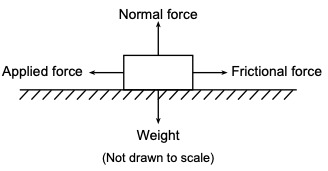
The diagram below shows the forces acting on a box on a horizontal surface.

If the box is moving toward the left at a constant velocity, the magnitude of the net force acting on it is equal to
Asemmisa {{asɛmmisaAhyɛnsode}}
47.

The charge on a single charm quark is equal to

Asemmisa {{asɛmmisaAhyɛnsode}}
48.

A car with a mass of $1.2 \times 10^3$ kilograms is moving around a circular track at a uniform speed of 20. meters per second. The magnitude of the centripetal force on the car is $6.0 \times 10^3$ newtons. What is the radius of the track?

Asemmisa {{asɛmmisaAhyɛnsode}}
49.

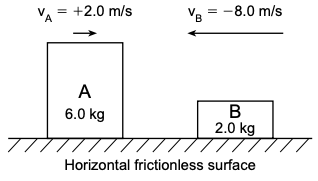
The diagram below shows two blocks, A and B, moving toward each other on a horizontal, frictionless surface. Block A has a mass of 6.0 kilograms and a velocity of +2.0 meters per second. Block B has a mass of 2.0 kilograms and a velocity of −8.0 meters per second.

After the blocks collide, they stick together and move off with a velocity of
Asemmisa {{asɛmmisaAhyɛnsode}}
50.

What is the minimum amount of energy needed to ionize a mercury atom by removing an electron in energy level g?

Asemmisa {{asɛmmisaAhyɛnsode}}
51.

A metal wire has an electrical resistance of $0.325\ \Omega$. If the wire has a length of $12.4$ meters and a cross-sectional area of $1.13 \times 10^{-6}$ meter squared, determine the resistivity of the wire.

\Omega \cdot {m}

Asemmisa {{asɛmmisaAhyɛnsode}}
52.

A cell phone emits electromagnetic waves with a frequency of $2.4$ gigahertz. Determine the period of these waves in seconds.

s

Asemmisa {{asɛmmisaAhyɛnsode}}
53.

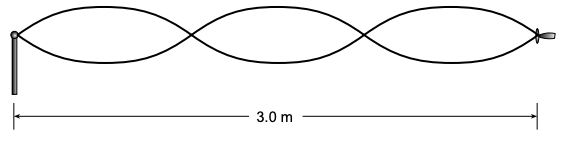
The diagram below shows a standing wave along a string. The distance between the ends of the string is $3.0$ meters.

Determine the wavelength of the wave.
m

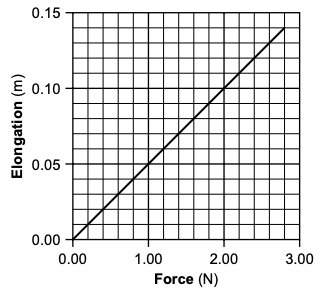
Base your answers to questions 54 through 56 on the graph below, which represents the relationship between the elongation of a spring and the force applied to the spring.

Elongation vs. Force

1
Asemmisa {{asɛmmisaAhyɛnsode}}
54.

Determine the spring constant of this spring.

N/m

2
Asemmisa {{asɛmmisaAhyɛnsode}}
55.

Calculate the potential energy stored in the spring when the spring is stretched 0.120 meter.

Show all work, including the equation and substitution with units.

0
Asemmisa {{asɛmmisaAhyɛnsode}}
56.

[Placeholder - do not respond. Original Regents exam groups questions 55-56 together for 2 points]

Base your answers to questions 57 through 60 on the information and diagram below and on your knowledge of physics.

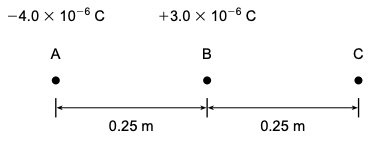
Three point charges, $A$, $B$, and $C$, are arranged in a straight line, as shown in the diagram. Charge $C$ exerts a repulsive electrostatic force of $1.4\ \text{N}$ on Charge $B$. Charge $A$ is $-4.0 \times 10^{-6} coulomb and Charge $B$ is $+3.0 \times 10^{-6} coulomb.

2
Asemmisa {{asɛmmisaAhyɛnsode}}
57.

Calculate the magnitude of the electrostatic force that Charge A exerts on Charge B.

Show all work, including the equation and substitution with units.

0
Asemmisa {{asɛmmisaAhyɛnsode}}
58.

[Placeholder - do not respond. Original Regents exam groups questions 57-58 together for 2 points]

1
Asemmisa {{asɛmmisaAhyɛnsode}}
59.

Determine the magnitude of the resultant electrostatic force exerted on Charge B by Charge A and Charge C.

N

1
Asemmisa {{asɛmmisaAhyɛnsode}}
60.

Compare the magnitude of Charge A to the magnitude of Charge C.

Asemmisa {{asɛmmisaAhyɛnsode}}
61.

Calculate the total amount of energy, in joules, that would result from the complete conversion of $1.00 \times 10^3$ kilograms of the Sun’s mass.

Show all work, including the equation and substitution with units.

Asemmisa {{asɛmmisaAhyɛnsode}}
62.

[Placeholder - do not respond. Original Regents exam groups questions 61-62 together for 2 points]

Base your answers to questions 63 through 65 on the information below and on your knowledge of physics.

A $1.89$-electronvolt photon is emitted when an electron in a hydrogen atom drops from energy level $n = 3$ to energy level $n = 2$.

1
Asemmisa {{asɛmmisaAhyɛnsode}}
63.

Determine the energy, in joules, of the emitted photon.

J

2
Asemmisa {{asɛmmisaAhyɛnsode}}
64.

Calculate the frequency of the emitted photon.

Show all work, including the equation and substitution with units.

0
Asemmisa {{asɛmmisaAhyɛnsode}}
65.

[Placeholder - do not respond. Original Regents exam groups questions 64-65 together for 2 points]

Base your answers to questions 66 through 71 on the information and diagram below and on your knowledge of physics.

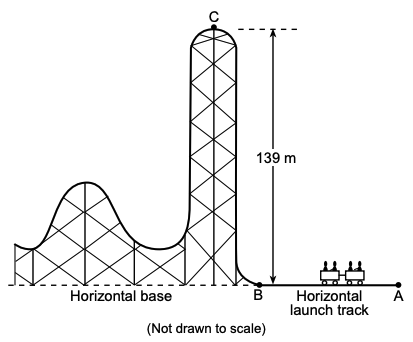
One of the tallest and fastest roller coasters in the world is represented in the diagram below.

The roller coaster train begins the ride at Point A on a horizontal launch track. A hydraulic launch mechanism uniformly accelerates the train from rest to 57.2 meters per second at Point B in 3.5 seconds. At Point B, the end of the launch track, the train begins to coast up the main tower, reaching Point C, a vertical distance of 139 meters above the horizontal base.

2
Asemmisa {{asɛmmisaAhyɛnsode}}
66.

Calculate the magnitude of the acceleration of the train on the launch track between Points A and B.

Show all work, including the equation and substitution with units.

0
Asemmisa {{asɛmmisaAhyɛnsode}}
67.

[Placeholder - do not respond. Original Regents exam groups questions 66-67 together for 2 points]

2
0
2
0

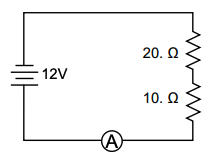
Base your answers to questions 72 through 76 on the circuit diagram below and on your knowledge of physics.

1
Asemmisa {{asɛmmisaAhyɛnsode}}
72.

Determine the equivalent resistance of the circuit.

Ω

2
Asemmisa {{asɛmmisaAhyɛnsode}}
73.

Calculate the current in ammeter A.

Show all work, including the equation and substitution with units.

0
Asemmisa {{asɛmmisaAhyɛnsode}}
74.

[Placeholder - do not respond. Original Regents exam groups questions 73-74 together for 2 points]

2
0

Base your answers to questions 77 through 81 on the information and diagram below and on your knowledge of physics.

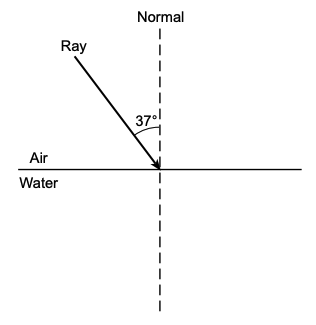
A light ray ($f = 5.09 \times 10^{14}\ \text{Hz}$) traveling in air is incident on the surface of water at $37^\circ$, as shown in the diagram below.

2
Asemmisa {{asɛmmisaAhyɛnsode}}
77.

Calculate the angle of refraction of the light ray as it enters the water.

Show all work, including the equation and substitution with units.

0
Asemmisa {{asɛmmisaAhyɛnsode}}
78.

[Placeholder - do not respond. Original Regents exam groups questions 77-78 together for 2 points]

1
2
0

Base your answers to questions 82 through 85 on the information and diagram below and on your knowledge of physics.

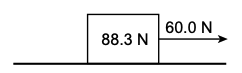
A 60.0-newton horizontal force is applied to a moving wooden box, weighing 88.3 newtons, across a horizontal wooden floor, as shown in the diagram.

1
Asemmisa {{asɛmmisaAhyɛnsode}}
82.

Determine the magnitude of the normal force exerted by the floor on the box.

N

2
Asemmisa {{asɛmmisaAhyɛnsode}}
83.

Calculate the magnitude of the force of friction acting on the box.

Show all work, including the equation and substitution with units.

0
Asemmisa {{asɛmmisaAhyɛnsode}}
84.

[Placeholder - do not respond. Original Regents exam groups questions 83-84 together for 2 points]

1
Asemmisa {{asɛmmisaAhyɛnsode}}
85.

Determine the magnitude of the acceleration of the box.

m/s2

Asemmisa {{asɛmmisaAhyɛnsode}}
68.

Calculate the kinetic energy of a 70.0 kilogram passenger in the train at Point B.

Show all work, including the equation and substitution with units.

Asemmisa {{asɛmmisaAhyɛnsode}}
69.

[Placeholder - do not respond. Original Regents exam groups questions 68-69 together for 2 points]

Asemmisa {{asɛmmisaAhyɛnsode}}
70.

Calculate the gravitational potential energy gained by a 70.0-kilogram passenger during the ride from Point B to Point C.

Show all work, including the equation and substitution with units.

Asemmisa {{asɛmmisaAhyɛnsode}}
71.

[Placeholder - do not respond. Original Regents exam groups questions 70-71 together for 2 points]

Asemmisa {{asɛmmisaAhyɛnsode}}
75.

Calculate the power dissipated by the 10-ohm resistor.

Show all work, including the equation and substitution with units.

Asemmisa {{asɛmmisaAhyɛnsode}}
76.

[Placeholder - do not respond. Original Regents exam groups questions 75-76 together for 2 points]

Asemmisa {{asɛmmisaAhyɛnsode}}
79.

On the diagram, draw the refracted ray using a protractor and straightedge.

Asemmisa {{asɛmmisaAhyɛnsode}}
80.

Calculate the speed of the light ray in water.

Show all work, including the equation and substitution with units.

Asemmisa {{asɛmmisaAhyɛnsode}}
81.

[Placeholder - do not respond. Original Regents exam groups questions 80-81 together for 2 points]