2024 (June): NY Regents - Global History & Geography II
star
star
star
star
star
Last updated 10 days ago
36 Nsɛmmisa
Answer all questions in this part.
Base your answers to questions 1 and 2 on the illustration below and on your knowledge of social studies.
The Agricultural Revolution

Source: Philip Dorf, World History, Oxford Book Company, 1958 (adapted)
This illustration can best be used to
Base your answers to questions 3 and 4 on the passage below and on your knowledge of social studies.
. . . The serf question is commonly seen as the acid test of Catherine's sincerity; and her failure to solve it is taken as proof of insincerity. But Catherine was convinced, both on humanitarian and practical grounds, of the desirability of emancipation, or at least of state regulation of the relationship between noble and serf.
She voiced her beliefs clearly and often, publicly and privately. She roundly declared that 'unless we agree to alleviate the cruelties and to mitigate [reduce] a condition intolerable for human beings, they themselves will take matters into their own hands, whether we like it or not'.
On the other hand, when it came to putting her wishes into action, Catherine was faced with the almost unanimous disapproval of the nobility. They, having won wide authority over the serfs from her predecessors, were bent on exacting [forcing] still more from Catherine herself, and had little patience with her liberal ideas. . . .
. . . The gulf between noble and serf had grown too wide for Catherine to bridge it. Faced with such an impasse, she could do nothing. To push through her programme with any prospect of success, she would have had to resort to the forcible methods of Peter the Great, an option that she had neither the inclination nor the power to take. Trapped in a historical process that was none of her making and which she could not control, Catherine was compelled to yield against her private judgment.
Hence the paradox [contradiction], that under the most enlightened Russian ruler of the century, the condition of the serfs underwent so marked and rapid a deterioration. The nobility demanded payment for their support of Catherine; and Catherine had to pay at the serfs’ expense. . . .
Source: A. Lentin, "Catherine the Great and Enlightened Despotism," History Today, March 1971
Based on this passage, what issue was debated but not changed during the reign of Catherine the Great?
Base your answers to questions 5 and 6 on the passage below and on your knowledge of social studies.
... The Communists disdain to conceal their views and aims. They openly declare that their ends can be attained only by the forcible overthrow of all existing social conditions. Let the ruling classes tremble at a Communistic revolution. The proletarians have nothing to lose but their chains. They have a world to win. ...
Source: Karl Marx and Friedrich Engels, Manifesto of the Communist Party, 1848
What conditions inspired the writing of this passage?
Base your answers to questions 7 and 8 on the passage below and on your knowledge of social studies.
... Prussia’s borders according to the Vienna Treaties [of 1814–15] are not favorable for a healthy, vital state; it is not by speeches and majority resolutions that the great questions of the time are decided – that was the big mistake of 1848 and 1849 – but by iron and blood. ...
Source: Speech by Otto von Bismarck, 1862
This statement is most closely associated with which event?
Base your answers to questions 9 and 10 on the document below and on your knowledge of social studies.
ARTICLE II. The Imperial Throne shall be succeeded to by Imperial male descendants, according to the provisions of the Imperial House Law.
ARTICLE VI. The Emperor gives sanction to laws and orders them to be promulgated [developed] and executed.
ARTICLE XI. The Emperor has the supreme command of the Army and Navy.
ARTICLE XIII. The Emperor declares war, makes peace, and concludes treaties.
ARTICLE XV. The Emperor confers titles of nobility, rank, orders and other marks of honor.
ARTICLE XVIII. The conditions necessary for being a Japanese subject shall be determined by law.
ARTICLE XXIV. No Japanese subject shall be deprived of his right of being tried by the judges determined by law.
ARTICLE XXVIII. Japanese subjects shall, within limits not prejudicial to peace and order, and not antagonistic to their duties as subjects, enjoy freedom of religious belief.
ARTICLE XXIX. Japanese subjects shall, within the limits of law, enjoy the liberty of speech, writing, publication, public meetings and associations.
Source: Meiji Constitution of 1889, Asia for Educators, Columbia University online
Which statement about Japan is best supported by this document?
Base your answers to questions 11 and 12 on the passage below and on your knowledge of social studies.
Source: President Woodrow Wilson's Fourteen Points, 1918
XIII... An independent Polish state should be erected which should include the territories inhabited by indisputably Polish populations, which should be assured a free and secure access to the sea, and whose political and economic independence and territorial integrity should be guaranteed by international covenant [agreement].
XIVA general association of nations must be formed under specific covenants for the purpose of affording mutual guarantees of political independence and territorial integrity to great and small states alike. ...
Which concept is best supported by the information in Article XIII?
Base your answers to questions 13 and 14 on the passage below and on your knowledge of social studies.
Source: Speech by Mustafa Kemal Atatürk, 1933
My citizens,We have accomplished many and great tasks in a short time. The greatest of these is the Turkish Republic, the basis of which is the Turkish heroism and the great Turkish culture. We owe this success to the cooperative progress of the Turkish nation and its valuable army. However we can never consider what we have achieved to be sufficient, because we must, and are determined to accomplish even more and greater tasks. We shall raise our country to the level of the most prosperous and civilized nations of the world. We shall endow our nation with the broadest means and sources of welfare. We shall raise our national culture above the contemporary level of civilization. ...
Which claim is being made by this passage?
Base your answers to questions 15 and 16 on the passage below and your knowledge of social studies.
It was dangerous to stand out from the crowd because of illness or any other reason. Once a prisoner became known to the guards, he or she was a target for abuse or “special” treatment. By staying invisible, by being nothing more than the number tattooed on your forearm, you stood a chance of living longer.
Disappearing in the crowd helped Helen stay alive for the two months she was in Auschwitz. During this time, she survived three more selections by Dr. Mengele. In the last, she was one of 300 women and teenage girls chosen to go to another barrack. Helen took this as a hopeful sign, because those selected for the gas chamber were never counted. Rumor soon spread that the women were going to be moved to a labor camp.
Source: Ayer et al., Parallel Journeys, Aladdin Paperbacks, 2000
The human rights violations discussed in the passage occurred during the
Base your answers to questions 17 and 18 on the passage below and on your knowledge of social studies.
... From the mound, Mr. Tanimoto saw an astonishing panorama. Not just a patch of Koi, as he had expected, but as much of Hiroshima as he could see through the clouded air was giving off a thick, dreadful miasma [fog]. Clumps of smoke, near and far, had begun to push up through the general dust. He wondered how such extensive damage could have been dealt out of a silent sky; even a few planes, far up, would have been audible. Houses nearby were burning, and when huge drops of water the size of marbles began to fall, he half thought that they must be coming from the hoses of firemen fighting the blazes. (They were actually drops of condensed moisture falling from the turbulent tower of dust, heat, and fission fragments that had already risen miles into the sky above Hiroshima.)...
Source: John Hersey, Hiroshima, Alfred A. Knopf, 1946
Which situation most directly led to the event described in this passage?
Base your answers to questions 19 and 20 on the cartoon below and on your knowledge of social studies.

Source: Herblock, Washington Post, November 1, 1962 (adapted)
This political cartoon is most closely associated with which world event of the 20th century?
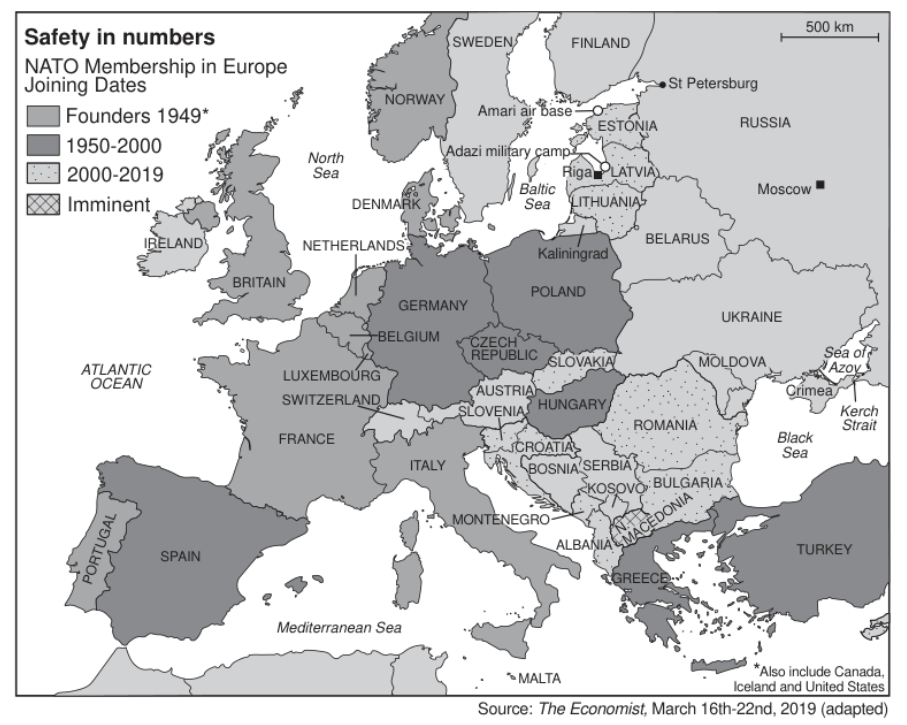
Base your answers to questions 21 and 22 on the map below and on your knowledge of social studies.
The international organization shown on this map was originally established to improve its
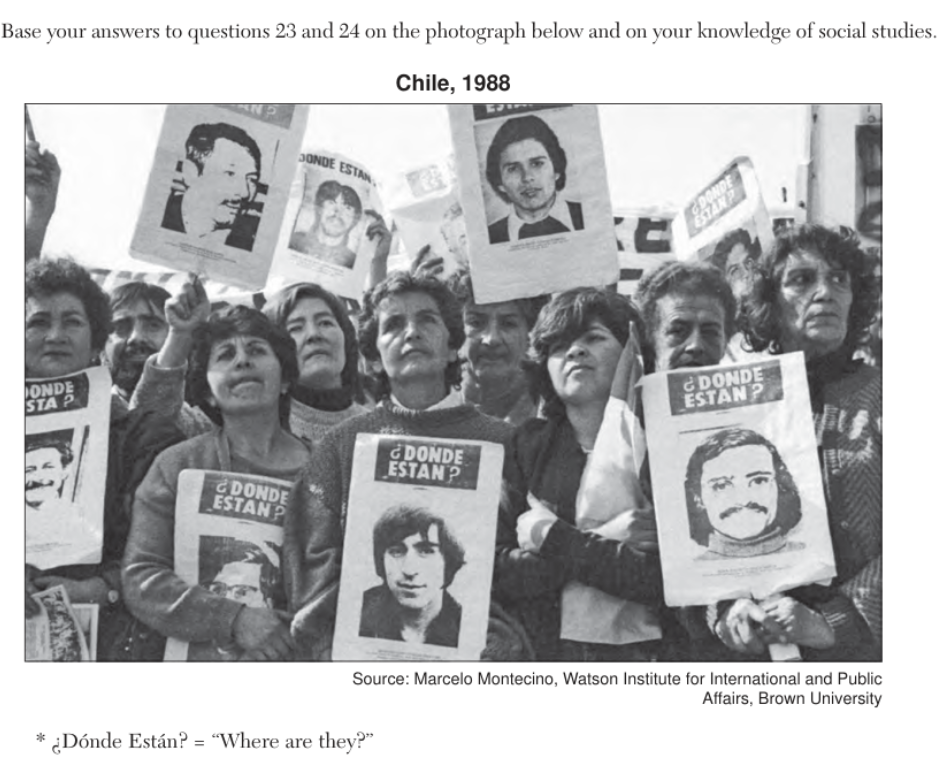
The photograph shows women demanding information about their relatives who disappeared
Base your answers to questions 25 and 26 on the passage below and on your knowledge of social studies.
. . . In 1991, while the attacking Tutsi rebels were gaining ground, speeches at Rwandan political meetings, notably at rallies held by the party of President Habyarimana and his ministers, consisted almost entirely of threats made against Tutsis. In Butare, home of the national university, professors vied with one another to publish historical screeds [rants] and anti-Tutsi diatribes [lectures]. In the broadcast studios of popular radio stations, Radio Rwanda and Radio Mille Collines, the Tutsis were referred to as "cockroaches." Announcers, the two best known of whom were Simon Bikindi and Kantano Habimana, used humorous sketches and songs to call openly for the destruction of the Tutsis. . . .Source: Jean Hatzfeld, Machete Season: The Killers in Rwanda Speak, Farrar, Straus and Giroux, 2005
Based on this passage, one can infer that popular radio programming
Base your answers to questions 27 and 28 on the passage below and on your knowledge of social studies.
A colossal hydroelectric dam being built on the Nile 2,000 miles upriver, in the lowlands of Ethiopia, threatens to further constrict Egypt’s water supply — and is scheduled to start filling this summer.
The dispute between Egypt and Ethiopia over the $4.5 billion Grand Ethiopian Renaissance Dam — Africa’s largest, with a reservoir about the size of London — has become a national preoccupation in both countries, stoking patriotism, deep-seated fears and even murmurs of war.
To Ethiopians, the dam is a cherished symbol of their ambitions — a megaproject with the potential to light up millions of homes, earn billions from electricity sales to neighboring countries and confirm Ethiopia’s place as a rising African power.
After years of bumpy progress, including corruption scandals and the mysterious death of its chief engineer, the first two turbines are being installed. Officials say the dam will start filling in July.
That prospect induces dread in Egypt, where the dam is seen as the most fundamental of threats. . . .
Source: Walsh and Sengupta, “For Thousands of Years, Egypt Controlled the Nile. A New Dam Threatens That,” New York Times, February 9, 2020
What is one concern expressed in this passage?
These questions are based on the accompanying documents and are designed to test your ability to work with historical documents. Each Constructed Response Question (CRQ) Set is made up of 2 documents. Some of these documents have been edited for the purposes of this question. Keep in mind that the language and images used in a document may reflect the historical context of the time in which it was created.
In developing your answers to Part II, be sure to keep these explanations in mind:
Identify—means to put a name to or to name.
Explain—means to make plain or understandable; to give reasons for or causes of; to show the logical development or relationship of something.
Short-Answer CRQ Set 1 Structure
Question 29 uses Document 1 (Context)
Question 30 uses Document 2 (Source)
Question 31 uses Documents 1 and 2 (Relationship between documents)
Short-Answer CRQ Set 2 Structure
Question 32 uses Document 1 (Context)
Question 33 uses Document 2 (Source)
Questions 34a and 34b use Documents 1 and 2 (Relationship between documents)
CRQ Set 1 Directions (29-31): Analyze the documents and answer the short-answer questions that follow each document in the space provided.
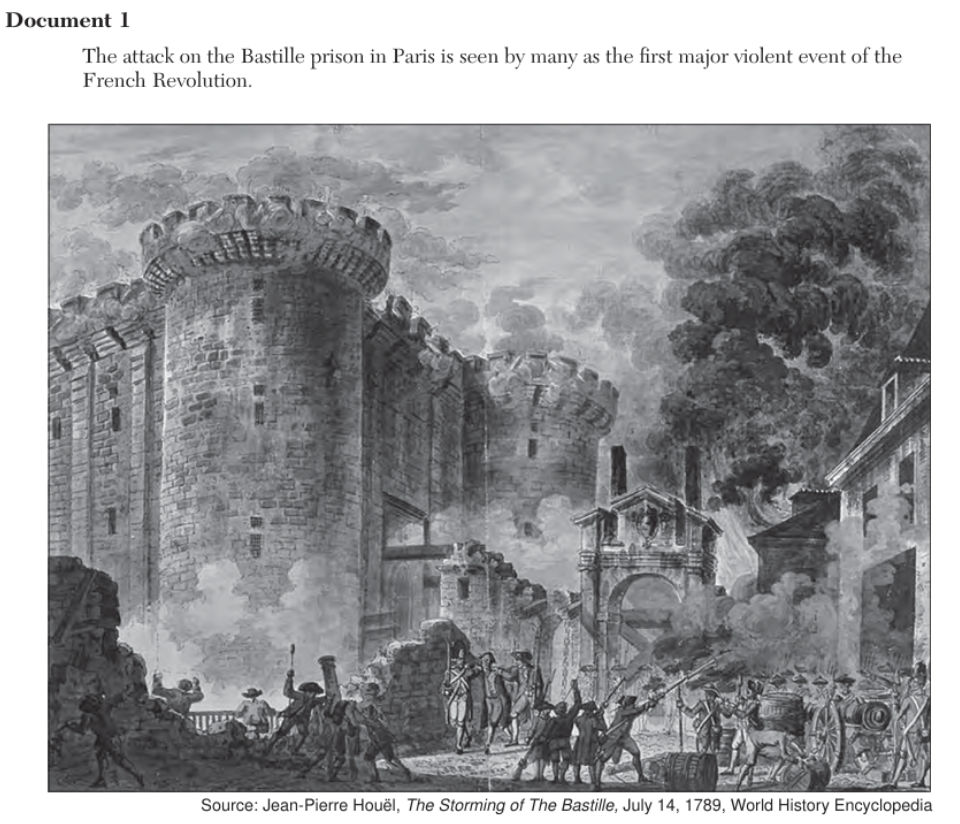
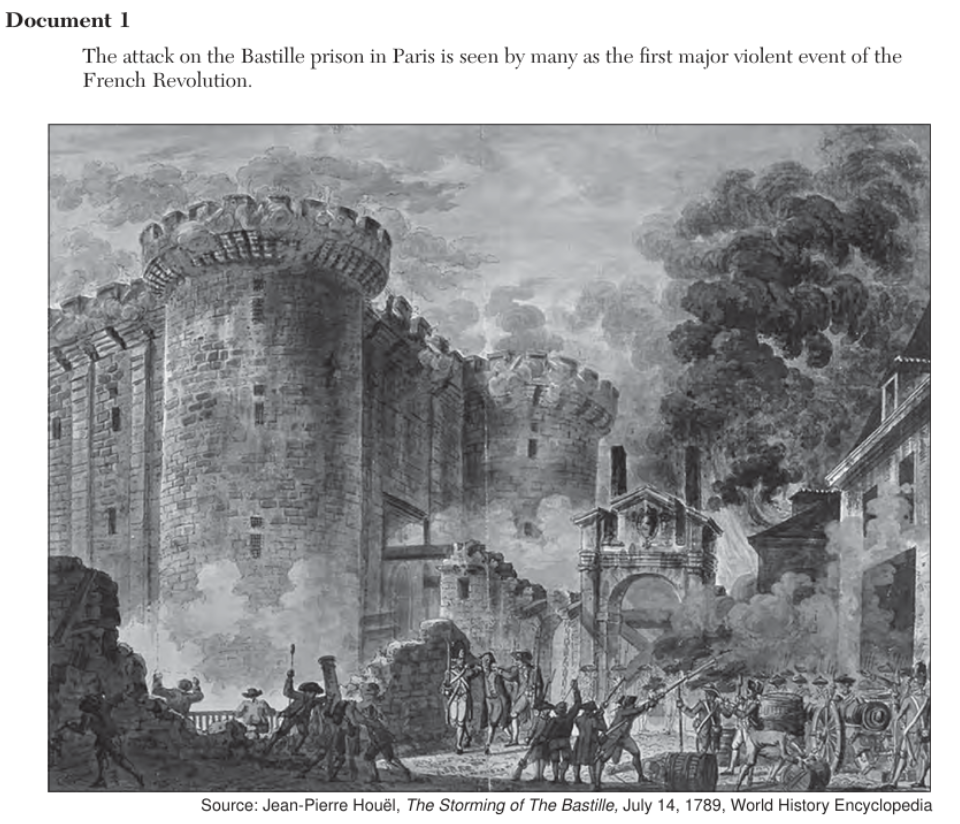
Base your answer to question 29 on Document 1 below and on your knowledge of social studies.
Explain the historical circumstances that led to the scene shown in this painting.
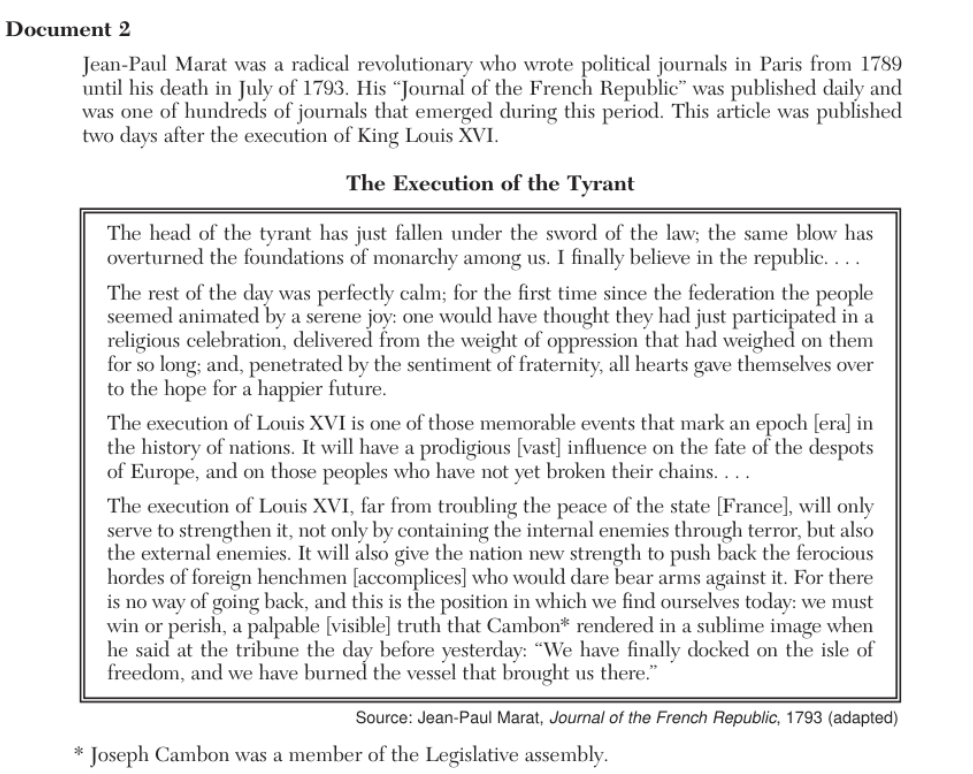
Base your answer to question 30 on Document 2 below and on your knowledge of social studies.
Based on this excerpt, explain Marat’s point of view regarding the effect King Louis XVI’s execution will have on political developments outside of France.
Identify and explain a cause-and-effect relationship between the events and/or ideas found in these documents. Be sure to use evidence from both Documents 1 and 2 in your response.
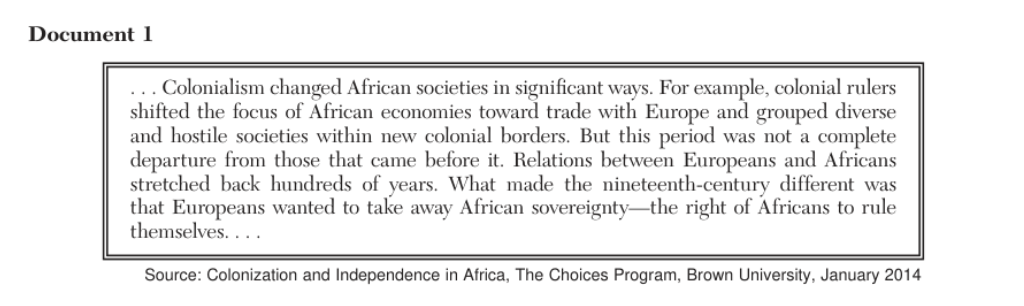
Base your answer to question 32 on Document 1 below and on your knowledge of social studies.
Explain the historical circumstances that led to the developments described in Document 1.
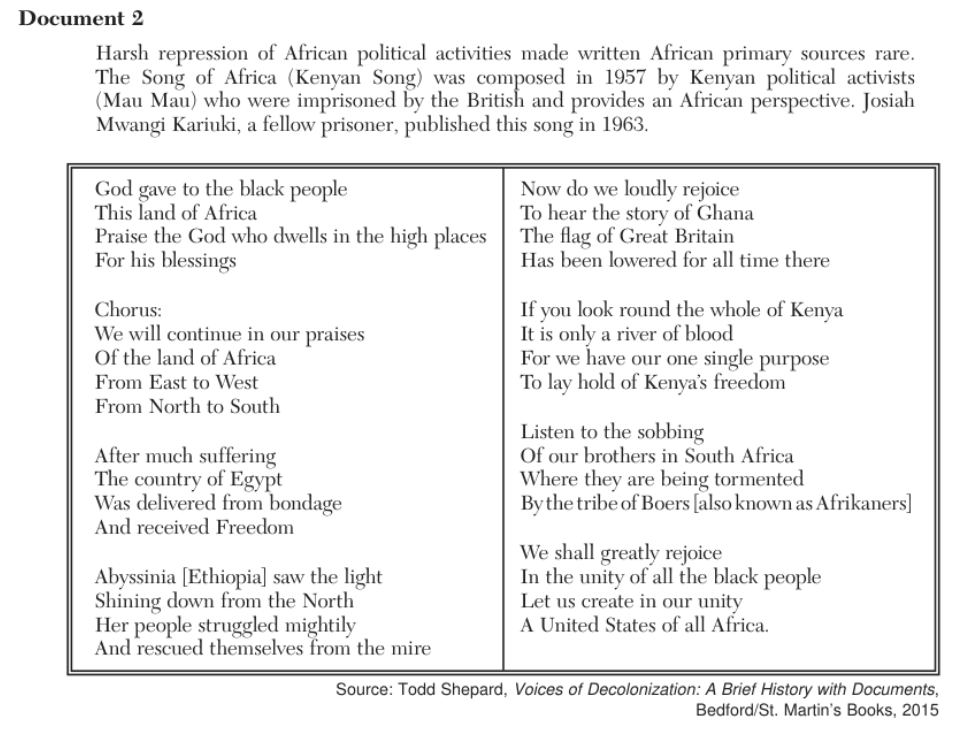
Base your answer to question 33 on Document 2 below and on your knowledge of social studies.
Based on this excerpt, explain Josiah Mwangi Kariuki’s purpose for publishing the Song of Africa (Kenyan Song).
Using evidence from both Documents 1 and 2 and your knowledge of social studies:
Identify a turning point directly associated with the historical developments found in both Documents 1 and 2. [1]
Explain how the turning point you identified created significant change using evidence from both Documents 1 and 2. [1]
This question is based on the accompanying documents. The question is designed to test your ability to work with historical documents. Some of these documents have been edited for the purposes of this question. As you analyze the documents, take into account the source of each document and any point of view that may be presented in the document. Keep in mind that the language and images used in a document may reflect the historical context of the time in which it was created.
Directions: Read and analyze each of the five documents and write a well-organized essay that includes an introduction, several paragraphs, and a conclusion. Support your response with relevant facts, examples, and details based on your knowledge of social studies and evidence from the documents.
An enduring issue is a challenge or problem that has been debated or discussed across time. An enduring issue is one that many societies have attempted to address with varying degrees of success.
Task:
• Identify and explain an enduring issue raised by this set of documents
• Argue why the issue you selected is significant and how it has endured across time using your knowledge of social studies and evidence from the documents
In your essay, be sure to
• Identify the enduring issue based on a historically accurate interpretation of at least three documents
• Explain the issue using relevant evidence from at least three documents
• Argue that this is a significant issue that has endured by showing:
– How the issue has affected people or has been affected by people
– How the issue has continued to be an issue or has changed over time
• Include relevant outside information from your knowledge of social studies
In developing your answer to Part III, be sure to keep these explanations in mind:
Identify—means to put a name to or to name.
Explain—means to make plain or understandable; to give reasons for or causes of; to show logical development or relationship of something.
Argue—means to provide a series of statements that provide evidence and reasons to support a conclusion.
Write your essay here following the instructions above.
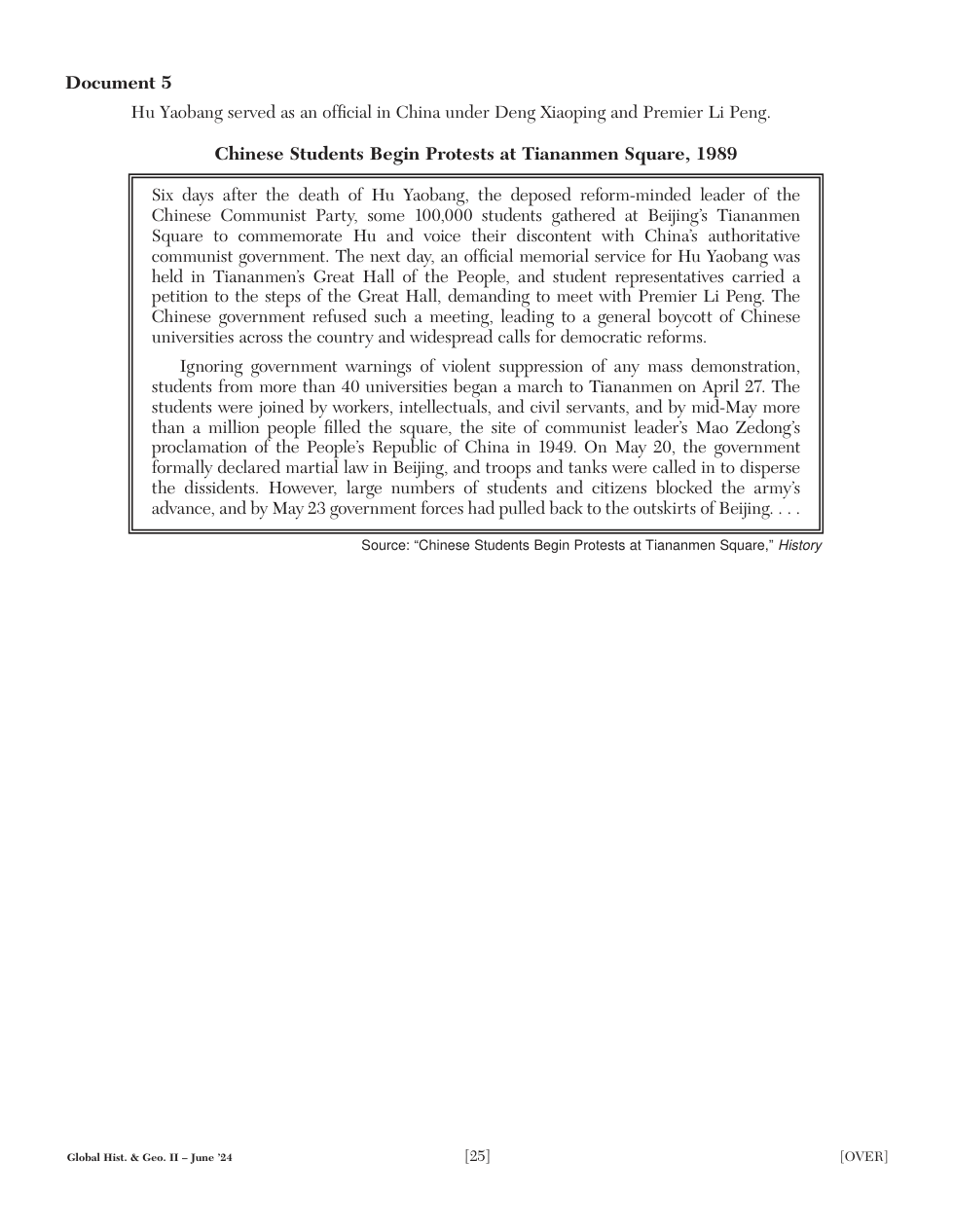
**SCROLL DOWN TO VIEW DOCUMENT 5**
Optional Planning Page
Which claim is best supported by this illustration?
Which claim is best supported by this passage?
Which leader agreed with the philosophy in this passage?
The opinion expressed in this statement was most likely influenced by
What was a goal of Japan in the 19th century that most influenced the writing of this document?
Which organization was formed in response to the concerns addressed in Article XIV?
Which concept is most closely associated with the ideas expressed in this passage?
Which course of action was taken in response to the atrocities described in this passage?
The event described in this passage resulted in
Based on this political cartoon, what statement about nuclear weapons is most accurate?
The shift in membership after 2000 can best be explained as a response to the
Which group of women took similar actions for similar reasons?
Which situation in Rwanda led to the events described in this passage?
Which claim is best supported by this passage?