Document 1
During World War I, President Woodrow Wilson announced his 14 Points, which he hoped would be included in the Treaty of Versailles.
“I [Woodrow Wilson] can predict with absolute certainty that within another generation there will be another world war if the nations of the world do not concert the method [agree to a plan] by which to prevent it.”
Once Wilson knew that the U.S. would be unable to avoid entering the war, he worked to find a way to stop such a war from happening again. In January 1918 he announced the 14 Points, a set of principles designed to remove the causes of another great war. The 14 Points included an international organization to keep the peace, by providing a place where disputes could be discussed and mediated. The 14 Points inspired the peoples of the Allied Nations and gave them hope that another great war could be prevented. When Wilson traveled to Europe in late 1918 to attend the Paris Peace Conference, he was met by crowds numbering in the millions in Britain, France and Italy.
At the Peace Conference in 1919, Wilson moved the seat of the presidency to Paris for six months while he commanded the attention of the world. He was faced with the leaders of the Allied Nations determined to win as many concessions and as much territory as they could for their countries. Wilson argued and fought with them through June of 1919 to make as fair a treaty as possible under the circumstances. Wilson drew up terms of peace including his design for a League of Nations, a world body to settle future conflicts among nations.…
Source: “League of Nations,” The President Woodrow Wilson House (adapted)
Document 2
After discussing the proposed treaty provisions relating to the League of Nations with President Woodrow Wilson, Senator Henry Cabot Lodge gave an address to the United States Senate on February 28, 1919.
. . . Animated by the conviction that he would “follow no man and vote for no measures which, however well intended, seem in my best judgment to lead to dissensions [disagreements] rather than to harmony among the nations or to injury, peril, or injustice to my country,” and his insistence that the Senate, “which is charged with responsibility... should investigate every proposal with the utmost thoroughness,” Lodge’s address was a painstaking critique of the League’s constitution. He began with the impassioned argument that the document repudiated [contradicted] George Washington’s September 17, 1796, Farewell Address and the Monroe Doctrine, two sacred canons [principles] of American foreign policy. “I ask the press and the public and, of course, the Senate to consider well the gravity of this proposition,” Lodge pleaded, “before it takes the heavy responsibility of finally casting aside these policies which we have adhered to for a century and more and under which we have greatly served the cause of peace both at home and abroad.”
Turning to the specific provisions of the proposed draft, Lodge argued that the provision guaranteeing the independence and territorial integrity of all members was particularly troubling. He warned that, to insure that guarantee, the United States “must be in possession of fleets and armies capable of enforcing them at a moment’s notice.” . . .
Source: “Henry Cabot Lodge: Constitution of the League of Nations,” Classic Senate Speeches, U.S. Senate
Document 3
Again and again, my fellow citizens, mothers who lost their sons in France have come to me and, taking my hand, have shed tears upon it not only, but they have added, "God bless you, Mr. President!" Why, my fellow citizens, should they pray God to bless me? I advised the Congress of the United States to create the situation that led to the death of their sons. I ordered their sons oversea. . . . They believe, and they rightly believe, that their sons saved the liberty of the world. They believe that wrapped up with the liberty of the world is the continuous protection of that liberty by the concerted [united] powers of all civilized people. They believe that this sacrifice was made in order that other sons should not be called upon for a similar gift—the gift of life, the gift of all that died. . . .
You will say, "Is the League an absolute guaranty against war?" No; I do not know any absolute guaranty against the errors of human judgment or the violence of human passion, but . . . I ask you this: If it is not an absolute insurance against war, do you want no insurance at all? Do you want nothing? Do you want not only no probability that war will not recur, but the probability that it will recur? The arrangements of justice do not stand of themselves, my fellow citizens. The arrangements of this treaty are just, but they need the support of the combined power of the great nations of the world. . . .
Source: President Woodrow Wilson, The Pueblo Speech, September 25, 1919
Document 4
... Opposition in the Senate to the Covenant of the League of Nations, led by Republican Henry Cabot Lodge of Massachusetts, was directed in particular at Article X, which stated that members would “undertake to respect and preserve as against external aggression the territorial integrity and existing political independence of all Members of the League” and that “the Council shall advise upon the means.” Many Americans believed with Lodge that through the treaty the United States would be committed to an “entangling alliance” and that other nations could determine its foreign policy by obliging it to participate in action against aggressors.
Deciding that an appeal to the country would force the Senate into line for the necessary two-thirds vote, President Wilson traveled over 8,000 miles by train and spoke forty times in twenty-two days. He became ill, and was forced to abandon his appeal. Wilson never succeeded in mustering enough votes to have the treaty passed as he had originally proposed it. Yet his belief in the original proposal was so intense that he used his influence to keep his supporters from agreeing to the changes which could have brought passage. . . .
Source: Leonard F. James, American Foreign Policy, Scott, Foresman and Company, 1967
Document 5a

Source: New York Tribune, March 20, 1920
Document 5b
The Gap in the Bridge
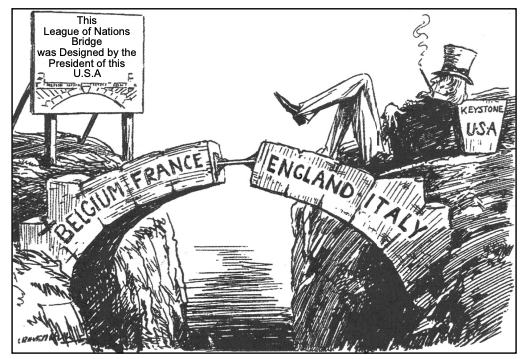
Source: Leonard Raven-Hill, Punch (adapted)
Document 6
... In the end Wilson failed largely because the country had never really abandoned its isolationist predilections [preferences], particularly the assumption that the United States unaided could maintain its national security. During the war, these convictions were driven underground. It is astonishing that despite the tradition of isolation, despite Wilson's collapse, despite partisan bitterness and the animosity of ethnic groups, 85 per cent of the senators voting on November 19 were willing to accept the League in some form. Yet even if the country had entered the League, it is doubtful that Americans would have been willing to assume their full obligations. The United States had not been prepared by a threat to its own security for the kind of enterprise [action] it was later to undertake in Korea. It had insufficient incentive for abandoning either isolation or absolute national sovereignty. It would take the chastening experience of World War II, Hiroshima, and the Cold War to provide that incentive. ...
Source: William E. Leuchtenburg, The Perils of Prosperity: 1914–1932, The University of Chicago Press, 1993


