2020 (Jan): NY Regents - Global History & Geography II
star
star
star
star
star
Last updated 23 days ago
36 questions
The sankin kōtai (lit., “alternate attendance”) system was a device of the Tokugawa shogunate, the government of Japan from 1603 to 1868, designed to insure political control by the regime over the daimyo, or territorial lords, who exercised virtually autonomous authority over the more than 260 feudal states into which four-fifths of the country was divided. Under this system most of the daimyo were required to travel biennially [every two years] from their domains to the capital of the Tokugawa at Edo (present day Tokyo) and to spend alternate years in personal attendance at the shogunal court. Each daimyo was also required to maintain residences at the capital where his wife and children were permanently detained. . . .Another important contribution of the operation of the sankin kōtai system to the modernization of Japan was to promote the intellectual and cultural unification of the country. The sankin kōtai served to bring a large part of the leadership elements from the whole country together in one place and to keep a constant stream of leaders and intellectuals moving back and forth between the capital and all parts of the country. This was important in giving Japan the tremendous intellectual unity with which it faced the West in the nineteenth century. It also enabled the people at large to have a stronger sense of national unity than would have been the case had the system not existed. By serving as the vehicle which spread the culture of Edo and Osaka to the countryside, the system influenced the diffusion of a truly national culture. . . .
Source: Toshio G. Tsukahira, Feudal Control in Tokugawa Japan, East Asian Research Center, Harvard University, 1966
The poor harvest could not have come at a worse moment. France had entered into an unfavorable trade treaty with England in 1776. The pact reduced import duties on English goods, the notion being to encourage French manufacturers to mechanize production in response to enhanced competition. A flood of cheap imports from across the Channel overwhelmed the cloth industry. Cloth production alone fell by 50 percent between 1787 and 1789. The 5,672 looms in Amiens and Abbeville in 1785 were down to 2,204 by 1789. Thirty-six thousand people were put out of work, throwing many poor workers onto city streets at a time when hungry peasants were flocking to urban centers in search of food. The rural crisis might have been short-lived had not urban unemployment mushroomed at the same time. In Paris, the government subsidized bread prices out of fear of the mobs, but to no avail. The situation was soon out of control.
Source: Brian Fagan, The Little Ice Age: How Climate Made History, 1300–1850, Basic Books, 2000
[18,641 miles] from China. The purpose of your ships in coming to China is to realize a large profit. Since this profit is realized in China and is in fact taken away from the Chinese people, how can foreigners return injury for the benefit they have received by sending this poison to harm their benefactors? They may not intend to harm others on purpose, but the fact remains that they are so obsessed with material gain that they have no concern whatever for the harm they can cause to others. Have they no conscience? I have heard that you strictly prohibit opium in your own country, indicating unmistakably that you know how harmful opium is. You do not wish opium to harm your own country, but you choose to bring that harm to other countries such as China. Why?...... Your country is more than 60,000 lilili
Owing to the extensive use of machinery and to division of labor, the work of the proletarians has lost all individual character, and, consequently, all charm for the workman. He becomes an appendage of the machine, and it is only the most simple, most monotonous, and most easily acquired knack that is required of him. Hence, the cost of production of a workman is restricted, almost entirely, to the means of subsistence that he requires for his maintenance, and for the propagation of his race. But the price of a commodity, and also of labor, is equal to its cost of production. In proportion, therefore, as the repulsiveness of the work increases, the wage decreases. Nay more, in proportion as the use of machinery and division of labor increases, in the same proportion the burden of toil also increases, whether by prolongation of the working hours, by increase of the work exacted in a given time, or by increased speed of machinery, etc. . . .
Source: Marx and Engels, The Communist Manifesto, 1848
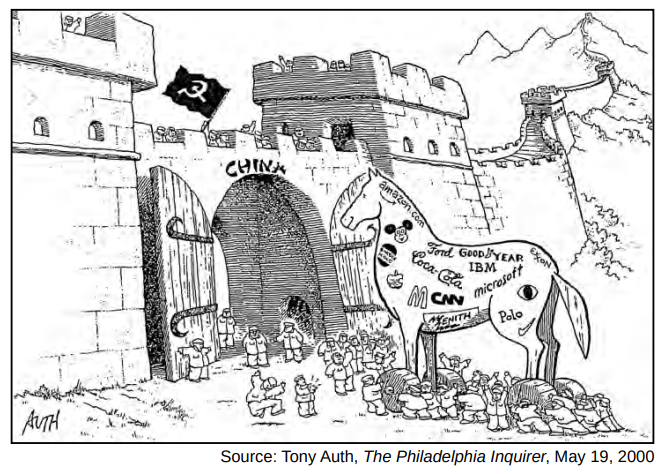
NAFTA [North American Free Trade Agreement] has led to an increase in the workforce, as foreign industry has grown. They are reforming labor laws and our constitution to favor even more foreign investment, which is unfair against our labor rights. For example, they are now trying to take away from us free organization which was guaranteed by Mexican law. Because foreign capital is investing in Mexico and is dominating, we must have guarantees. The government is just there with its hands held out; it’s always had them out but now even more shamelessly. . . . Ecological problems are increasing. A majority of women are coming down with cancer — skin and breast cancer, leukemia, and lung and heart problems. There are daily deaths of worker women. You can see and feel the contamination of the water and the air. As soon as you arrive and start breathing the air in Acuña and Piedras Negras [border cities between the states of Coahuila and Texas], you sense the heavy air, making you feel like vomiting. . . .