History of Medicine
star
star
star
star
star
Last updated over 2 years ago
30 Nsɛmmisa
1
1
5
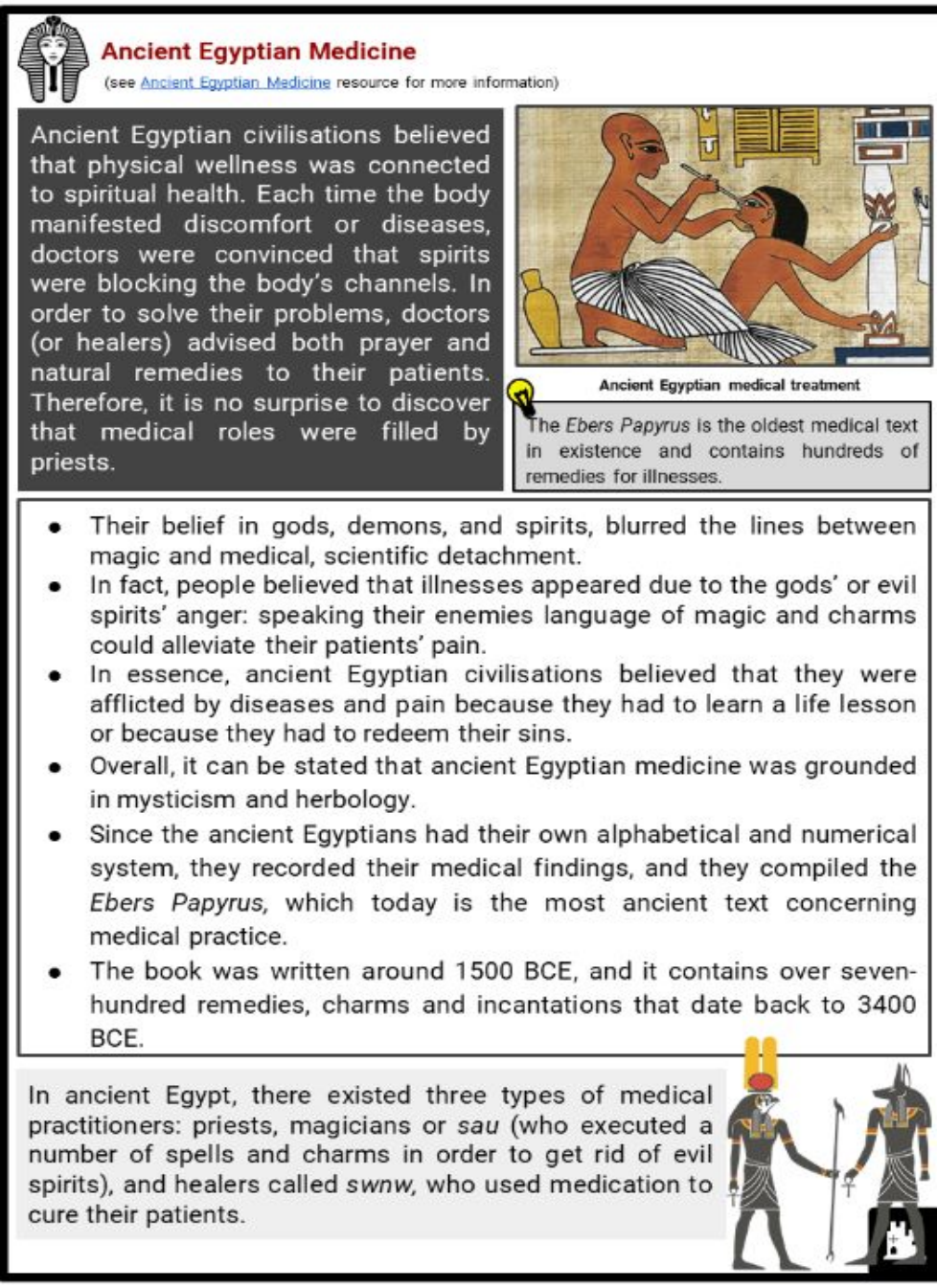
Each time the body manifested discomfort or diseases, doctors were convinced that spirits were blocking the body's channels.
With the concept of “a healthy mind in a healthy body”, ancient Greeks viewed medicine as the connectedness of both physical and mental health.
Hippocrates, also known as the ‘father of medicine’, was a Greek philosopher who developed the theory of four humors or liquids that remained popular in Western Europe until the 17th century.
In addition to the Hippocratic School of Medicine, Hippocrates pioneered the examination of a living person as a means of studying diseases.
Today, the Hippocratic oath is widely used by doctors and other healthcare professionals as a commitment when practising medicine.
The theory of the Four Humors states that the human body is composed of four substances or liquids that should be in perfect balance, if not, sickness will occur.
Succeeding generations further developed the theory of the four humors.
Galen, a Greek-born Roman citizen and supporter of Hippocrates who lived centuries after, expanded humoral physiology.
He included the three varieties of pneuma or vital energy: the liver, heart and brain.
Who is known as "father of medicine"?
Hippocrates pioneered the examination of a living person as a means of studying disease.
The main factor that contributed to Renaissance medicine was increased anatomical knowledge. Societies eased the religious and legal restrictions that had been put on dissecting cadavers. This allowed physicians to carry out many anatomical studies, making a lot of new discoveries about human anatomy possible.
Autopsy was first introduced by the Greeks in Europe, but was immediately halted with the rise of the Church. Leonardo da Vinci had several accounts on dissection of the human body, while Giovanni Battista Morgagni led autopsy in science form.
Today, autopsy is a general procedure of finding out the cause of death.
Bloodletting using leeches became a prominent practice in the Renaissance era until the 19th century. Based on the theory of humors, blood’s imbalance was pointed out as the cause of headache, fever, apoplexy, and others. As a cure, blood was drawn until the patient began to faint.
What factor contributed to Renaissance medicine?
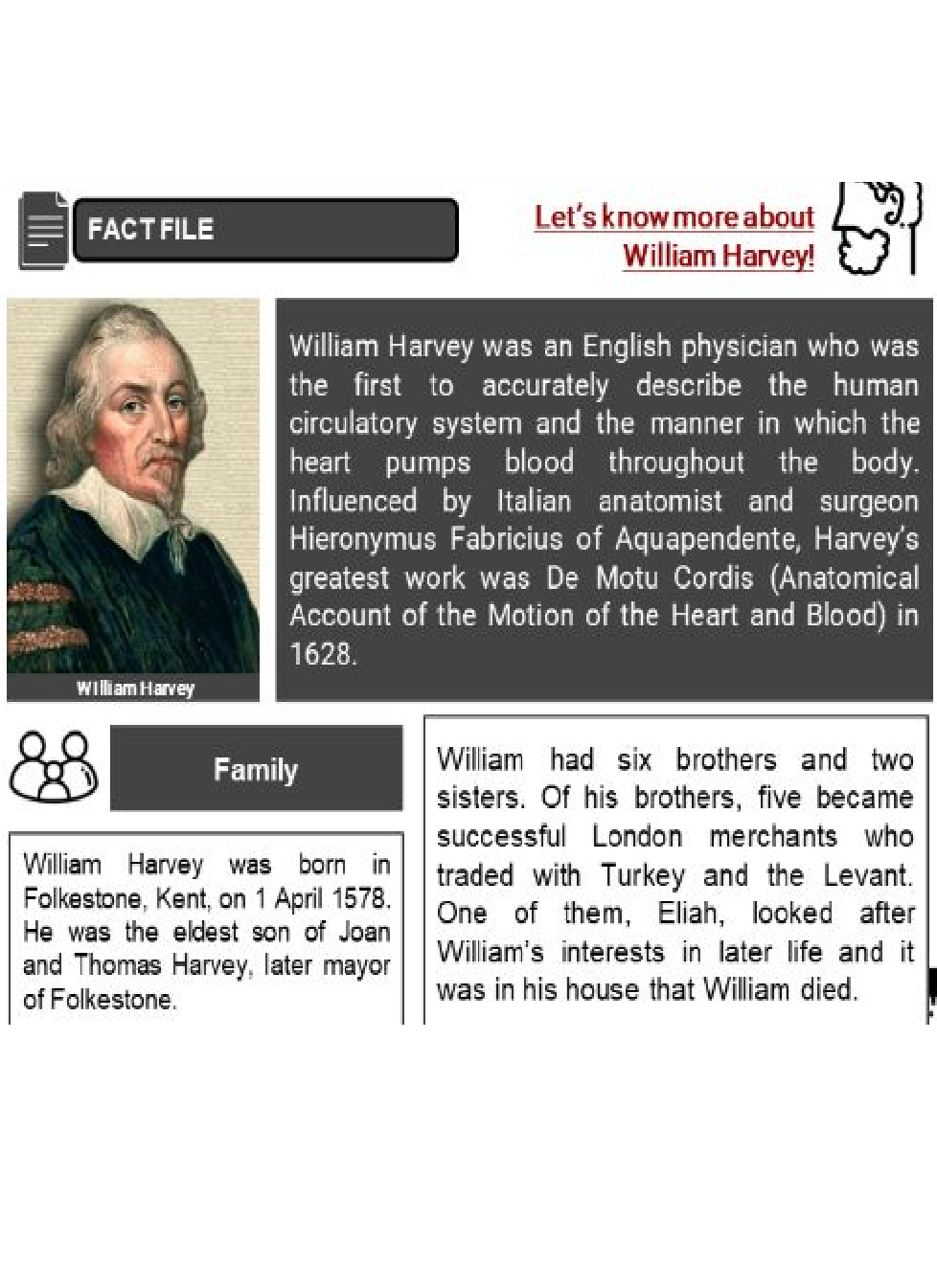
What year was Harvey born?
Harvey was the first physician to accurately describe what body system?
In 1628, Harvey’s greatest work, Anatomical Account of the Motion of the Heart and Blood (De Motu Cordis) was published in Frankfurt. In this work, he explained with exemplary clarity his observations of the movement of the heart and blood, his theory of blood circulation, and his experimental proofs of the validity of his theory.
Through his work, Harvey was able to refute many of the standard beliefs of blood circulation. He established that: Blood in the arteries and the veins is all of the same origin, not manufactured in different parts of the body.
The blood sent through the arteries to the tissues is not consumed there.
The circulation mechanism is designed for movement of liquid, not air. The blood on the right side, although carrying air, is still blood.
The heart, not the liver, is the source of blood movement.
The heart contracts at the same time as a pulse is felt.
The ventricles squeeze blood into the aorta and pulmonary artery.
The pulse is not produced by the arteries pulling blood in, but by blood being pushed by the heart into the arteries, enlarging them.
There are no vessels in the heart’s septum: all of the blood in the right ventricle goes to the lungs and then through the pulmonary veins to the left ventricle.
Similarly, all of the blood in the left ventricle is sent into the arteries, round by the smaller veins into the venae cavae, and then to the right ventricle again. In this way, the circulation is complete. The blood has come back to where it began its circuit of the body. There is no to-and-fro movement of blood in the veins, but a constant flow of blood to the heart. (Famous Scientists 2015).
He wrote that for nine years he had been working on this subject, slowly drawing the inevitable conclusions from his observations and experiments. By determining the correct path the blood took through the body, he concluded that the amount and rate of passage of blood from the heart necessitated that the blood return to the heart.
Prior to Harvey, Galen had been an influential medical authority for many centuries. His studies say there were two separate blood systems in the body.
One carried the venous blood that uses the veins to distribute nutrition from the liver to the rest of the body.
The other carried the arterial blood that uses the arteries to distribute heat and life from the heart to all parts of the body.
In present times, these two systems are now understood as oxygenated and deoxygenated blood.
These existing beliefs made Harvey’s theory so revolutionary that there was little wonder that he met with some bitter opposition, especially since his claims were opposed to that of the great Galen’s.
Write down TWO things that Harvey discovered about blood circulation.
Prior to Harvey, Galen had been the influential authority. Galen believed that there were separate blood systems.
Galen believed in venous blood. Venous blood uses to distribute nutrition form the to the rest of the body.
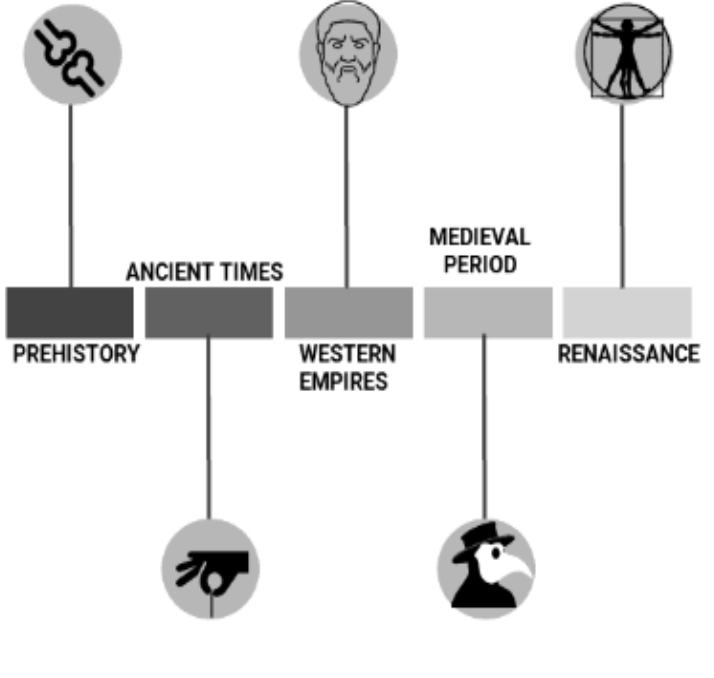
Drag the text boxes to complete the timeline.
Remedies for disease or discomfort was both prayer and natural remedies.
In Ancient Egypt, what did people believe that illness was due to
Ancient Egyptians believe that they were afflicted by disease and pain because they needed to learn a life lesson
Egyptians recorded their medical findings on
In ancient Egypt, there existed three types of medical practitioners, priests, magicians, or sau.
Explain the theory of the Four Humors.
List the three pneuma or vital energy that Galen believed in
Historically, the Medieval period in Europe began with the fall of the Roman Empire, thus making medical knowledge derived from the ideas of Hippocrates and Galen. In general, societies during this period carried out medical practices that today are considered unhygienic, hazardous, and unreasonable.
The superstition and dogmatism that marked the rise of Christianity in Europe continued to flourish throughout the Middle Ages.
Therapy relapsed into magic and prayer, fantastic and often revolting concoctions, charms and amulets, and faith healing.
Venesection and various herbs were used widely. Dissection of cadavers was completely forbidden, and anatomy, if studied outside of textbooks, was based on the dissection of pigs.
Hygiene and sanitation were at a very low level, since the human body was held in contempt - being a temporary vessel that housed the soul.
Throughout the Middle Ages, only the wealthiest could afford physicians. On the other hand, the poor were obliged to consult local practitioners that referred to folkloric traditions.
When the bubonic plague started in Europe due to widespread unhygienic habits, people were not aware that the main cause of death was the bacteria Yersinia pestis, which was spread by infected fleas on black rats.
Not having a scientific explanation for the disease that had wiped out over one-third of Europe’s population, people attempted to save their lives in a variety of ways.
In an age when religion ruled society and its thought, it is not surprising that the Black Death was considered a sort of divine punishment inflicted by God on sinful members of humanity.
Others thought that the best solution to avoid the plague was hiding in the sewers, where no one could reach them, see them, or touch them.
However, the filthy conditions of the sewers, with their foul-smelling surroundings and fetid insects, did not save them from death: and although they may not have been infected by the bubonic plague, they nonetheless died due to other severe illnesses and infections.
If an individual suffered from regular headaches, migraines, or epilepsy, trepanation was carried out: such practice consisted of perforating the skull with the intention of relieving pressure.
Stomach problems were cured using herbal remedies. One of them was St. Paul’s potion, which involved the use of several ingredients such as: ‘liquorice, sage, willow, roses, fennel, cinnamon, ginger, cloves, cormorant blood, mandrake, dragon’s blood, and three kinds of pepper’ (Tan 2016).
Teeth were cleaned with a cloth or with leaves. In cases of decay, they were extracted by local barbers.
The Medieval period in Europe began with the fall of what Empire?
During the Medieval period, magic, prayer, charms and amulets were used to treat disease.
People were able to dissect cadavers to learn about the human body and disease.
During the medieval periods, hygiene and sanitation were at very high levels.
The bubonic plague spread across Europe due to unhygienic habits and fleas.
What bacteria caused the bubonic plague?
People tried to avoid the plague by hiding in
What procedure was carried out if a person suffered from headaches, migraines, or epilepsy?
Who extracted teeth if the teeth were decayed?
Autopsy was first introduced by the Greeks in Europe.
What practice using leeches became a prominent practice in Renaissance era?
Blood imbalance was believed to be the cause of headaches and fever. So blood was drawn until the patient began to faint.
Galen also believed in arterial blood that use arteris to distribute