O.G. Rabbit Case Study (LONG)

Last updated over 1 year ago
33 questions
This case study, A Simple Plan: E.L. Trudeau, The Rabbit Island Experiment, and Tuberculosis Treatment is by Karen M. Aguirre
Imagine that it is 1874 and you have just been diagnosed with consumption, which we now call tuberculosis. That’s what happened to Edward Livingston Trudeau. A few years earlier, he had nursed a brother who ultimately died of the disease. Now, he had a fresh doctor’s degree, a young wife, a new baby, and a terrible problem—a diagnosis that, in his time and place, was often a death sentence.

Dr. Trudeau knew all too well that a large number of people diagnosed with consumption ultimately died. Crowded together in cities like New York, where he was living with his young family, were tens of thousands of immigrants who were very glad to have their back-breaking factory jobs, but came home each night to inadequate housing, food, ventilation, sanitation, and little or no leisure or relaxation time.

Consumptives labored for as long as they could draw breath as the bacterial infection in their lungs worsened and spread, eroding blood vessels and causing bleeding and poor oxygenation, or causing the lungs to fill with fluid until the sufferer might literally drown. Finally, exhausted consumptives would retire to their dank, crowded apartments to be nursed by their families until they died. Often family members would themselves become infected from their close contact and constant inhalation of organisms expelled by their sneezing, coughing, bleeding loved one.

E.L. Trudeau, however, was not poor, nor was he a member of the factory-worker class. He decided to travel to a place where he had spent a lot of time as a boy and a young man, the Adirondack Mountains of upstate New York. There he could rest a bit, think, take long walks in the open air, and make a plan.

Dr. Trudeau’s condition worsened during the arduous trek north by rail and carriage. In fact, the young man was so frail and sick that he had to be carried into the house of an Adirondack outdoorsman and wilderness guide. But a remarkable thing happened. Dr. Trudeau began to feel better. In time, he could hike and hunt and enjoy life with his friends. He resumed his correspondence with doctors and scientists. He sent for his wife and child, and began to build a medical practice in the distant little outpost of Saranac Lake. And he began to think about the cause and cure of what more and more scientists called not consumption, but tuberculosis
1

Consumption is now know as

1

People with consumption have a bacterial infection in their

1

Often family members who are taking care of a loved ones with consumption become infected because their loved one sneezed and coughed.

1

Where did E.L. Trudeau go to rest after he was diagnosed with consumption?

1

Did Dr. Trudeau's condition improve?

In the 19th century, a portion of the medical community believed that diseases like consumption were caused by an unfortunate combination of bad “family blood” (after all, the poor were certainly not well-bred, and they were more likely to become sick and to die early) and mysterious causative agents as ill-defined as dank conditions, bad “humours,” obnoxious smells, and miasmas (harmful air). But, in 1882, Robert Koch demonstrated to most of the scientific establishment’s satisfaction that the tiny bacterium Mycobacterium tuberculosis (MTb) caused the disease known as consumption.

Moreover, he could grow pure cultures of the finicky MTb and infect cells of experimental animals, and ultimately the animals themselves, causing the disease. Koch said: “If the importance of a disease for mankind is measured by the number of fatalities it causes, then tuberculosis must be considered much more important than those most feared infectious diseases, plague, cholera and the like. One in seven of all human beings dies from tuberculosis. If one only considers the productive middle-age groups, tuberculosis carries away one-third, and often more.”

Koch’s work, along with Louis Pasteur’s, led to the more general “germ theory of infection,” which stated that infectious diseases were caused by germs, which was the name given to the microscopic organisms (we know them now as viruses, bacteria, fungi, and parasites) that cause disease in people and animals.
1

Early in the 19th Century people believed that diseases like consumption were caused by family blood and bad smells.

1

Who discovered the bacterium that caused consumption?

1

What bacteria caused consumption?

1

Koch was able to grow MTb and infect animals causing them to develop tuberculosis.

1
Koch's work along with __________ led to germ theory of infection.
1

What does the germ theory of infection state

Dr. Trudeau had followed Dr. Koch’s work with interest. He worked hard to learn how to culture MTb organisms, and was the first to do so in the United States. Intrigued by the correlation between healthy outdoor lifestyle and efficient anti-tubercular defense in his own case, he devised a simple experiment. The experiment spoke to both the MTb “germ” as sole causative agent of tuberculosis and a possible therapy for the disease. The experiment was described in his 1886 paper, “Environment in its Relation to the Progress of Bacterial Invasion in Tuberculosis.” The following is an excerpt from that paper.

First. What results ensue when both bacillary infection and unhygienic surroundings are made to coexist in tuberculosis?

Second. Are unhygienic surroundings when every known precaution has been taken to exclude the bacillus sufficient of themselves to bring about the disease?

Third. Is bacillary infection invariably progressive in animals placed under the best conditions of environment attainable?

Experiments.—Fifteen rabbits were made use of and divided in three lots, each set of animals being placed under conditions best adapted to answer in the results noted [in] the three questions already referred to.

Experiment No. 1. Five rabbits were inoculated in the right lung and in the left side of the neck with five minims of sterilized water in which was suspended a sufficient quantity of a pure culture (third generation) of the tubercle bacillus to render the liquid quite perceptibly turbid. The needle of the Koch’s inoculating syringe was inserted subcutaneously on the left side of the neck and in the third intercostal space to a depth of thirty millimetres on the right side. These animals were then confined in a small box and put in a dark cellar. They were thus deprived of light, fresh air and exercise and were also stinted in the quantity of food given them while being themselves artificially infected with the tubercle bacillus.

Experiment No. 2. Five healthy rabbits were placed under the following conditions: A fresh hole about ten feet deep was dug in the middle of a field, and the animals having been confined in a small box with high sides but no top, were lowered to the bottom of this pit, the mouth of which was then covered with boards and fresh earth. Through this covering a small trap door was cut which was only opened long enough each day to allow of the food, consisting of a small potato to each rabbit, being thrown to the animals. So damp was the ground at the bottom of this pit that the box in which the rabbits were confined was constantly wet. Thus these animals were deprived of light, fresh air, and exercise, furnished with but a scanty supply of food while breathing a chill and damp atmosphere, though free from disease themselves and removed as far as possible from any accidental source of bacterial infection.

Experiment No. 3. Five rabbits having been inoculated in precisely the same manner as the animals in the first experiment, were at once turned loose on a small island in June, 1886. It would be difficult to imagine conditions better suited to stimulate the vitality of these animals to the highest point than were here provided. They lived all the time in the sunshine and fresh air, and soon acquired the habit of constant motion so common in wild animals. The grass and green shrubs on the island aff orded all the fresh food necessary and in addition they were daily provided with an abundant supply of vegetables. Thus, while artificially infected themselves they were placed in the midst of conditions well adapted to stimulate their vital powers to the highest point attainable.
1

What kind of animal did Dr. Trudeau use in his experiment?

1

Rabbits in Experiment No. 1 were

1

The rabbits in Experiment No. 2 were inoculated with tubercle bacillus.

1

Rabbits in Experiment No. 3 were

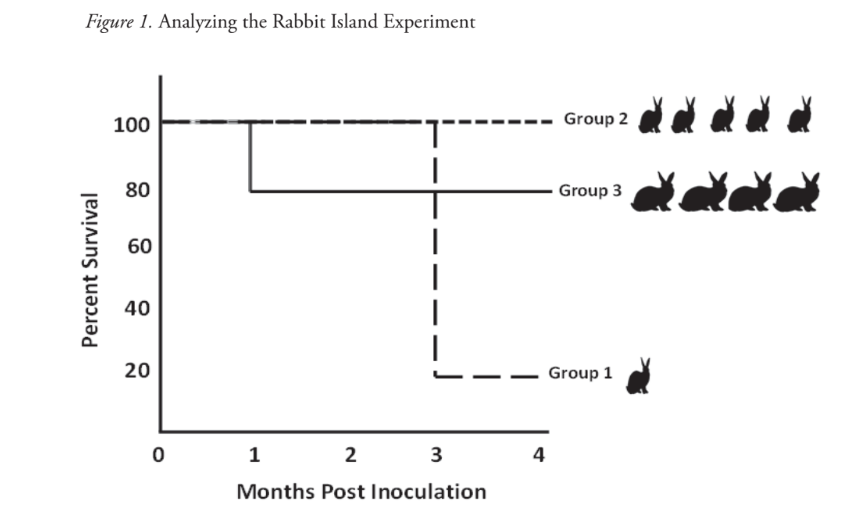
The data from the experiment Dr. Trudeau describes is shown below in Figure 1. Graphs like Figure 1 are called survival curves.
3

Explain why the rabbits are emaciated (think and weak) in groups 1 and 2. (Please note: What Dr. Trudeau called Experiments 1, 2, and 3 are more like what modern scientists would call treatment groups 1, 2, and 3, and that terminology is used in Figure 1.)

1

According to the figure, what were the results of group 3?

3

How did Experiment No. 1 answer Dr. Trudeau's first question: What results ensue when both bacillary infection and unhygienic surroundings are made to coexist in tuberculosis?

3

How did Experiment No. 2 answer Dr. Trudeau's second question: Are unhygienic surroundings when every known precaution has been taken to exclude the bacillus sufficient of themselves to bring about the disease?

3

How did Experiment No. 3 answer Dr. Trudeau's third question: Is bacillary infection invariably progressive in animals placed under the best conditions of environment attainable?

3

Do Dr. Trudeau's result support the germ theory of infection? Why or why not?

2

What do the data suggest might be good environmental conditions for tuberculosis patients?

2

What might be the effect of crowding on effective exposure rate of individual animals to MTb? (Hint: Would
you rather board an airplane for a 3-hour trip where 2 out of 300 passengers had the flu or board an airplane
where 200 out of 300 passengers had the flu?)

Dr. Trudeau’s little experiment had a big impact on medical thinking at the time. His experiment offered a rationale for opening his Adirondack Cottage Sanitarium, which offered rich and poor alike a regimen of abundant nourishing food, lots of sunlight, plenty of rest, and as much fresh air as a person could tolerate. Hundreds were helped, and many similar establishments were opened. Perhaps the experiment was so successful because of the care with which Trudeau had designed its components. It is important to identify an interesting and potentially approachable question or set of questions before undertaking an experiment. But it is just as important to devise a clever experimental design.

When we design an experiment, we choose the treatments that will be received and we control or manipulate them in appropriate ways. These treatments or manipulations are the independent variable(s). The observed or measurable differences in outcome for the treatment groups are the dependent variable(s). Suppose I want to know how much sunlight is needed to produce the sweetest oranges? Based on what I know about sunlight and photosynthesis, I hypothesize that the greater amount of sunlight an orange plant gets, the sweeter the juice of the orange. To investigate whether this is true, I might place one group of plants in the sun for 2 hours per day, another group for 4 hours per day, and another group for 8 hours per day. At the end of the experiment, I could test for the amount of sugar in the juice of the oranges. The amount of time in the sun is the independent variable. The sugar in the juice is the dependent variable.
1

What is the dependent variable in the Rabbit Island Experiment ( the variable that Dr. Trudeau is measuring?)

1

What is the independent variable in the Rabbit Island Experiment ( the variable that Dr. Trudeau is changing)?

2

We respect Dr. Trudeau and all those earlier scientists who did the best they could within the contemporary
understanding of the problem they addressed and utilizing the materials and technology they had at hand.
Modern-day biologists like to talk about resistance/susceptibility genes and patterns of inheritance, rather than
family blood. They think about infectious disease in terms of microbes and pathogenicity, rather than speaking
of bad humors. They have identified vitamins and other nutrients that are abundant in some food stuffs
and lacking in other that are essential for optimal immune function. Without the benefit of such modern
formulations, Dr. Trudeau, by a disciplined application of scientific curiosity and careful, clever methodology, shed light on each of these concerns, light that helped to illuminate the minds of scientists who came after. Still, a look at his original paper leaves us wondering, were the rabbits genetically identical? Probably not! Were they all of the same sex and age? Couldn’t he have given the animals kept on short rations just a smaller amount of the same varieties of food available to the animals fed abundantly—after all, there might be some important nutrient missing in potatoes. In light of the title of the paper, why not measure bacterial numbers in the rabbits on post mortem rather than just survival time? (In a subsequent paper, he did exactly that.) Once you start
critiquing an experiment from 100 years ago, or 10 years ago, or sometimes even last year, it’s hard to stop. Can
you think of anything else you would have changed about the Rabbit Island Experiment?

3

Suppose you were the Mayor of New York City in the 1890s/early 1900s and were convinced by Dr. Trudeau’s
experiments that in your city a transmissible bacterium was causing tuberculosis and that poor living conditions and inadequate diet were adversely affecting the ability of hundreds of people to fight the infection. What sort of public policies might you try to enact in order to combat the public health menace? What obstacles might you encounter?

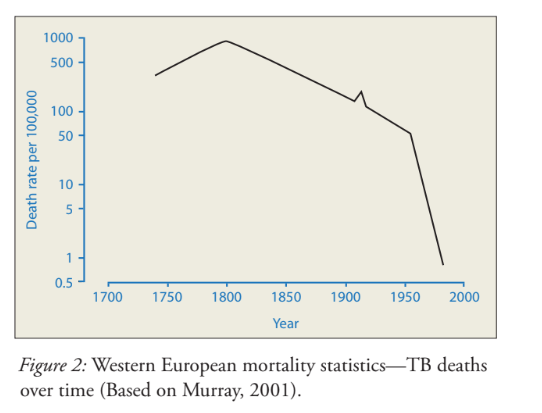
E.L. Trudeau was quick to distinguish between a helpful therapy and a cure. He opened the Adirondack Cottage Sanitarium, where poor and rich alike could come and receive the benefits of fresh air, plenty of sunlight, rest, and abundant but simple nourishing food. Hundreds benefited. Similar institutions opened up in the U.S., and the movement was already well underway in Western Europe. But the cure would only come in the 1950s with the discovery of antibiotics that were effective against the mycobacterium.

Question 1: Th e curve shown in Figure 2 has three parts, from 1700–1800, 1800 to approx. 1955, and 1955 to approximately 1985. The data used to produce the curve are from Western Europe, but a similar one could be expected for the United States.


1

From what you know about the history and culture of the United States and Western Europe, write a sentence explain why the death rate increased from 1700 to 1800.

1

Looking at the graph, explain what happened from 1800 to 1950? Be sure to state if the death rate increased or decreased.

1

Why do you think the number of deaths from 1950 to 2000 decreased dramatically?

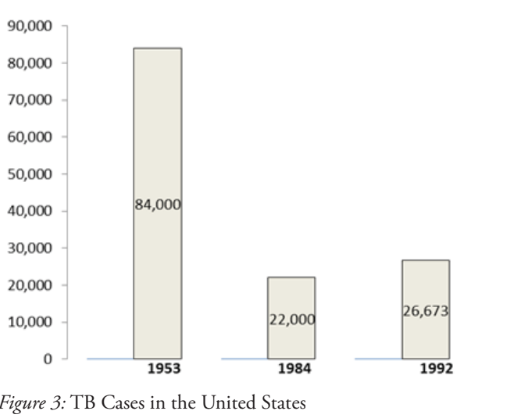
In recent years, a combination of development of antibiotic resistant strains of MTb along with the creation of a reservoir of immunocompromised people by the worldwide AIDS epidemic have contributed to a resurgence of tuberculosis in the United States and a worldwide upswing in TB cases and deaths. This resurgence has been accompanied by a resurgence of interest in
the disease by scientists asking new questions about the nature of true host genetic susceptibility/resistance genes for tuberculosis, about virulence genes within the mycobacterium itself which might offer new drug targets, and about the epigenetic factors that may influence disease predisposition and outcome in people with tuberculosis.


1

Suggest a reason for why there was an increase in TB in 1992?

2

U.S. prisons and all over the world TB remains a serious health problem.
In the U.S., zero tolerance drug laws have resulted in a burgeoning (growing) incarcerated population, which
constitutes a significant reservoir of disease, with a far higher incidence rate than the general population. In New York prisons, the incidence rate of TB is 156.0/100,000 compared to the rate of 10.4/100,000 in the general population
(U.S. Agency for International Development, 2009). Considering all you have learned in Parts I and II, discuss why these rates may be so much higher in prison.

In 2006, there were 9 million new cases of tuberculosis worldwide, many of these caused by drug-resistant strains of the mycobacterium. Scientists struggle to find new drugs that will be effective against the resistant strains and to propose better treatment regimens involving more direct observation of treatment (DOT) to assure patient compliance. Additionally, many have called for public acceptance and physician support for more responsible dispensing of antibiotics. These are difficult and complex problems that require a resolve on the part of many sectors coupled with a willingness to devote adequate resources to a fi ght a disease that most often strikes people in the poorest of places.

Additionally, it is certainly the case that many modern TB cases occur in a global incarcerated population of approximately 8 million (U.S. Agency for International Development, 2009). Many of those incarcerated were political prisoners taken prisoner in war zones. Conditions in the prisons include inadequate ventilation, poor nutrition, negligent healthcare, HIV co-infection, and rampant despair.

We know a lot about how to prevent and treat tuberculosis. Th ere is much more to be learned. In 2010, 8.8 million people in the world fell ill with TB and 1.4 million died (World Health organization, 2012).

All of the following factors are important in causing the worldwide resurgence of tuberculosis:
(a) emergence of strains that are resistant to one or more of the available antibiotics effective against MTb
(b) incomplete or inadequate understanding by scientists of the details of the host/pathogen interaction in MTb infection
(c) lack of a universally-accepted vaccine;
d) lack of financial support for science and for public health
initiatives in developing countries
(e) famine
(f) geopolitical instability in the developing world
(g) inadequate public awareness of public health issues.
2

If you were a billionaire philanthropist where would you focus your efforts against tuberculosis (choose from options A to G). Explain your answer